I came home early from the market that Tuesday because the peaches were bruised and I didn’t feel like arguing with the vendor about it.
That’s the kind of thing you remember afterward — the small, stupid reason you walked through your own front door at the wrong hour.
The house was quiet in a way that felt wrong.
Norman’s car was in the driveway, though he’d told me he’d be at a supplier meeting until four.
I set the grocery bags on the kitchen counter and heard a sound from down the hall — a chair scraping, maybe, or a laugh cut short.
The door to my home office was open a few inches.
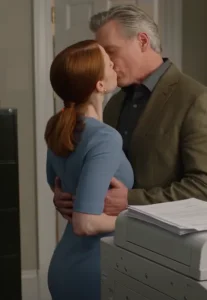
I pushed it wide and my husband was kissing his personal assistant, Sabra, against the edge of my father’s old desk.
For a second nobody moved.
Then Norman stepped back so fast he knocked a stack of folders onto the floor.
Sabra’s hand went to her mouth.
“Thea,” Norman said.
“This isn’t — wait.”
I didn’t say anything.
I couldn’t.
And then the printer kicked on.
It sat on the credenza by the window, and it whirred and pulled a page through, slow and loud in that silent room.
The page slid into the tray and stopped.
I walked over to it because my legs needed to do something.
I picked it up.
At the top it said: DRAFT — BENEFICIARY CHANGES.
Below that, my name was typed in a neat little box.
Someone had drawn a single black line through it.
Next to my name, in the same box, was Sabra’s name, written in Norman’s handwriting.
I turned the page over like there might be an explanation on the back.
There wasn’t.
“Thea, let me explain,” Norman said.
“That’s a draft.
It’s nothing.
It’s an old template.”
I looked at Sabra.
She was pale, but she wasn’t crying, and she wasn’t backing toward the door.
She looked at Norman, then back at me, and she said, “He told me your wife agreed to everything.”
I felt the floor tilt a little.
“What?”
I said.
“He said you were sick,” Sabra said.
“He said you wanted me to take over the household accounts.
He said you signed off on it.”
Norman started talking over her, saying she misunderstood, saying the office was a mess, saying I should sit down.
I didn’t sit down.
I held the page and looked at my husband — the man I’d been married to for nineteen years — and I said, “Then he lied to you too.”
Sabra’s face changed.
Not much.
Just enough.
Norman put his hand on my arm and I pulled it back like his touch was hot.
“Don’t,” I said.
“Thea, be reasonable,” he said.
“You’re upset.
You’re jumping to conclusions.”
“I’m standing in my own office,” I said.
“That’s not a conclusion.”
The printer hummed again, ready for another page.
I turned and walked out with the draft in my hand.
I went straight to the kitchen, set the page on the counter, and stared at the black line through my name until my hands stopped shaking.
Then I heard Norman’s footsteps behind me.
He was already talking, already explaining, already building the story he thought I would believe.
And that was when I understood something I hadn’t let myself think yet.
This wasn’t going to be about a kiss.
The kiss was just the part that happened to be visible.
Norman followed me into the kitchen and put both hands flat on the counter like a man trying to hold a table still during an earthquake.
“It was a clerical error,” he said.
“The software pulls in old names.
I’ve been meaning to fix it for months.
That’s all this is.”
I looked at the draft on the counter.
My name crossed out in pen, not by a printer.
Sabra’s name written in, in his handwriting, in the box that was supposed to be mine.
I didn’t argue with him because I was done arguing with him.
I walked past him, back down the hall, and into the office.
Sabra was still there, standing by the desk with her purse strap twisted in her hands.
“You should go,” I said.
She didn’t argue with me either.
She went.
Norman stood in the doorway and watched me walk to the wall behind the desk, where my parents’ portrait hung.
I lifted the frame off the hook and set it on the floor.
The safe behind it had a keypad.
Norman’s voice got higher.
“Thea, what are you doing?”
I typed the code — my mother’s birthday, the one she never let any of us forget — and the door clicked open.
Inside was a manila envelope I hadn’t touched in six years.
I pulled out the deed to this house and the land around it.
The deed my father had signed over to me before he died, with my name alone on it, notarized at the kitchen table by a neighbor who’s since passed.
I laid it flat on the desk next to the printer.
Norman looked at it like it was a snake.
“That’s not — where did you get that?” he said.
“It’s been here the whole time,” I said.
“You just never asked.”
I picked up my phone and called Mark Halvorsen.
Mark has been my family’s lawyer since I was twenty-four, and he answers his cell on the second ring, which is one of the reasons I trust him.
“Mark,” I said.
“I need an audit.
Every document my husband has filed in my name since he started calling himself my office manager.
Every signature.
Every form.
Everything.”
There was a pause on the line.
“Thea,” Mark said slowly.
“Is this about the beneficiary draft?”
I looked at Norman.
“What do you know about that?”
I asked.
“I know somebody called my office last week asking about the process for changing beneficiaries on an estate plan,” Mark said.
“Didn’t give a name.
I didn’t think anything of it.
Now I’m thinking something of it.”
Norman started talking again, fast and smooth, saying Mark was confused, saying it was probably a client, saying this was getting blown out of proportion.
I hung up on Mark and turned to Norman.
“Did you have Sabra sign anything in my name?”
I asked.
He blinked.
“What?
No.
Why would you — she’s an assistant.
She files things.”
“Did she initial client forms as me?”
I said.
He didn’t answer right away, and that pause told me everything.
“Thea, sometimes paperwork gets messy,” he said.
“We’ve got eight rental clients now.
Things get signed in a rush.”
“That’s a yes,” I said.
“It’s not — “
“It’s a yes, Norman.”
We stood there in the office with my father’s portrait face-down on the floor and the deed on the desk, and I watched my husband decide, in real time, which lie to try next.
He chose the one where he was tired and overworked and I was being dramatic.
I let him talk.
I let him talk until my phone rang again.
It was Mark, an hour later, and he didn’t waste time on hello.
“Thea, Norman isn’t on the deed,” he said.
“But he’s been using your power of attorney to move things around.
And there’s a second filing scheduled for next Tuesday.”
I looked at Norman across the kitchen.
“What kind of filing?”
I asked.
“A transfer into a trust,” Mark said.
“One I’ve never heard of.
And Thea — you need to be careful who you tell.”
I hung up and put the phone in my pocket.
Norman was still talking.
I picked up the draft beneficiary page, folded it in half, and slid it into my purse.
“Next Tuesday,” I said.
“What’s happening next Tuesday?”
Norman’s mouth opened.
Nothing came out.




