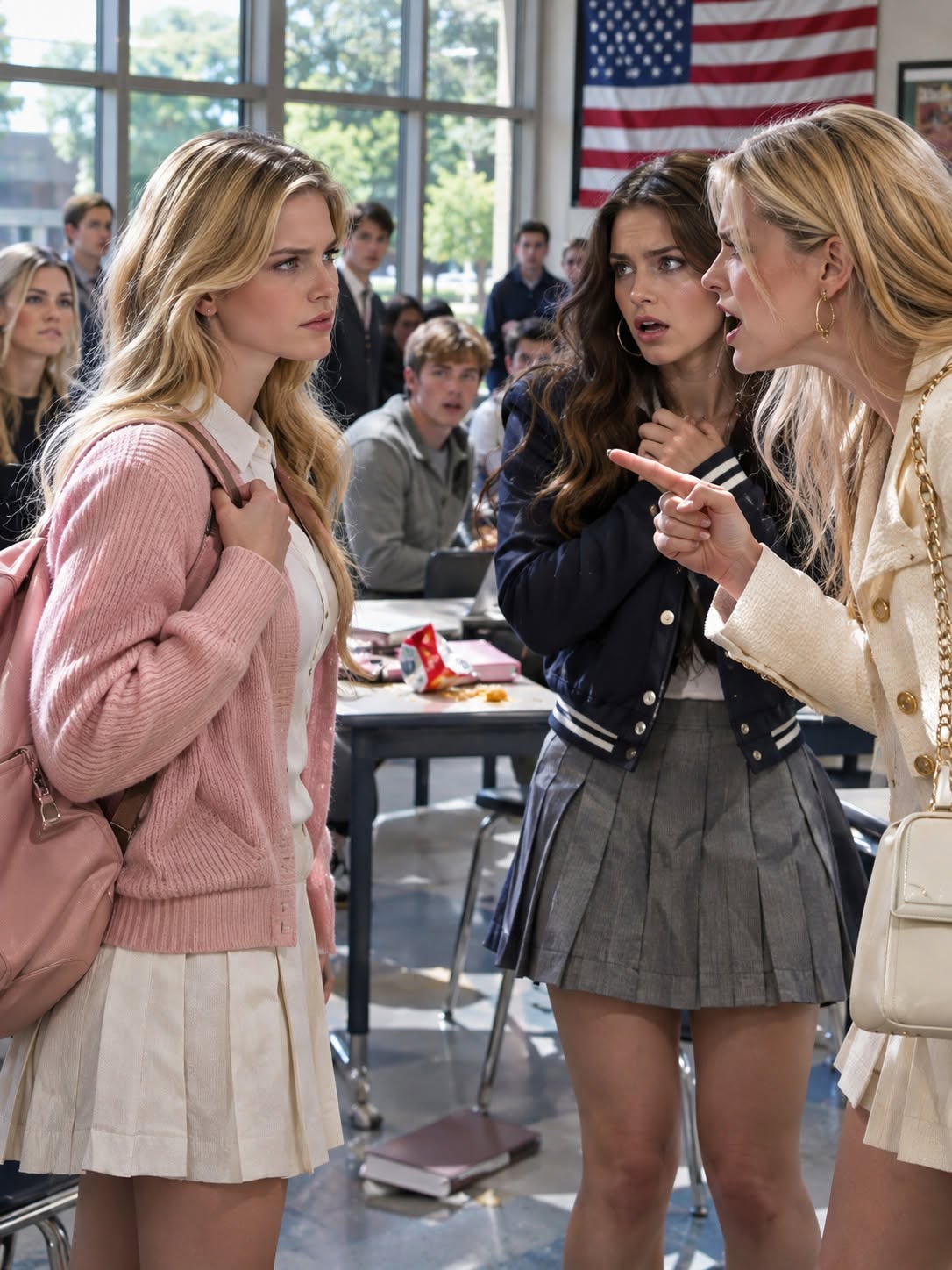
“The police can’t touch me. We’re minors.”
Zoe Whitmore leaned back in her chair across from the juvenile detective, twirling a strand of salon-bleached hair around her manicured finger. She wore a pristine designer hoodie that cost more than most families spent on groceries in a month, and her expression held nothing but mild irritation. To her right sat Mia Collins, chewing gum with her mouth open, letting out a sharp little giggle every time the officer mentioned criminal harassment.
My twin sister, Lily, was lying in Room 314 of the county hospital with IV tubes taped to her arms and purple bruises ringing both of her wrists. It was her second suicide attempt in five months.
I watched the interrogation through the two-way glass from the dim hallway. My fingers dug so hard into the fabric of my black leather jacket that my palms bruised. Beside me, my father sat rigidly, staring at the floor with his jaw clenched so tightly the muscles jumped. My mother didn’t move at all. She sat with her hands folded over her navy purse, her eyes fixed on Zoe with a terrifying, motionless patience that only people who knew our family understood.
The detective, a tired man named Miller, pushed a printed screenshot across the table. “Zoe, we have witness statements confirming that you and Mia repeatedly forced Lily into the girls’ locker room, held her under cold water, and threatened to release edited videos if she didn’t write your term papers.”
Zoe barely cast a glance at the paper. “Statements from who? Her friends? Lily doesn’t have friends. She’s pathetic. Honestly, Detective, maybe she bullied me. Did you ever stop to consider that? She’s psychotic and obsessed with my boyfriend.”
“She tried to end her life yesterday, Zoe,” Detective Miller said, his voice flat.
“If Lily wanted attention that badly, she should’ve joined drama club,” Mia chimed in with a high-pitched laugh. “It’s embarrassing.”
My father stood up so violently his wooden chair screeched against the linoleum. Detective Miller turned toward the glass, raising a warning hand.
My mother didn’t blink. She reached out, caught Dad’s wrist, and pressed him down with unnatural strength. “Sit down, Richard,” she whispered. Her voice sounded like silk wrapped around steel. “Let the little girls talk.”
The meeting ended without a single charge. The school refused to turn over complete server logs, claiming student privacy laws. Zoe’s father, a prominent zoning commissioner, had already phoned the district attorney before the interview began. The Whitmores’ family lawyer arrived twenty minutes later, threatening countersuits for defamation and emotional distress against minors.
Detective Miller walked out into the corridor, rubbing his tired eyes. “I’m sorry, Mr. and Mrs. Carter. Without direct digital verification or a cooperating eyewitness inside the school, my hands are tied. It’s classified as mutual schoolyard friction.”
Zoe walked past us five minutes later, reeking of expensive French perfume. She didn’t even look at my parents. She just tapped her screen, laughed at a meme Mia showed her, and muttered, “What a total waste of my afternoon.”
They didn’t see me standing in the shadow of the vending machine. And even if they had, they wouldn’t have understood what they were looking at.
My name is Emma Carter. Lily and I are identical twins. We share the exact same golden-blonde hair, the same wide blue eyes, the same delicate jawline, and the exact same five-foot-five frame. But that was where God finished making copies and started over.
Lily was gentle. She cried when stray animals were injured. She apologized when people bumped into her in crowded hallways. When somebody deliberately stepped on her foot, she worried she had been standing in their way.
I was the daughter our parents had removed from traditional schooling in the seventh grade after three boys tried to corner me behind a municipal ice rink and two of them went home in an ambulance with broken orbital bones. Our family lived on a massive, gated parcel of land at the edge of town. My father owned industrial warehouses and commercial nurseries. Behind our main house stood a line of six unusually vibrant, ancient oak trees that my parents tended with personal care. My dad used to tell us each tree represented an unavoidable lesson our family had to bury. Lily thought the phrasing was poetic. I knew what was buried underneath the root systems.
That Sunday night, Lily came home from the psychiatric wing. She sat on her pastel-pink bedspread, clutching a stuffed rabbit with trembling fingers. Her skin was translucent, her collarbones sharp against her skin. Every time a car drove down our private road, she flinched so hard she spilled her chamomile tea.
I sat beside her and took her cold hands. “Did you tell Miss Lee?”
Lily looked down at the carpet. “Miss Lee told me Zoe comes from a respectable family. She told me I was interpreting jokes too harshly. She said I lacked resilience.”
“And the principal?”
“He told me to stop escalating conflicts with honor students.” A tear slipped down her pale cheek, soaking into her pink sleeve. “Emma, Zoe has videos. They took them during gym. Things they made me say while holding me down. If anyone sees them, I… I can’t stay alive. I really can’t.”
I leaned in, brushing a soft strand of hair behind her ear, feeling the cold metal of her pulse fluttering like a trapped moth. “Do you trust me, Lily?”
“More than anyone,” she whispered.
“Then go to sleep. Don’t look at your phone. Don’t think about that building. Starting tomorrow, Lily Carter doesn’t exist at Oakridge High. Only you exist here, safe in this house.”
Downstairs, my mother was sitting at the marble kitchen island, slicing an apple with a surgical paring knife. My father stood near the patio doors, looking out into the pitch-black woods toward the line of oak trees.
“I’m wearing her clothes tomorrow,” I told them, resting my palms flat against the granite.




