Chapter 1:
The first thing Officer Mark Harlan took from me was my ability to see clearly.
The second was my belief that the truth could protect anyone who carried it.
By the time the police dispatcher announced my name over the radio, my face was burning, my neighbors were screaming, and the man responsible stood beside my car with the stunned expression of someone who had just realized he had made a terrible mistake.
But the most frightening part wasn’t what he had done.
It was the realization that someone had arranged for him to do it.
My name is Vanessa Cole.
I was forty-six years old, the chief of the FBI’s regional field office, and a woman who had spent twenty-two years investigating people who believed power made them untouchable.
That Friday evening, I was simply trying to get home.
The September sky was turning purple above the quiet streets of Ashford Heights, a wealthy but unremarkable suburb about thirty minutes outside the city.
I had left my office later than planned after a difficult meeting about a corruption investigation involving a municipal technology contractor.
My shoulders ached, my phone battery was nearly empty, and all I wanted was a quiet dinner.
I drove a distinctive red-and-black sedan that had belonged to my father.
He had loved unusual cars, especially ones that looked as if they belonged in old detective movies.
After his death, I had restored the vehicle instead of selling it.
Driving it was one of the few rituals that still made me feel close to him.
At 6:12 p.m., I noticed the patrol vehicle behind me.
Its headlights had been following me since the intersection near Willow Creek Elementary School.
Initially, I thought nothing of it.
Then I made a right turn.
The police cruiser followed.
I turned left onto my residential street.
It followed again.
When I slowed beside my mailbox, the officer activated his emergency lights.
Red and blue flashes swept across the neatly trimmed hedges and white fences of my neighborhood.
I looked at the cruiser in my rearview mirror.
There had been no speeding, no missed signal, and no unusual maneuver.
Still, I kept both hands visible and continued the short distance into my driveway, where I stopped.
My garage door stood directly ahead.
The porch light was already glowing.
For a moment, the sight of my own front door reassured me.
Then the patrol officer stepped out.
He was broad-shouldered, perhaps thirty-seven, with a square jaw and short sandy hair.
His uniform identified him as Officer Mark Harlan.
He approached quickly, one hand resting near his equipment belt.
I lowered my window.
“Good evening, Officer,” I said.
He stared at me without returning the greeting.
“License and registration.”
“Certainly, but could you explain why you’ve stopped me?”
“License and registration,” he repeated.
His tone was unnecessarily sharp.
I glanced toward the center console.
“My identification is in here, so I’m going to reach for it slowly.”
“Don’t touch that console.”
I stopped immediately.
“My identification is inside it.”
“I said don’t touch it.”
His eyes moved toward the house behind me.
That was the first detail that seemed wrong.
He wasn’t studying my hands or the vehicle.
He was watching my front door.
“Officer, is there something about this car that concerns you?”
“Step out.”
“Would you verify the registration first?”
His expression tightened.
“You don’t get to tell me how to do my job.”
“I’m asking you to confirm what information you have.”
“Are you refusing an order?”
“No, and I would prefer that we keep this conversation calm.”
Across the street, my neighbor Ruth Bell emerged onto her porch carrying a watering can.
Ruth was a retired school administrator in her sixties who seemed to know every person, dog, and delivery driver in Ashford Heights.
She stopped when she saw the flashing lights.
“Vanessa?” she called.
Harlan turned sharply.
“Ma’am, go back inside.”
Ruth set down the watering can.
“Officer, that’s her house.”
“I don’t need your assistance.”
Another neighbor opened a window.
A dog began barking behind a wooden fence.
I could feel the situation changing, as if some invisible boundary had been crossed.
Harlan glanced toward his shoulder radio.
A quiet burst of static interrupted the evening.
Then he looked at his wristwatch.
Not at me.
At his watch.
“Officer Harlan,” I said carefully, “I am willing to cooperate, but I need to understand what you believe is happening.”
His jaw tightened.
“Get out of the vehicle.”
“I’ll do that as soon as you give me enough room to open the door safely.”
He moved closer instead.
I noticed something on his face that I had not expected.
Fear.
It lasted barely a second before anger replaced it.
“You think you’re above the law?”
“Absolutely not.”
“Then stop acting like it.”
My professional training told me not to argue with an increasingly agitated officer.
My instincts told me something worse.
Harlan was not behaving like someone conducting an ordinary traffic stop.
He was behaving like someone trying to reach a specific outcome before a deadline.
I kept my voice steady.
“Please request a supervisor.”
He laughed once.
“You really want to make this difficult?”
“No, Officer.”
I took a measured breath.
“I’m trying to prevent it from becoming difficult.”
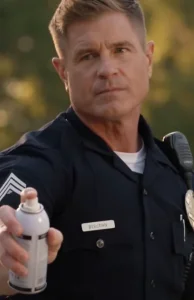
He reached toward his belt.
I saw the orange marking on the canister.
“Officer, there is no reason for that.”
“Last warning.”
“My hands are visible.”
He stepped toward the open window.
I leaned back instinctively.
Then he pressed the nozzle.
A sharp burst struck my face.
For an instant, the entire world disappeared behind a burning haze.
I recoiled, coughing and struggling to keep my breathing steady.
My own driveway became a place where I could no longer feel safe.
I heard Ruth screaming.
“Stop!”
Someone else shouted that they were recording.
I reached blindly for the door handle, desperate for fresh air.
“Stay where you are!”
Harlan shouted.
“I’m not resisting!”
My voice sounded strange to me.




