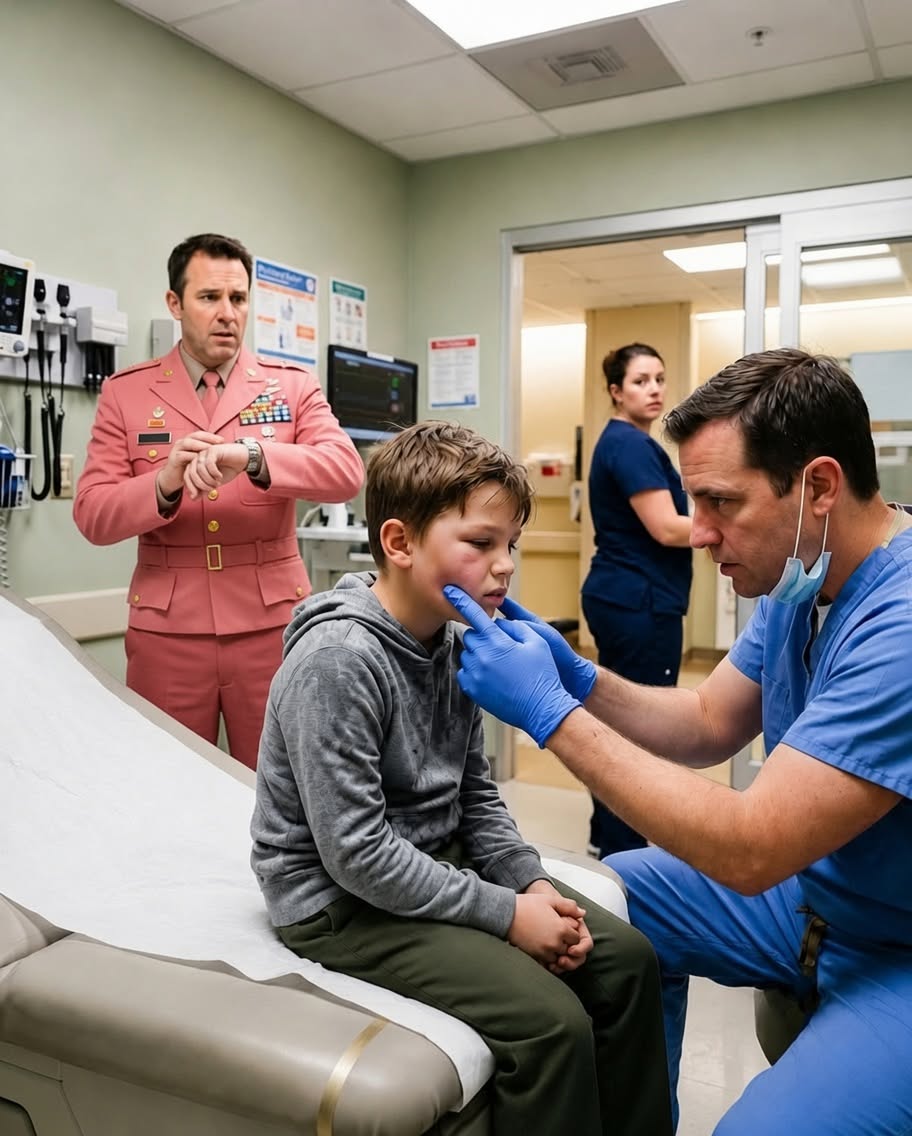
The air inside Examination Room 4 felt unnaturally heavy, as if the damp, coastal fog outside had seeped through the hospital walls.
I leaned down so that my eyes were level with Leo’s. “He put you in the shed, Leo?”
The nine-year-old boy gave a single, rigid nod. His eyes remained fixed on the plastic pens sticking out of my scrub pocket. “He locked the door from the outside. He said I was too loud while his friends were watching the game.”
“How long were you in there?” I asked softly, keeping my voice calm, professional, and entirely free of the rising fury that burned in my chest.
“Two days,” Leo whispered, his vocal cords raw from disuse. “It was dark. There were rusty garden tools, bags of old fertilizer… and something crawling near the woodpile.”
My nurse, Sarah, swallowed hard, her hand hovering over her mouth in sheer horror. She immediately tapped her tablet screen, initiating an emergency Child Protective Services (CPS) notification and alerting hospital social services.
“Did something bite you in the shed, Leo?” I asked gently.
“I fell against a metal rod near the floor when he pushed me,” Leo explained, his breathing shallow. “It poked my cheek. Then something came out of the dirt… something cold.”
I turned my attention back to the deep, unnatural puncture wound on his swollen right cheek. The tissue around it was engorged, purple, and radiating severe localized heat. But it was what lay beneath the dermis that made my medical training grind to a halt.
I put on a fresh pair of sterile nitrile gloves and lubricated the tips. “Leo, I need to touch your cheek again very lightly. I won’t hurt you. If it pinches, tell me immediately.”
“Okay, Dr. Thomas,” he muttered.
I laid the flat of my index finger against the inflamed tissue, two centimeters below his cheekbone.
Thump.
It wasn’t a pulse. It was far too slow, far too deliberate, and entirely out of sync with his racing heart rate. Beneath my fingertips, a solid, rounded object—roughly the size of an acorn—shifted beneath the subcutaneous fat layer. When I applied gentle pressure, the mass reacted immediately, wriggling upward against my gloved finger with a distinct, undulating resistance.
Sarah gasped aloud, taking a step back toward the door. “Dr. Thomas… what is that?!”
“It’s parasitic or foreign biological material,” I said, my medical instincts overriding my shock. “The puncture wound from the rusty metal introduced an exotic organic spore or larval mass from the decomposing fertilizer and damp soil in that shed. We need a high-resolution CT scan of his facial structure immediately.”
Suddenly, the door to Room 4 slammed open with a loud CLANG.
Greg stood in the doorway, his eyes bloodshot, flanked by two hospital security guards whom he had somehow slipped past. He wasn’t wearing his jacket anymore; his sleeves were rolled up, revealing thick, scarred forearms.
“Enough of this medical circus!” Greg yelled, his voice echoing down the quiet ER corridor. “I’m his stepfather, and I have legal guardianship! We are leaving now, or I’m calling my lawyer and suing this dump for false imprisonment!”
“You aren’t taking him anywhere, Mr. Vance,” I declared in a firm tone that cut through his shouting. “As a licensed emergency physician in the State of Oregon, I am placing this child under an immediate 72-hour protective medical hold pursuant to mandatory child abuse reporting laws. He has a life-threatening deep-tissue infection and severe physical trauma consistent with non-accidental injury.”
Greg’s face turned bright red. “You little punk! You don’t know who you’re dealing with! I work for the city public works department! I know every judge in this county!”
“Then you can explain to those judges why a nine-year-old boy was locked in an unheated shed with toxic chemicals for forty-eight hours,” Sarah interjected fiercely from behind her desk, holding up her phone. “The County Sheriff and CPS are already en route. They will be here in ten minutes.”
Greg looked at Sarah, then at the two heavy security officers blocking the hallway behind him. He knew he had lost his temper too early.
He sneered, pointing a calloused finger directly at my face. “You think you’re a hero, Doc? You don’t know what happens in this town after dark. My wife will back me up 100%. She’ll tell the cops the kid made the whole thing up.”
“Get him out of my department,” I ordered the security officers.
The guards grabbed Greg by his shoulders, forcibly dragging him backward down the hallway as he shouted obscenities and threats against my medical license.
Once the hallway quieted down, I turned back to Leo. The boy was trembling violently, clutching his knees against his chest.
“Are you going to send me back to him?” Leo asked, his voice breaking into small, heartbreaking sobs.
I walked over, sat down on the stool beside his bed, and took his small, cold hand in mine. “Leo, listen to me very carefully. You are safe here. Nobody is going to drag you out of this hospital. Nobody is going to lock you in a shed ever again. I promise you that on my honor as a doctor.”
He looked at me with his wide, bruised eyes, searching my face for any sign of deceit. When he realized I was telling the truth, his shoulders slumped, and he let out a long, shuddering breath.
“Now,” I said, standing up. “Let’s go take some pictures of your face so we can get whatever is in there out.”
I stood in the control room beside Dr. Aris Thorne, our Chief Radiologist, watching the three-dimensional cross-sectional images render in real-time across four high-definition monitors.
As the contrast fluid moved through Leo’s facial arteries, a dark, alarming shape appeared on the screen, highlighted in glowing red.
“My God, Thomas,” Dr. Thorne whispered, leaning closer to the screen, adjusting the image contrast. “Look at the mass in his cheek cavity.”
The scan revealed a thick, encapsulated fibrous sac lodged between the masseter muscle and the maxillary bone. But inside the sac, visible on the high-resolution tissue scan, was something terrifying.
It wasn’t a tumor. It was a live, parasitic organism—a rare deep-soil nematode larva, Gnathostoma spinigerum, which had grown to nearly two inches in length inside the unsterilized wound caused by the rusty metal rod. The parasite had encysted itself, feeding on localized fluid, reacting to external pressure by shifting violently against the surrounding facial nerves.
“If that cyst ruptures or burrows half an inch deeper, it hits his facial nerve complex and carotid arterial branch,” Dr. Thorne warned, his voice grave. “He’ll suffer permanent facial paralysis, or worse, septic shock.”
“He needs immediate micro-surgical extraction,” I said, pulling out my phone. “Get Dr. Marcus Vance in Pediatric Surgery down here right now.”
Just then, my phone vibrated with an incoming internal call from the ER reception desk.
It was Sarah. Her voice was panicked.
“Dr. Thomas, you need to come back to Triage immediately! Leo’s mother just arrived with a private attorney… and they brought a legal injunction signed by a night-court magistrate demanding Leo’s immediate release!”




