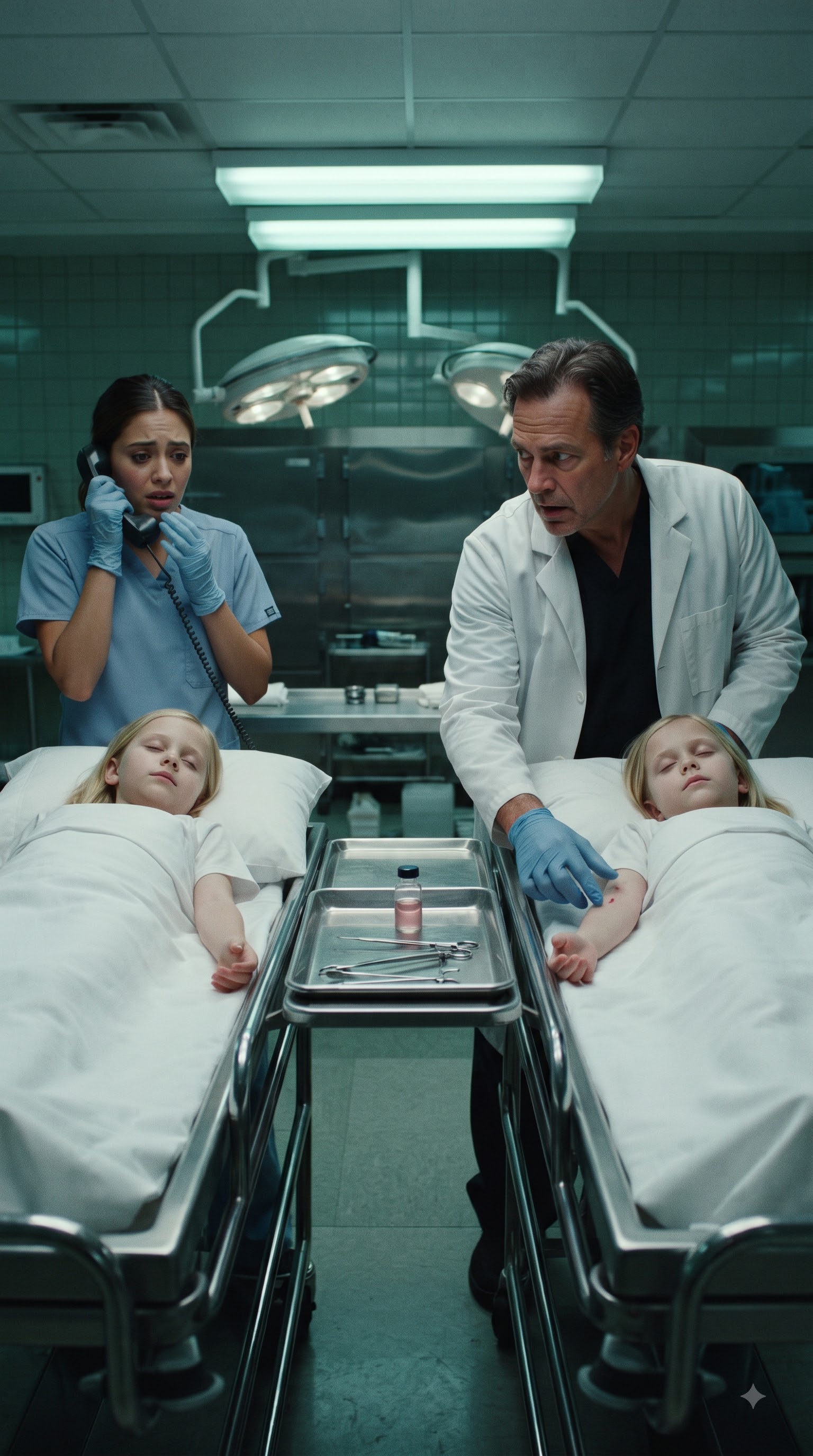
Cristina Alvarez was holding the left twin’s hand when the dead child grabbed her finger.
There was no warning.
No twitch in the eyelid.
No movement beneath the white sheet.
No cinematic gasp.
One second, the eight-year-old girl’s small hand rested cold and motionless inside Cristina’s pale-blue glove.
The next, four fingers curled tightly around Cristina’s index finger.
Cristina jerked backward.
Her hip struck the stainless instrument tray between the two gurneys.
Forceps and scissors rattled violently against steel.
“Doctor! She moved! Her hand touched me!”
Dr. Vincent Harper entered from the right side of the cold morgue room, his white coat hanging open over dark scrubs.
He had been a forensic pathologist for twenty-seven years.
He had seen bodies stiffen.
Muscles contract.
Fingers move after death.
He had watched interns become convinced that corpses were breathing because refrigeration changed shadows across skin.
“Post-mortem spasms happen,” he said firmly. “Stay calm.”
Cristina shook her head hard enough to loosen a strand of dark hair from beneath her surgical cap.
“No. Check her yourself.”
The twins lay side by side beneath identical white sheets.
Same blonde hair.
Same white pillows.
Same peaceful faces.
The left child was identified on the morgue intake bracelet as Abigail Nolan.
The right was Madison Nolan.
Eight years old.
Identical twins.
Pronounced dead in the emergency department seventy-eight minutes earlier after being transferred from St. Catherine Community Urgent Care following what the chart described as sudden respiratory collapse.
No trauma.
No blood.
No visible disease.
Too young to be in this room.
Vincent placed his gloved palm flat against Abigail’s upper chest.
Cristina watched his face.
At first there was annoyance.
Then concentration.
Then something Cristina had never seen on him before.
Fear.
Vincent leaned down until his ear hovered close to the child’s chest.
The room went almost completely silent.
Then:
Thump.
Nothing.
Cristina stopped breathing.
Another faint beat.
Thump.
Vincent rose so quickly the edge of his coat hit the instrument tray.
“She has a heartbeat.”
Cristina rushed in.
She pressed her ear against the child’s chest.
There.
Weak.
Slow.
Real.
“She’s alive! Oh my God, she’s alive!”
Abigail’s lips parted.
A tiny involuntary breath escaped.
It carried a strange little sound, almost a giggle, not playful or conscious, simply air passing through a throat that should never have been sent downstairs.
Both adults recoiled half a step.
Vincent immediately turned toward the second gurney.
Madison remained perfectly still.
Half a second.
Then her right hand slowly curled into a fist above the sheet.
Vincent’s voice sharpened.
“The other one too.”
Cristina reached for Madison while keeping her own arm clear of the girl’s hand.
Vincent checked the neck.
Then the chest.
His face went rigid.
“Pulse.”
Cristina lunged for the internal phone.
Her hands shook so violently she nearly dropped the receiver.
“Code Blue in the morgue! Two pediatric patients alive! Repeat—both girls are alive!”
The hospital operator asked her to confirm the location.
“The morgue!”
There was silence at the other end.
Then:
“Confirming pediatric Code Blue, lower level morgue.”
Footsteps began somewhere outside.
Cart wheels.
Voices.
Vincent pulled back the left twin’s sheet only far enough to check for medical identifiers and visible injury.
That was when he saw the mark.
Tiny.
Red.
Inner left arm.
He checked Madison.
Matching location.
Matching mark.
Cristina followed his eyeline.
“What is that?”
Vincent did not answer.
He looked toward the stainless center tray.
Among the instruments sat a small evidence vial containing pale-pink liquid.
It had arrived with the twins in a sealed hospital property bag.
The morgue technician had placed it on the tray because the emergency-department transfer sheet described it only as:
UNIDENTIFIED VIAL — FOUND WITH PATIENT PROPERTY — HOLD FOR PATHOLOGY.
Vincent stared from the vial to Abigail’s arm.
Then Madison’s.
The red marks were too similar.
Too recent.
Cristina heard emergency staff approaching.
Vincent’s voice dropped.
“Someone did this to them.”
The doors opened.
The morgue exploded into movement.
Respiratory therapists.
Pediatric nurses.
A code physician.
Warm blankets.
Portable monitors.
Oxygen.
Questions.
“How long have they been down here?”
“Who pronounced?”
“What were the temperatures?”
“Where are the charts?”
Cristina moved against the wall because suddenly twenty professionals had more useful hands than hers.
Abigail was transferred first.
Madison second.
Their white sheets disappeared beneath warming blankets.
Both monitors registered slow cardiac activity.
Not artifact.
Not fantasy.
Life.
Vincent stood beside the evidence tray and did something Cristina did not understand until later.
He did not touch the pink vial.
He pulled his phone from his pocket and photographed the entire tray from three angles.
Then the sealed property bag.
Then the accession number.
Then the marks on both children only after the code physician authorized clinical documentation.
“Why are you doing that?”
Cristina whispered.
“Because in ten minutes,” Vincent said, “this room is going to contain fifty explanations.”
He looked at her.
“I want the evidence to remember what was here before they arrive.”
Upstairs, the twins were moved to pediatric intensive care.
Their body temperatures were dangerously low.
Their heart rates remained slow.
They began breathing more effectively with support.
Neither fully awakened.
Hospital administration arrived before their mother did.
That detail would haunt Cristina.
Chief Medical Officer Dr. Russell Keane entered the morgue at 9:42 p.m.
Nine minutes after the twins left.
Behind him came risk management director Elaine Porter and hospital counsel Bradley Stone.
Keane looked at the empty gurneys.
Then at Vincent.
“What happened?”
Vincent answered precisely.
“Both children demonstrated spontaneous circulation after arrival in the morgue.”
Keane’s face tightened.
“They were pronounced in the ED.”
“I know.”
“Could this be postmortem artifact?”
“No.”
“You’re certain?”
“Russell, one of them is currently on a pediatric monitor upstairs.”
Silence.
Keane glanced at Cristina.
“What did you see?”
She described the hand.
He asked whether she might have involuntarily flexed the fingers while repositioning.
Cristina felt humiliation burn up her neck.
“No.”
“You’re an intern.”
“Yes.”
“I’m asking because these events are confusing.”




