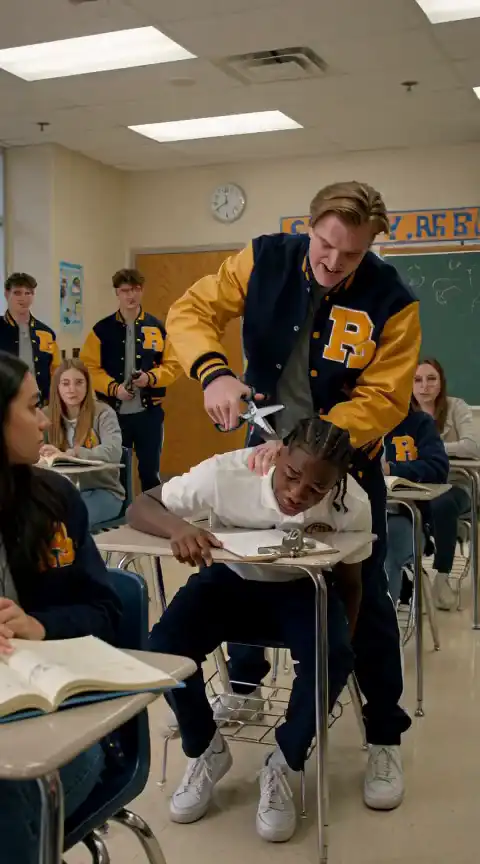
THE STAR QUARTERBACK PINNED ME TO A DESK AND SHEARED MY CORNROWS WITH DULL SCISSORS — THEN THREE BLACKED-OUT SUVS RACED UP THE LAWN WITH ROARING SIRENS.
The sudden flash of red and blue light painted the classroom walls in harsh, jagged strokes.
Chet froze with the heavy kitchen shears still hovering two inches above my ear.
Brett’s grip on my wrists slipped slightly as he twisted his neck toward the courtyard windows.
“What the hell is that?” Tanner muttered from the doorway, his back no longer pressing against the locked exit.
Nobody answered him.
The siren died with one final, ear-splitting whine that echoed off the concrete pillars outside.
Three mammoth, customized black SUVs were parked directly across the manicured grass of the senior quad, engine heat shimmering off their dark hoods.
Doors swung open in perfect unison.
Four men in tailored dark suits and security earpieces stepped out first, flanking the center vehicle.
Then a tall, broad-shouldered man with deep brown skin and silver-tipped hair stepped down onto the turf, wearing a charcoal wool overcoat and carrying a slim leather portfolio.
He didn’t run, and he didn’t shout.
He just looked straight toward the second-floor windows of the humanities wing with cold, absolute authority.
“Is that… the state police?” Brett whispered, his fingers finally dropping away from my arms.
I pushed myself up from the scratched wooden desk, ignoring the dull ache in my shoulders.
I brushed the sheared pieces of my hair off my chest, feeling each severed strand fall away like burned wire.
Chet stepped back, tucking the scissors half-heartedly behind his thigh as if he could hide fifteen inches of steel in broad daylight.
“Don’t move, Vance,” Chet hissed, though the swagger in his voice sounded thinner now.
“I’m not moving, Chet,” I said softly.
Down the hall, the heavy double doors of the administration entrance crashed open against the brick stop.
Heavy, rapid footsteps echoed down the polished corridor.
Mr. Garrity suddenly cracked the storage closet door open, peeking out like a rat sniffing for danger.
“What’s going on out there?” Garrity asked, stepping into the classroom with a single ream of copy paper clutched to his gut.
He stopped dead when he saw the dark hair scattered across the floor, then looked at Chet’s hand holding the kitchen shears.
Instead of checking on me, Garrity pointed his finger straight at my chest.
“Malik, pick that mess up right now before Principal Mercer sees it,” Garrity barked.
“He didn’t make the mess, Mr. Garrity,” a quiet voice called out from the second row.
It was Kendra, a quiet junior who usually sat near the pencil sharpener.
“Quiet, Kendra,” Garrity snapped, his eyes darting nervously toward the open door.
The footsteps in the hall stopped right outside our room.
Our principal, Dr. Mercer, burst through the entrance, his face red and his tie completely crooked.
Right behind him walked the man in the charcoal coat.
His name was Raymond Vance.
He is the founder and chief executive of Kestrel Dynamics, the private infrastructure company that manages enterprise server networks, cloud grading portals, and security grids for over four hundred school districts across the state.
He is also my grandfather.
He raised me from the day my mother passed away in an intensive care unit six years ago.
He didn’t announce his name, and he didn’t look at Dr. Mercer.
His dark eyes swept across the room until they landed directly on me standing beside the overturned chair.
He saw the sheared patches on the side of my head.
He saw the kitchen scissors in Chet’s right hand.
He saw the lock of my braid resting on the corner of Chet’s expensive sneaker.
Grandpa Raymond didn’t raise his voice by a single decibel.
“Take your hand off the steel, young man,” Grandpa Raymond said.
Chet scoffed, trying to puff out his padded shoulders the way he did on Friday nights.
“Who do you think you’re talking to?” Chet sneered, glancing back at Brett and Tanner for backup.
“Chet, shut your mouth!” Dr. Mercer shouted, his voice cracking violently.
I had never heard Dr. Mercer yell at Chet Holbrook in my entire life.
Chet was the boy who had his picture framed in the trophy case near the main gym.
Chet was the boy whose father, Bradley Holbrook, owned three commercial contracting firms and funded the new digital scoreboard over the field.
“Excuse me, Dr. Mercer?” Chet said, frowning with genuine disbelief.
“Put the scissors on that desk right now,” Mercer ordered, his hands trembling so hard his keys rattled against his belt.
Chet hesitated, then tossed the heavy shears onto the wood with a loud clatter.
Grandpa Raymond stepped forward, his leather shoes clicking evenly against the linoleum.
He stopped two feet in front of Chet.
Grandpa stood six-foot-three, with shoulders carved from thirty years of manual labor before he ever wrote a single line of server architecture.
He looked down at Chet the way a master carpenter looks at a rotten piece of pine.
“You must be Bradley Holbrook’s boy,” Grandpa Raymond said quietly.
Chet smirked, finding his footing again.
“Yeah, that’s right,” Chet said, crossing his arms.
“My dad’s company built the technology wing you’re standing in.”
“Your father’s company laid the drywall,” Grandpa Raymond corrected him, unbuttoning his coat and pulling out a slim tablet from his portfolio.
“My company built the fiber spine underneath it.”
“My company also hosts the enterprise recruitment compliance portal for the entire athletic conference.”
Chet blinked, not understanding the words.
Mr. Garrity, however, understood instantly.
The ream of copy paper slipped out of Garrity’s hands and hit the floor with a dull thud.
“Mr. Vance… please,” Garrity stammered, stepping between my grandfather and Chet.
“This was just some locker-room horseplay.”
“The boys get carried away before rivalry week, you know how high-spirited athletes can be—”
“Were you in this room, Mr. Garrity?” Grandpa Raymond asked, cutting him off without looking at him.




