A fourteen-year-old boy lay motionless beneath the trauma lights, his mother screaming outside the treatment bay.
Dante Romano arrived demanding that I abandon him.
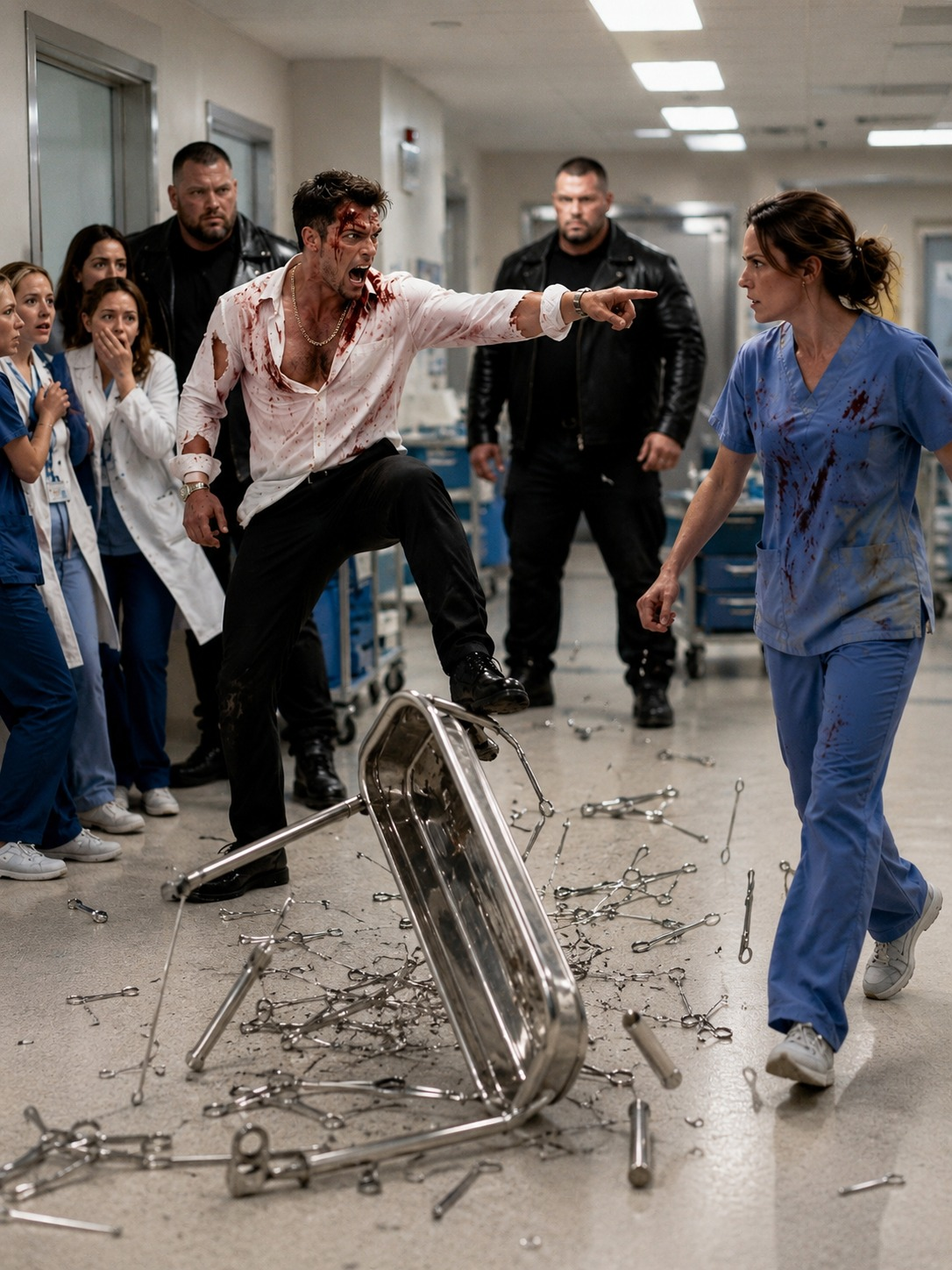
Beside Dante’s bloodstained shoe, a metal instrument tray lay overturned across the hospital floor.
On its polished underside, someone had scratched two words: ASK LORENZO.
I didn’t understand them yet, but the man who entered the corridor moments later did.
My name is Madeline Brooks, and until that night, I believed the hardest decision a trauma nurse ever had to make was choosing what to do first when two patients needed help at the same time.
I was wrong.
Sometimes the hardest decision was choosing whether to protect a stranger’s life when the people demanding that you let him die had enough money, influence, and violence behind them to make your own death look like an unfortunate accident.
“Pressure’s dropping!” one of my colleagues shouted.
I leaned over Noah Reeves, watching the monitor while another nurse prepared the equipment we needed. His face had turned frighteningly pale. His mother had been following the stretcher until hospital security stopped her outside the restricted treatment area.
“Please!” she screamed through the glass. “He’s only fourteen! Somebody, please save my baby!”
I heard her, but I couldn’t look at her.
Not yet.
I had to concentrate on Noah.
“Keep the airway support ready,” I instructed. “Get the attending physician back in here. Tell him the patient is deteriorating.”
A nurse nodded and hurried toward the doors.
Then someone shouted in the corridor.
“I said move!”
The emergency department doors swung open hard enough to strike the wall.
A man in a torn white designer shirt strode into the restricted area as if he owned the building. Blood streaked his forehead, and a gold watch gleamed on his wrist. Two enormous men in black leather jackets followed him.
I recognized the name before anyone spoke it.
Dante Romano.
His father, Anthony Romano, was a powerful Boston businessman whose interests extended through shipping, private clubs, labor contracts, and political circles. People whispered that Anthony could make troublesome problems disappear. Nobody in the hospital had ever been foolish enough to challenge his son in public.
Dante pointed at an orderly who stood in his way.
“Get out of my way.”
The orderly stepped aside.
One of the bodyguards shoved another employee against the wall, making several nurses recoil.
I glanced toward the commotion, then returned my attention to Noah.
“Someone needs to assess that man’s injury,” I said, keeping my voice controlled. “But he needs to go through triage.”
Dante heard me.
He turned his head slowly.
“Who said that?”
Nobody answered.
His eyes found me.
“You. Blue scrubs.”
I didn’t move away from the bed.
“My name is Madeline Brooks. I’m caring for this patient.”
“Then stop caring for him.”
For one strange second, I thought I had misunderstood him.
Dante touched the shallow cut above his eyebrow and inspected the blood on his fingers.
“Look at my face. I need a doctor. Now.”
“You’ll be assessed as soon as the emergency team can safely see you.”
He stared at me as though I had spoken in a language he had never encountered.
Then he pointed toward Noah.
“Leave the kid and fix my face.”
The room fell silent.
Even the people who had been whispering stopped.
I could hear the medical monitor, the ventilation system, and the faint squeak of a cart somewhere beyond the doors.
I looked at Dante’s injury.
It was a shallow cut. He was standing upright, speaking clearly, and showing no obvious sign of immediate medical collapse.
Noah was a different story.
His condition was critical.
“I can’t abandon a patient whose life is in danger,” I said.
Dante gave a short, disbelieving laugh.
“Do you know who my father is?”
“I know you’re in an emergency department.”
“My father could buy this hospital before breakfast.”
“Then he can afford to wait for you to be examined.”
A nurse beside me inhaled sharply.
Dante’s smile disappeared.
He took two steps toward me, stopping just short of the treatment bed.
“I could end your career before you finish this shift.”
I felt my heartbeat in my throat.
I was afraid. Anyone who claimed otherwise would have been lying.
But fear was not an instruction, and it wasn’t a medical priority.
Years earlier, my father had entered a Boston hospital with a condition that required urgent surgical attention. While our family waited, a wealthy donor’s son received preferential treatment for an injury that could safely have waited.
My father deteriorated.
By the time a surgeon finally came to see him, the opportunity to save his life had narrowed beyond what anyone could repair.
I still remembered my mother’s hand gripping mine in a hospital corridor, her wedding ring cold against my skin as the doctor explained what had happened.
I remembered the empty chair at our kitchen table afterward.
Most of all, I remembered the promise I had made at his funeral.
No one would ever have to be rich, important, or connected to receive my best effort.
I had carried that promise through nursing school, night shifts, understaffed wards, and emergencies that left me too exhausted to sleep.
I wasn’t going to abandon it because a spoiled man had a famous last name.
“Then call administration from the waiting room,” I told Dante.
His jaw tightened.
“I could end your life.”
I met his eyes.
“You can threaten me tomorrow. Tonight, get out of my trauma bay.”
One of his bodyguards moved.
He was the larger of the two, a broad man with a thick beard and a dark expression. His right hand slipped toward the inside of his jacket.
A young nurse near the wall covered her mouth.
I didn’t step back, but I shifted slightly toward Noah’s bed, unwilling to let the confrontation pull me away from the child.
The bodyguard’s hand disappeared farther inside his coat.
Then a quiet voice came from the doorway.




