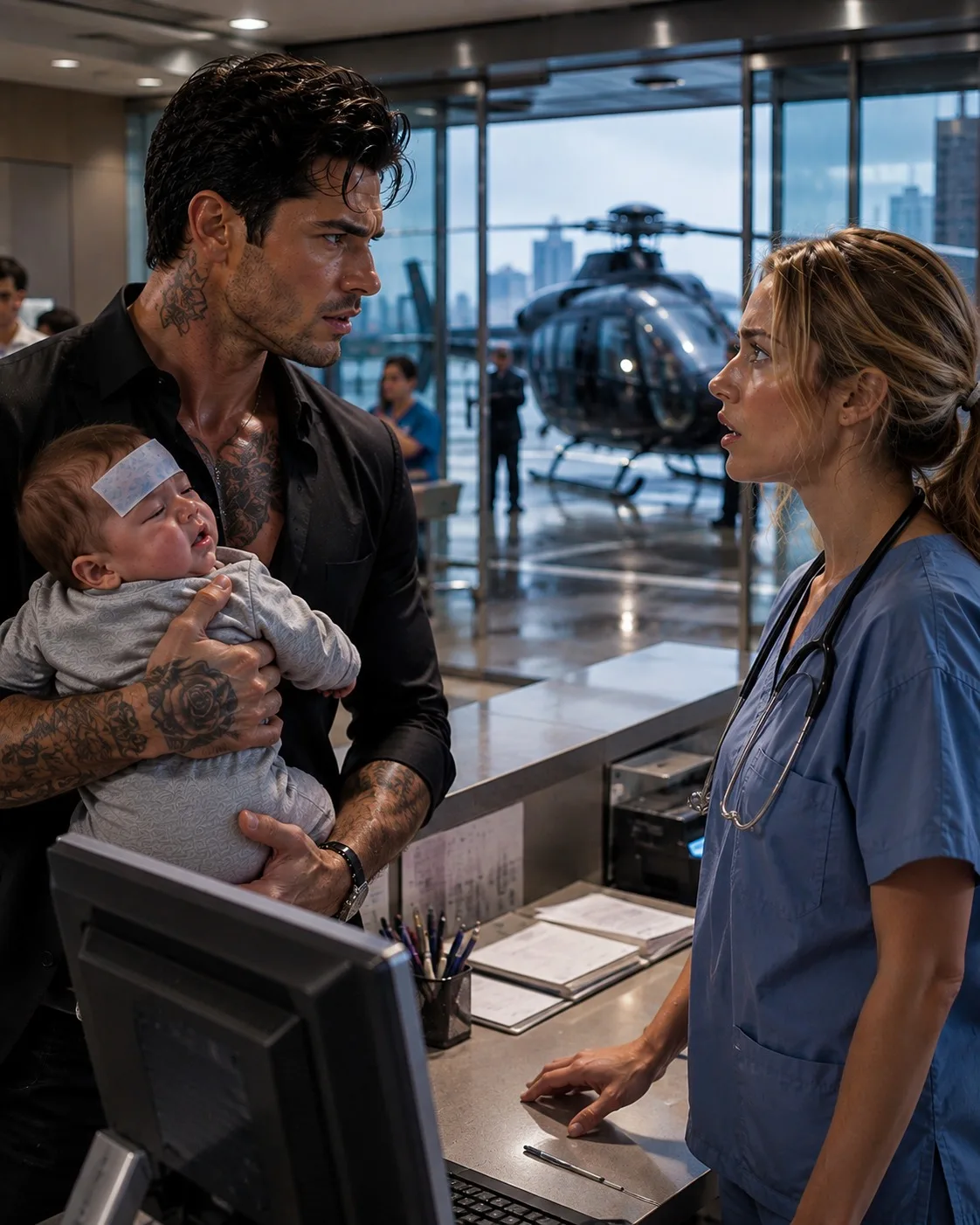
My six-month-old son went limp in my arms as I shouted, “Get a doctor now!”
At the pediatric emergency desk, I—Damian Cross, the man half of Boston was afraid to disappoint—set a small amber medicine bottle beside Caleb.
One corner of its label had been peeled back, revealing a handwritten number:
That bottle was not the one I had opened at home.
I knew it before anyone said a word.
Caleb’s head rolled weakly against the crook of my elbow.
Everything inside me went cold.
“Sir, we need you to let us take him.”
A nurse in blue scrubs reached toward my son.
I stepped backward automatically.
“No.”
“Mr. Cross—”
“I’m holding him.”
“Then walk with me.”
Her tone was steady enough to cut through the panic.
That irritated me.
Then I realized why.
She wasn’t afraid of me.
Most people were.
Bankers became careful when I entered rooms. Competitors checked exits. Men twice my size lowered their voices around me because they knew the companies I owned, the attorneys I employed, and the security detail that never stayed more than twenty feet away.
None of that mattered now.
Caleb made a weak sound.
My entire world narrowed to that tiny breath.
“Do something,” I said.
“We are.”
The nurse pressed two fingers against his neck while another employee appeared with a pediatric stretcher.
I looked toward the glass entrance.
Two members of my security team stood just beyond the doors.
Mason Hale, my head of security, had arrived seconds after me.
He raised one hand, asking silently whether I needed him.
For the first time in fifteen years, I had no order to give.
No target.
No contract to cancel.
No problem money could erase.
I looked down at Caleb.
His cheeks were red from fever.
A cooling strip clung crookedly to his forehead.
His lashes barely moved.
“Come on, buddy.”
Nothing.
“Caleb.”
My voice cracked.
The nurse heard it.
So did I.
I had not heard that sound come out of myself since I was twenty-three years old.
“Mr. Cross,” she said more gently, “please place him on the stretcher.”
My grip tightened.
Then a voice came from behind her.
“Damian?”
Every muscle in my body locked.
I knew that voice.
I had heard it angry.
Laughing.
Whispering my name at three in the morning.
I had also heard it three years earlier when its owner told me never to contact her again.
Dr. Nora Bennett stood ten feet away.
For half a second, neither of us moved.
She looked almost exactly as memory had kept her and completely different at the same time.
Light brown hair pulled into a loose ponytail.
Blue scrubs.
Stethoscope around her neck.
No jewelry except a small silver watch.
There were shadows beneath her eyes that had not been there when we were together.
She stared at me.
Then at the child in my arms.
Whatever history existed between us vanished from her face.
“Bring him here.”
“Nora—”
“Now, Damian.”
I obeyed.
That might have been the first strange thing anyone in that hospital witnessed.
I followed her.
We moved through two swinging doors into a treatment bay.
Nora pulled on gloves.
“Put him down.”
I hesitated.
She looked at me.
“Trust me for sixty seconds.”
Those two words almost stopped me.
Trust me.
The last time she had asked for my trust, I had failed her.
This time my son was barely conscious.
I laid Caleb on the examination bed.
Nora leaned over him immediately.
She checked his breathing.
His pulse.
His skin.
Then she lifted one eyelid.
She froze.
It lasted less than a second.
But I knew Nora.
I saw it.
“What?”
She checked the other eye.
“Nora.”
“Has he had any seizures?”
“No.”
“Vomiting?”
“Once.”
“When?”
“About forty minutes ago.”
“Was he sweating?”
“He was burning up.”
“That’s not what I asked. Was he sweating?”
I thought about it.
Caleb’s skin had been hot.
Almost painfully hot.
But dry.
“No.”
Nora’s eyes flicked toward me.
“Dry mouth?”
“He’s six months old.”
“Damian.”
“Yes. Maybe.”
She turned to the nurse.
“Full labs, tox screen, blood cultures, glucose, electrolytes. Continuous cardiac monitoring.”
The nurse moved.
I caught Nora’s arm.
“What are you thinking?”
She looked at my hand.
I released her.
“His pupils are unusually dilated,” she said.
“So?”
“Combined with the sudden fever, flushed skin, altered responsiveness, and how quickly this happened, I don’t want to assume infection.”
“What does that mean?”
“It means I need information.”
I remembered the bottle.
“The medicine.”
“What medicine?”
I pointed toward the hallway.
“I brought it.”
Nora went still again.
“What did you give him?”
“Infant fever reducer. Same thing the pediatrician told us to use.”
“How much?”
“The amount printed on the instructions.”
“Who gave it?”
“I did.”
“When?”
“About an hour before he collapsed.”
She stared at me.
“What?”
“Nothing yet.”
“Nora, don’t do that.”
“Do what?”
“Know something and decide I’m too stupid to hear it.”
Her jaw tightened.
For one heartbeat, the doctor disappeared and the woman I used to love returned.
Then she turned toward the nurse.
“Get that bottle.”
I followed her gaze.
Someone had placed it inside a plastic evidence bag.
Mason appeared at the doorway.
Hospital security tried to stop him.
“He’s with me,” I said.
Nora did not look pleased.
“This is a medical bay, Damian.”
“He stays.”
“Then he stays against that wall and touches nothing.”
Mason obeyed.
That surprised me almost as much as my own obedience.
Nora lifted the evidence bag.
She studied the bottle.
“What is seventeen?”
“I don’t know.”
“Was it written there earlier?”
“No.”
“You’re sure?”
“I opened the box myself yesterday.”
“Where did you buy it?”
“I didn’t.”
“Then who did?”
“My house manager keeps the nursery supplied.”
“Name?”
“Evelyn.”
Mason shifted near the wall.
I glanced at him.
“What?”
“Sir, Evelyn left the residence around midnight.”
“Why?”
“She said her sister had been taken to the hospital.”
“Which hospital?”
“I didn’t ask.”




