Chapter 1: When the problem still didn’t have a name
In Puebla, Don Raúl Mendoza wasn’t someone who sought attention. At 69, his routine was simple and quite predictable. The smell of coffee brewed in a clay pot wafted from the window, and on a folding table lay repaired radios, old tools, and wooden frames that Raúl sanded throughout the week.
Don Raúl Mendoza was a veteran with an amputated arm who supplemented his pension by selling repaired items. Those who dealt with Don Raúl Mendoza knew of his reserve: he never used his personal history as a credential to demand special treatment. In Puebla, Don Raúl Mendoza had earned respect in a less conspicuous way: by being reliable, arriving on time, and treating everyone the same, whether they wore a suit or a work uniform. This way of life also explained why, when something bothered him, he first tried to resolve it by talking.
That day also held a detail that Don Raúl Mendoza didn’t discuss with just anyone. Tomás was going to pick up a box of military photographs that Raúl had donated to the foundation’s archive; a patrol arrived because a neighbor had called 911. He wasn’t expecting a spectacular visit or a scene of recognition; there was simply a prior agreement that, later, would explain why Tomás Villaseñor would appear at the location without any impossible coincidences.
There were subtle signs before the conflict erupted. Sergio Alcázar, 48, was a real estate developer who had just bought a house on the block. He arrived with a manner of speaking that made it clear he considered his own time more important than everyone else’s. Sergio Alcázar asked rude questions, gave orders where no one had asked for them, and ended up venting his frustration even on people who weren’t involved. No one reacted immediately because, individually, each gesture seemed like just a sign of bad temper.
Don Raúl Mendoza noticed, but continued with what he was doing. At one point, he even preferred to step aside to avoid an argument. What he couldn’t do was accept an absurd order or relinquish a right just to appease a stranger. That difference—giving up space out of courtesy is not the same as accepting humiliation—was what Sergio Alcázar chose not to understand.
When they first crossed paths, Don Raúl Mendoza spoke calmly.
—Listen, we can fix this without yelling.
Sergio Alcázar responded with a short smile, one of those that are anything but friendly.
—Then do what I’m telling you.
The comment seemed insignificant. By then, two people near the front of an old house during a garage sale had already stopped what they were doing to watch Sergio Alcázar. The tension didn’t stem from a major accident, but from someone convinced that a “no” was a provocation.
Chapter 2: The Claim That Changed the Course
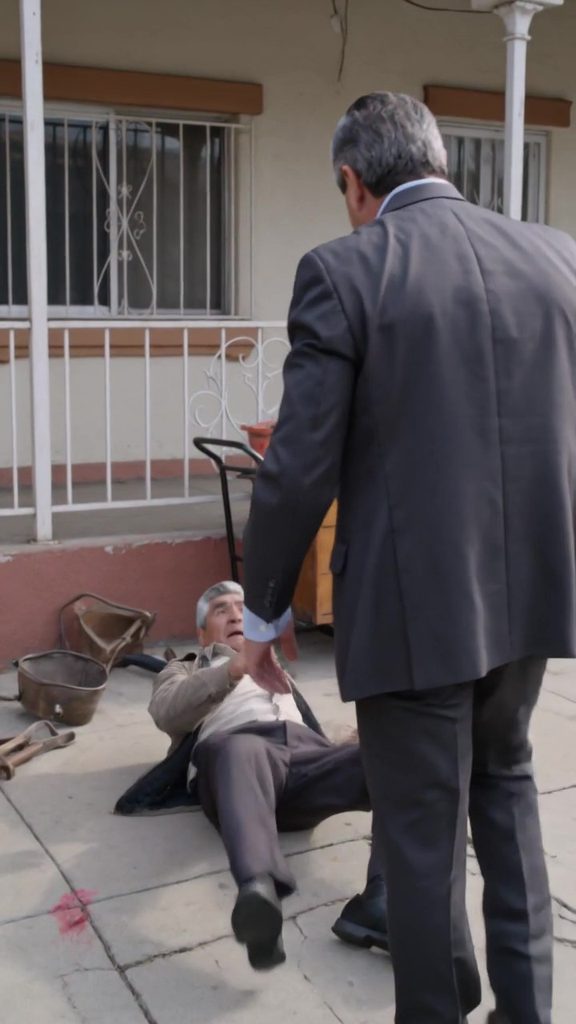
The specific reason was this: Sergio demanded that Raúl remove his stall because, according to him, it made the street look cheap; the argument ended in an assault witnessed by neighbors. Up until that point, there was still a simple solution. All they had to do was stop, check what had happened, and allow someone from the area to intervene.
Sergio Alcázar chose the opposite.
Facing Don Raúl Mendoza, Sergio Alcázar looked for someone to blame before bothering to reconstruct what had happened. His voice growing louder, Sergio Alcázar stopped talking about the incident and began questioning whether Don Raúl Mendoza should even be there. Don Raúl Mendoza tried to respond without mirroring his tone.
“I’m not being disrespectful,” he said. “I’m asking him to calm down.”
“Don’t tell me to calm down,” Sergio Alcázar replied, without lowering his voice.
The people around them began exchanging glances. Some pulled out their phones; others looked for an employee, teacher, supervisor, or security guard, depending on the location. That delayed reaction would later prove important: it would show that the conflict hadn’t been a private argument between two isolated individuals.
Don Raúl Mendoza didn’t respond with blows or threats. He backed down as needed and repeated that he wanted to end the argument. This restraint didn’t cause Sergio Alcázar to lower his voice; on the contrary, he seemed to interpret it as permission to continue.
There was a moment when everything could have stopped. Someone nearby said, “That’s enough.” Another asked for space. Sergio Alcázar heard, but continued. The confrontation escalated into direct aggression. It wasn’t necessary to describe it in a lurid way to understand its seriousness: Don Raúl Mendoza ended up on the floor or leaning against the furniture, dazed, while several people pleaded with Sergio Alcázar to step back.
The most revealing thing happened next. Sergio Alcázar showed no concern for whether Don Raúl Mendoza was alright. Instead of asking about Don Raúl Mendoza, Sergio Alcázar wanted to know who had the authority to order him to leave and who was going to “take responsibility” for his displeasure.
That attitude changed the perception of the witnesses. To those watching, Sergio Alcázar no longer seemed like someone caught off guard by a moment of madness, but rather someone determined to justify what he had just done. They were seeing someone still trying to justify himself after crossing a line.
A person who was near the front of an old house during a garage sale noted the exact time on their phone so they could later locate the moment on the cameras.
That seemingly insignificant note about the time ended up being more useful to Don Raúl Mendoza than any discussion at the time.




