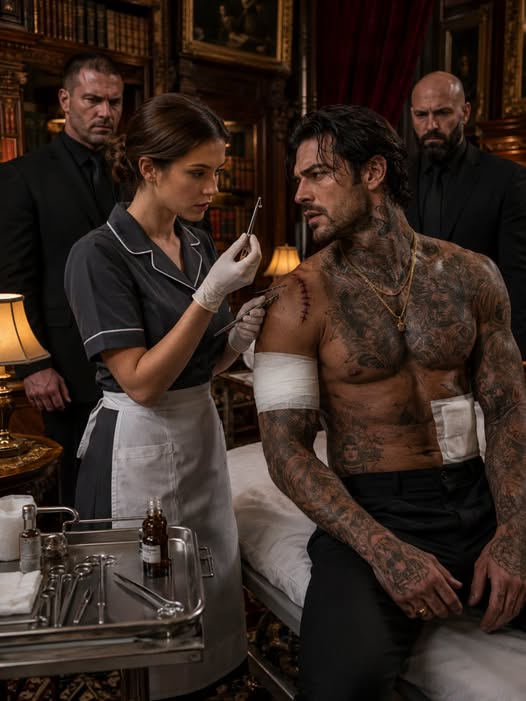
20 medical degrees, decades of combined experience, and millions of dollars in cash stacked on a mahogany desk could not save Gabriel Falcone.
The undisputed king of the city’s underworld was rotting from the inside out, slowly being killed by a phantom infection no antibiotic could touch. The best surgeons available had been brought to his estate, and 1 by 1, they had left in defeat.
It took a quiet 22-year-old woman who scrubbed floors for minimum wage to notice what they had missed.
Blood ruined everything.
It seeped into handwoven Persian rugs, stained the crisp white scrubs of private nurses, and filled the sprawling estate with the scent of copper and bleach.
Gabriel lay in the center of his converted library, a king drowning in his own bedsheets.
He was 34, built like a heavyweight fighter, and almost untouchable on the streets. A rival syndicate had tried to change that 3 weeks earlier with a drive-by shooting.
They had failed.
A single bullet passed cleanly through Gabriel’s left shoulder. It missed the artery and the bone. The injury was considered a flesh wound. Emergency surgery was supposed to involve a routine closure, followed by approximately 2 weeks of recovery before he returned to running his empire.
Instead, Gabriel was dying.
Dr. Harrison Cole paced the library, repeatedly wiping sweat from his forehead.
He was surgeon number 18.
The previous 17 doctors had either left in frustration or been escorted from the estate by armed men before they could fail any further.
“His temperature is 104,” Cole said, staring at the bank of monitors blinking in the darkened room. “His white blood cell count is plummeting. The necrosis is spreading radially from the incision site. Sepsis is already in the bloodstream. I’m telling you, Carmine, we have to amputate the arm at the shoulder tonight or he’s dead by tomorrow noon.”
Carmine did not blink.
Gabriel’s underboss stood in the corner. His tailored suit jacket had been discarded over a leather chair, revealing the heavy outline of a pistol at his waist.
He looked at the Ivy League surgeon with flat, expressionless eyes.
“You cut off his arm, Doc, and I cut off yours.”
Carmine’s voice was a low, gravelly scrape.
“You were brought here to fix the infection. The first butcher closed the hole. You just have to make the meat heal.”
“Why won’t it heal? Because medicine isn’t magic,” Cole snapped.
The pressure of days spent working beneath armed threats had begun breaking through his professional composure.
“We have him on every broad-spectrum antibiotic known to modern science. Vancomycin, meropenem, Zosyn. We’ve performed 3 debridement procedures to remove the dead tissue. But the tissue keeps dying. It’s like the infection is generating from thin air. I can’t fight a ghost.”
In the far corner of the room, kneeling beside a silver tray of discarded biohazard bags, was Sadi.
She wore a gray uniform. Her hair was tied in a practical knot.
She was invisible.
In a room filled with mobsters and millionaire doctors, a 22-year-old maid holding a sponge barely registered as furniture.
Sadi preferred it that way.
Invisibility was safety.
She had worked at the Falcone estate for 6 months, keeping her head down, cleaning baseboards, and pretending not to hear the muffled screams that occasionally came from the basement.
She needed the wages to pay the hospital debts left behind by her mother.
During the previous week, however, Sadi had been assigned almost exclusively to the library, which had effectively become a private trauma ward.
She squeezed a cleaning cloth into a plastic bucket.
The water turned pale pink.
Her eyes remained lowered.
She was still watching.
She had watched doctors arrive with polished silver cases and enormous confidence. She watched them study tablets, blood cultures, MRI scans, and medical charts.
What Sadi rarely saw them do was actually look at Gabriel.
They treated him like a malfunctioning engine, concentrating on diagnostic readings instead of the machine itself.
Sadi understood broken things.
She had grown up in a cramped apartment above a garment factory. Her mother spent 40 years bent over a sewing machine, repairing mistakes made by other people.
From her, Sadi learned seams, tension, fabrics, and thread.
She understood what happened when a foreign or incompatible material was forced into something delicate.
The fabric puckered.
It tore.
Eventually, the entire garment could be ruined.
Gabriel groaned.
The ragged sound cut through the room.
His chest heaved beneath a film of pale, feverish sweat. The heavy bandages surrounding his left shoulder were already leaking foul-smelling black-yellow fluid.
Carmine stepped closer to the bed.
For an instant, the hard exterior of Gabriel’s underboss fractured.
His hand closed around a wooden bedpost.
“Boss, hang in there. Cole is going to figure this out, or I’ll find somebody who will.”
“There is nobody else,” Cole muttered as he pulled on fresh latex gloves. “I need to change the dressings again. But I am documenting my recommendation for immediate amputation. When he dies, this is not on me.”
“Everything in this room is on you,” Carmine said.
Sadi collected a fresh roll of sterile gauze and a basin.
Her task was simple. She was supposed to stand beside the bed and hold the biohazard bag while Cole removed and discarded Gabriel’s rotting dressings.
She approached silently.
The smell reached her first.
Decaying flesh.
It was unmistakable and overpowering.
But when Sadi leaned closer, holding the yellow biohazard bag open beside Dr. Cole, she noticed another odor underneath it.
Faint.
Sharp.
Burnt almonds and cheap copper dye.
Cole carefully peeled back the layers of gauze surrounding Gabriel’s shoulder.
The skin underneath was mottled purple and black.
Repeated debridement procedures had opened the original bullet wound into a jagged crater exposing muscle and fascia.
Sadi held her breath.
Not because of the wound.
Because of the smell.
Burnt almonds.
Copper.




