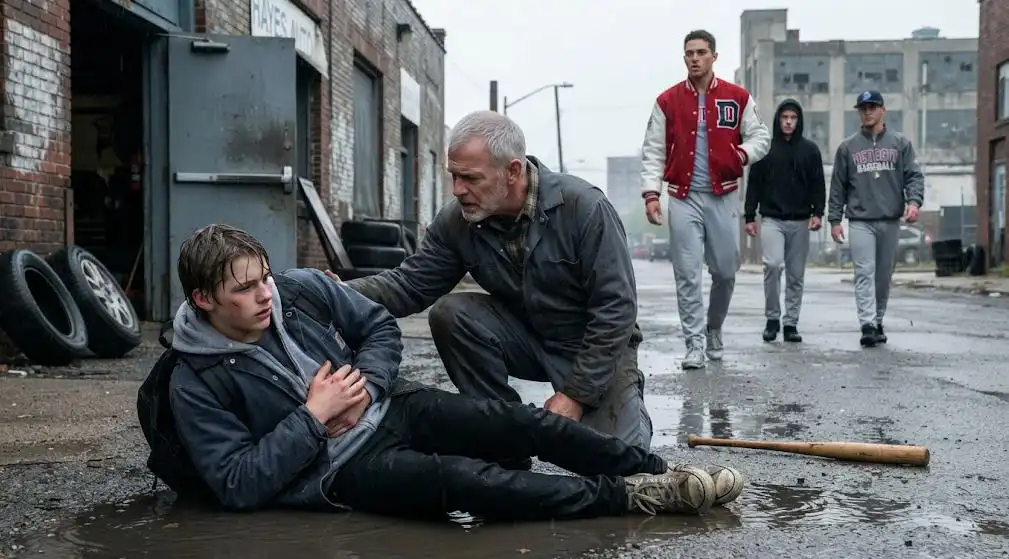
The baseball bat struck Owen Mercer across the ribs with a hard, hollow crack.
The sixteen-year-old folded sideways and hit the pavement in the alley behind Keller Auto & Tire. Rainwater splashed over his jeans and soaked through his jacket. His backpack slid from his shoulder, and for a moment, all he could do was curl around the pain and struggle to breathe.
Grant Keller stood over him, the wooden bat still in his hands.
“You should’ve fixed my car.”
Owen pressed one palm against the wet pavement. His other arm guarded his injured side.
“I said no.”
Grant’s jaw tightened.
“Tell the cops, and my dad fires Hayes.”
Then the metal service door at the end of the alley flew open.
“Step away from him.”
Walter Hayes, the garage’s oldest mechanic, hurried toward them. Grant’s two teammates backed away first. Grant followed, his face hard with anger, until all three disappeared toward the street.
Walter dropped to one knee beside Owen.
“Don’t try to stand up yet,” he said. “Just keep breathing. I’m getting you help.”
Owen tried to answer, but pain cut off the words.
Walter stayed beside him in the rain until medical help arrived.
By the time the ambulance doors closed, the boy who had spent years trying not to need anybody had one urgent fear that hurt almost as much as his ribs.
Grant hadn’t threatened to fire Owen.
He had threatened to fire Walter.
And Owen knew exactly how much that could cost the old man.
Three days earlier, Grant had driven his blue Camaro into the garage after school and demanded that Owen finish preparing it for an illegal street race.
Owen was sixteen, but he understood engines better than many adults who worked around them. He could hear a misfiring cylinder, recognize a failing bearing, and diagnose an electrical problem from the way a starter hesitated. He had learned by reading discarded repair manuals, studying broken equipment, and rebuilding whatever other people considered worthless.
At Keller Auto & Tire, he was officially a part-time shop helper. Most days, that meant sweeping floors, carrying parts, cleaning tools, and doing the jobs nobody else wanted.
Walter had gradually given him more.
A small engine that refused to start. A stubborn carburetor. A discarded alternator that everyone assumed was beyond repair.
Walter never made a show of praising him. He simply left another broken component on the workbench.
If Owen could explain what was wrong and demonstrate how to fix it, Walter let him try.
That was how their relationship had developed: one repaired machine at a time.
Owen had grown up in the foster-care and group-home system after losing his parents. He had learned to keep his belongings packed lightly and his expectations even lighter. Adults made promises. Placements changed. People who said they cared could disappear behind paperwork, arguments, or new circumstances.
He wanted two things more than anything else: a safe place to belong and, someday, a repair garage of his own.
The old shop had begun to feel like a possible first step.
Walter noticed the way Owen stayed late to study service manuals. He noticed how carefully the boy returned every tool to its proper place. He noticed that Owen could spend an entire break repairing a discarded lawn-mower engine but barely speak to another student at school.
Walter never demanded an explanation.
Sometimes, he left a sandwich beside Owen’s toolbox. Sometimes, he asked a question about an engine and listened seriously to the answer.
It wasn’t much, but Owen had learned that kindness did not always arrive with a speech.
Then Grant Keller drove in.
Grant was eighteen, captain of the high-school baseball team, and the son of Victor Keller, the owner of the garage. He had money, a good-looking car, and a reputation that made other students careful around him.
His father’s business gave him something else: access to a fully equipped repair shop and the freedom to use it after hours.
Grant wanted his Camaro ready for a midnight street race. The car already had an illegal exhaust bypass and other modifications that would not survive a proper inspection. He wanted Owen to finish the work and help conceal what had been changed.
Owen inspected the car before answering.
He found a brake line in dangerous condition and saw enough of the existing modifications to understand that the requested work was not merely against the rules. It was unsafe.
“I’m not hiding this,” he told Grant. “That brake line needs fixing, and I’m not helping you disguise the rest.”
Grant stared at him as if Owen had spoken a language he had never heard before.
“Do you know whose shop you’re standing in?”
“Yes.”
“Then you know who decides whether you work here.”
Owen glanced toward Walter, who was working at another bay. He knew the truth. Victor Keller could end his employment with a few words.
But he also knew what would happen if that car failed at speed.
“I still won’t do it.”
Grant left without another word.
The following afternoon, he cornered Owen in the alley with Mason Reed and Tyler Brooks, two teammates who had grown accustomed to following his lead.
The wooden bat ended the argument.
Or at least, Grant thought it did.
At the hospital, doctors confirmed that Owen had two fractured ribs, along with extensive bruising and a scrape on his cheek.
The examining physician documented the injuries and noted that the broad, linear bruising was consistent with a single strike from a hard, elongated object such as a wooden baseball bat.
The report could not identify the attacker. It could not prove who had held the bat. But it preserved something important: the injuries were consistent with the account Owen gave the medical staff.
When Walter brought him back to the garage after treatment, the boy moved slowly, holding his injured side.




