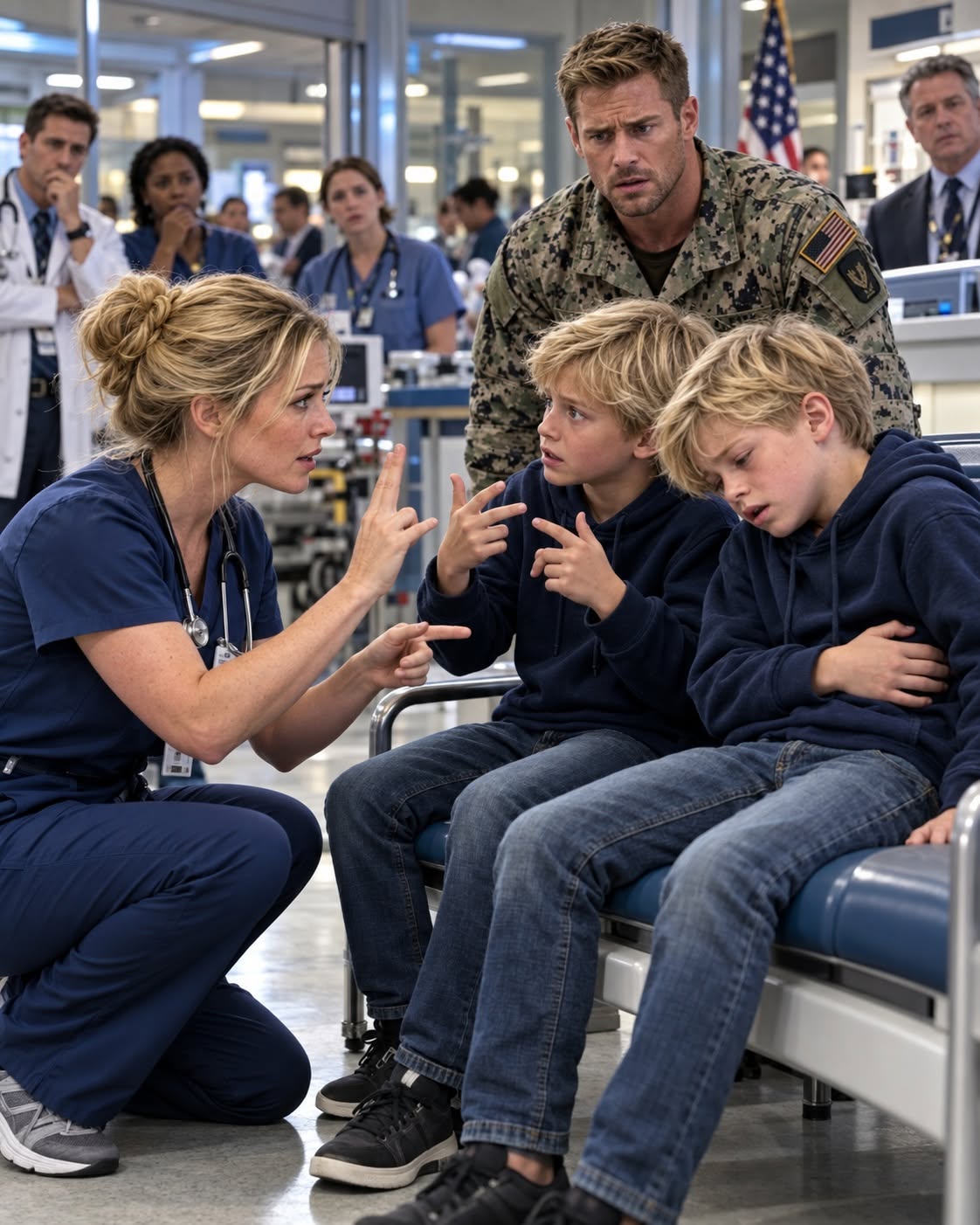
The fluorescent lights of the Hion Bay Naval Medical Center emergency waiting room buzzed with an unrelenting, synthetic hum that set Jo Merrick’s teeth on edge. It was the frequency of impending failure. She had heard that exact hum in sterile surgical suites across three continents, in plywood forward operating bases in Helmand Province, and inside the rattling belly of an MH-60 Black Hawk flying through pitch-black Afghan valleys.
Right now, that sound accompanied the slow, terrifying suffocation of a nine-year-old boy.
“Nurse, stand down!” Captain Raymond Aldrich’s voice boomed across the tiled room, thick with the unyielding authority of a hospital chief who had spent the last decade fighting budget deficits rather than trauma. “That is a physician’s procedure. If you puncture that child’s thoracic wall without an attending’s sign-off, you are committing aggravated assault under the Uniform Code of Military Justice! You will be discharged dishonorably and stripped of your civilian licensure before dawn!”
Jo did not flinch. She did not even look at him.
Her eyes remained pinned to Dr. Kyle Apprentice, whose youthful, scrub-suited frame was shaking. The resident’s penlight was clutched in hand, his knuckles white, his mouth opening and closing like a landed fish. Apprentice knew the medicine—he knew what absent breath sounds on the left meant, knew what a deviating trachea signified, knew that the mediastinum was being shoved violently to the right, crushing the inferior vena cava and choking off venous return to the boy’s heart.
He knew it, but his limbs were paralyzed by Aldrich’s glare and the suffocating weight of protocol.
“Doctor,” Jo said again. Her voice was not loud, but it possessed a strange, flat resonance that sliced straight through the mounting panic in the room. It was the tone of someone who had given orders while mortar shells ruptured the earth ten yards away. “Are you going to decompress this child’s chest… or am I?”
“I… we need an ultrasound to confirm,” Apprentice stammered, his gaze darting between Aldrich and the dying boy. “Protocol requires visualization of the pleural sliding sign before we—”
“He doesn’t have ninety seconds for an ultrasound,” Jo said calmly.
The cardiac monitor attached to Owen’s chest let out a long, unbroken warble. His oxygen saturation read 78%. His pulse was spiking to 148, thready and weak, his blood pressure sliding into the basement: 64 over 32.
Beside the gurney, Owen’s identical twin, Ethan, threw his entire body over his brother’s legs, weeping silent, tearing sobs that shook his shoulders. His small hands flew through the air in frantic, broken signs that no one in this room understood—no one except Jo.
*Wake up. Owen, look at me. Don’t go to sleep. Please look at me.*
“Joanna, step back right now!” Aldrich barked, reaching out a manicured, gold-ringed hand to seize her shoulder.
He never reached her.
A massive hand, calloused like iron and stained with base grit, clamped onto Aldrich’s wrist with the precision of a hydraulic vise.
Captain Daniel Brandt didn’t shout. He didn’t draw a weapon. He simply stepped between the Chief Medical Officer and the nurse, his frame towering over Aldrich by three inches, his chest broad enough to block out the emergency room lights. His eyes, rimmed in sleepless crimson, locked onto Aldrich’s face with lethal clarity.
“Touch her,” Daniel whispered, the sound vibrating from the soles of his combat boots, “and you will spend the rest of this night learning what a crushed radial nerve feels like. She speaks to my boy. Let her work.”
“Brandt, this is civilian-contracted military property—you cannot interfere with hospital administration!” Aldrich gasped, trying to pull his arm back, but finding himself entirely pinned.
Jo didn’t waste the second Daniel had bought her.
“Tara,” Jo commanded, not looking back.
Tara Vance, the triage clerk who had spent two hours mechanically denying families entry, was suddenly moving on pure instinct. She slammed the plastic packaging of a fourteen-gauge angiocatheter onto Jo’s tray, along with a bottle of brown chlorhexidine and sterile gauze.
Jo’s fingers moved without a tremor. The trembling that usually haunted her whenever she poured coffee or held a charting pen had evaporated completely. The muscle memory buried under nine years of self-imposed exile, nine years of quiet night shifts and floor-scrubbing humility, surged to the surface with ferocious clarity.
She ripped open the packaging.
With her left hand, she located Owen’s sternal notch, slipped two fingers down to the Angle of Louis, and slid directly across to the left second intercostal space, along the midclavicular line.
*Superior border of the third rib,* she calculated silently. *Avoid the intercostal neurovascular bundle running along the inferior edge.*
“Owen,” she signed swiftly with one hand, catching the fading boy’s glassy eyes for a fraction of a second. *Hold on. Big pressure. Then you breathe.*
The nine-year-old’s eyelids fluttered.
Jo doused the skin with chlorhexidine in one swift, circular sweep. She positioned the thick, hollow needle at a ninety-degree angle to the child’s small, bruised ribs.
“Nurse Merrick, no!” Apprentice cried out.
Jo drove the needle home.
There was a distinct, gritty *pop* as the needle pierced the parietal pleura.
Instantly, a sharp, violent hiss erupted from the hub—a pressurized plume of trapped air and vaporized blood that sprayed against Jo’s forearm. The trapped air that had been crushing Owen’s heart and collapsing his left lung whistled as it vented into the sterile waiting room.
The hiss lasted for four full seconds.
For four seconds, no one in the room breathed.
Then, a sudden, ragged gasp tore from Owen Brandt’s throat.
His back arched off the mattress. His chest heaved as air flooded into the expanding lung tissue for the first time in six hours. Color—a flush of warm, pink life—rushed back into his lips, chasing away the deadly slate-gray pallor.
On the monitor, the alarms changed their cadence.
Pulse: 118.
Oxygen saturation: 84%… 89%… 94%.
Blood pressure: 90 over 58.




