Chap 2
The silence in the triage waiting area did not just fall; it shattered like heavy glass.
Ten seconds. In pediatric trauma, ten seconds was not a measurement of time—it was an eternity measured in dying brain cells and the slowing pulse of an innocent child.
Dr. Kyle Apprentice stood paralyzed. The twenty-eight-year-old resident held his clipboard against his chest like a wooden shield, his knuckles white, his mouth half-open. He looked at the screaming digital monitor:
*Pulse: 138. SpO2: 81%. Blood pressure: 68/38.*
“Stand down, Nurse Merrick!” Captain Raymond Aldrich’s voice cracked like a bullwhip across the polished linoleum. He took two aggressive strides forward, his polished dress shoes squeaking violently. “That is an invasive surgical procedure. You are a civilian staff nurse. If you touch that child with an open needle, I will have the shore patrol remove you in handcuffs. You will never set foot in a medical facility again!”
Jo Merrick did not look at him. She did not blink.
Her world had narrowed to a circle no wider than the nine-year-old boy’s chest. The quiet, invisible woman who had scrubbed bedpans, cleaned up vomit, and apologized for existing for nearly a decade had vanished. In her place stood muscle memory carved from blood, desert dust, and screaming rotors.
“Tara,” Jo said. Her voice was not loud, but it possessed a low, terrifying frequency that made the receptionist stop trembling and slam the sterile tray onto the gurney. “Tear the packaging. Dr. Apprentice, hold his right shoulder flat against the gurney. If he bucks when the pleural space vents, the needle will shear.”
“Merrick, do not do this!” Apprentice gasped, terrified of Aldrich, yet even more terrified of the blue tint spreading across Owen’s eyelids.
“He has thirty seconds of cardiac output left, Kyle,” Jo said, her eyes boring into the young doctor’s soul. “Look at his neck. His jugular is the size of my thumb. His heart is being crushed by trapped air. Are you going to let him die because you’re scared of an administrative write-up?”
Apprentice swallowed hard. He looked at Owen’s little hand, which hung limply over the side of the vinyl mattress. The boy wasn’t fighting anymore. His eyes were rolling back into his head, showing only the whites.
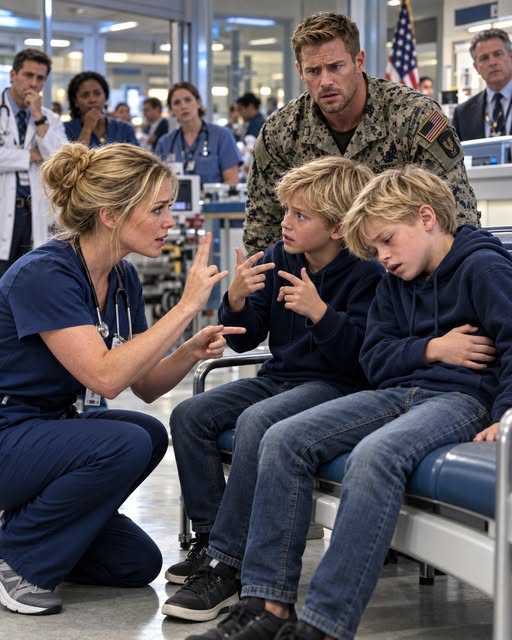
Behind them, Ethan let out another sound—a guttural, heartbroken cry that tore through the chest of every parent sitting in that waiting room. Ethan couldn’t hear the monitors screaming, but he could see his twin brother slipping into the dark.
“Hold him,” Jo commanded.
Apprentice dropped his clipboard. He threw his weight across Owen’s right shoulder.
“I am ordering you to stop!” Aldrich roared, reaching out a hand to grab Jo’s shoulder.
He never reached her.
A hand like a steel vice clamped onto Aldrich’s wrist.
Captain Daniel Brandt stepped into the chief medical officer’s path. Daniel was half a foot taller than Aldrich, his chest broad under his woodland utilities, his combat boots planted into the floor with the immovable weight of a man who had survived three tours in the mountains of southern Helmand. Daniel’s eyes were black ice.
“Touch her,” Daniel whispered, his voice vibrating with lethal calm, “and I will break your arm in three places, Captain. Get out of her way.”
Aldrich gasped, trying to pull his arm free, but Daniel didn’t budge.
Jo didn’t waste the second Daniel had bought her.
Her fingers flew. She ripped the cap off the large, eighteen-gauge needle. With her left hand, she located the second intercostal space—two finger-widths below Owen’s left collarbone, right along the mid-clavicular line. She felt the rib, slipped her index finger just over the superior border to avoid the intercostal artery and nerve bundle, and swabbed the skin in one violent swipe of brown Betadine.
*Don’t hesitate,* the voice inside her head whispered—the voice she hadn’t listened to since 2015. *Find the rib. Roll over the top. Drive straight.*
Jo positioned the needle at a ninety-degree angle.
She looked at Ethan, who was watching her with terror in his wide eyes. With her left index finger, she tapped her own chest once, giving him the universal sign they had used minutes ago: *Hold on.*
Then, she drove the needle deep into Owen’s chest.
There was a pop as the bevel penetrated the parietal pleura.
*Psssssssssssssssssssssh.*
A sound like an over-pressurized tire exploding whistled out of the catheter hub. Jo immediately withdrew the metal stylet, leaving the flexible plastic cannula firmly seated in the pleural cavity. A foul blast of trapped air hissed against her nitrile glove.
The monitor beeped once.
Then again.
Owen’s chest visibly relaxed as the deadly pressure crushing his vena cava and heart escaped into the sterile air of the room. The monstrous tension that had pushed his trachea into his right neck collapsed back toward the midline.
*SpO2: 84%… 88%… 93%.*
*Heart rate: 118… 110.*
*Blood pressure: 88/54.*
Owen gasped—a deep, shuddering, beautiful intake of breath that dragged cool oxygen into his reinflated right lung and relieved the compression on his left. His small eyelids fluttered. The gray, ash-like pallor surrounding his lips melted away, replaced by the faint, fragile pink of living tissue.
The waiting room exhaled as one single organism.
A woman sitting three benches away clutched her daughter and began to weep. The elderly Navy veteran near the water cooler took off his ballcap and stared at Jo in disbelief.
Dr. Apprentice fell back against the wall, his hands shaking so violently he had to tuck them under his armpits. “My God,” he breathed. “She did it. The trachea… it centered.”
Jo secured the hub with a strip of adhesive tape. Her hands, which had trembled for nine long years behind the medication carts, were utterly motionless. Cold. Steady.
She turned to Ethan.
The little boy was frozen, his hands still raised near his chin in half-finished signs. He looked from the hissing plastic tube in his brother’s chest up to Jo’s face.




