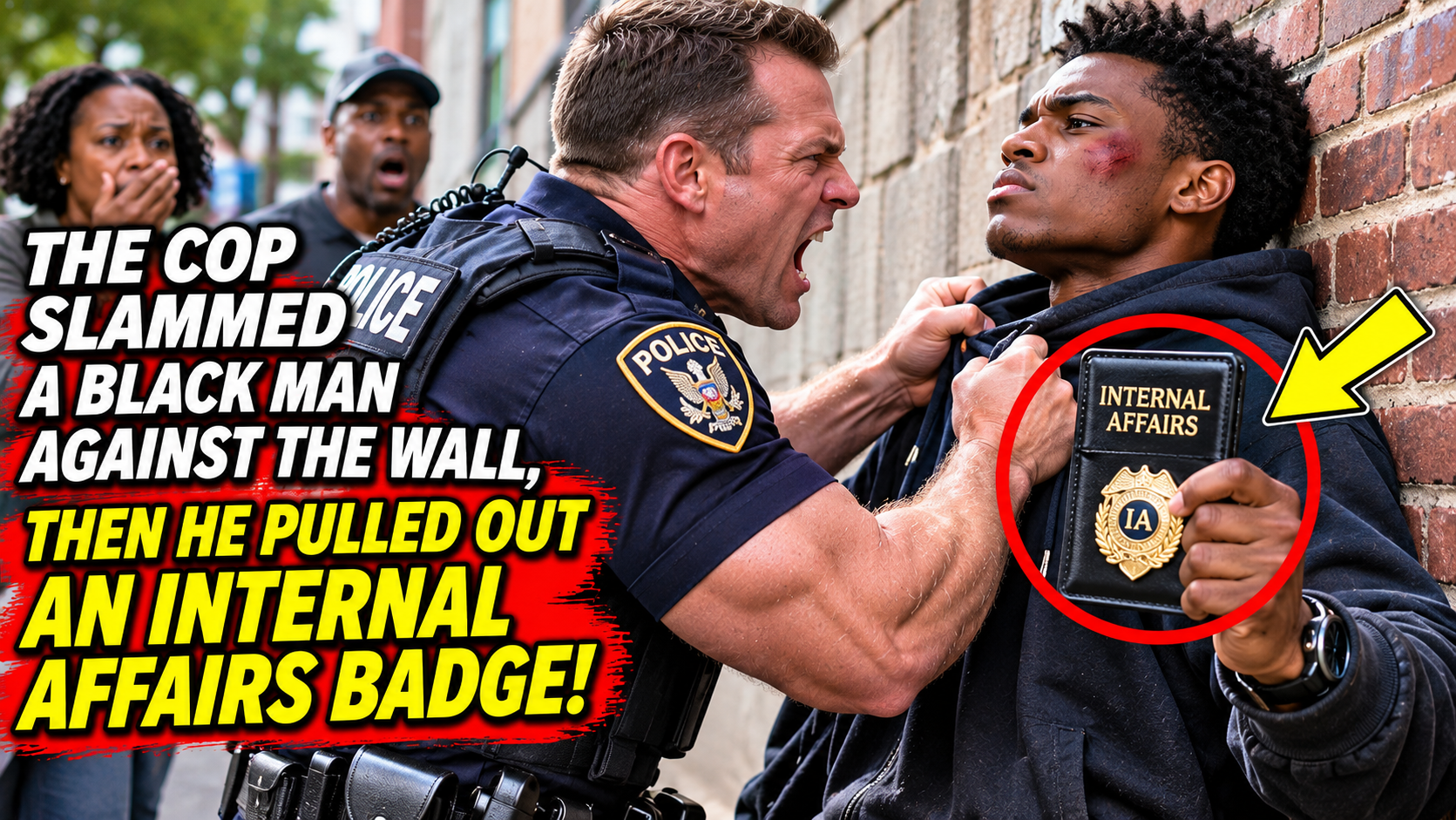
Officer Grant Mercer had already decided Malik Carter was guilty before the boy ever opened his mouth.
It was 4:17 on a Wednesday afternoon in downtown Bellhaven, and the sidewalks were crowded with office workers, students, delivery drivers, and people heading toward the train station. Malik was nineteen, skinny, wearing a gray hooded sweatshirt and carrying a paper pharmacy bag under one arm.
He had just stepped out of Benson Pharmacy when Mercer grabbed him.
“Against the wall.”
Malik froze.
“What?”
“I said against the wall.”
People moved around them without stopping.
Malik looked at the officer, then toward the pharmacy entrance behind him.
“Sir, I didn’t do anything.”
Mercer stepped closer.
He was tall, muscular, and carried himself with the confidence of someone accustomed to people obeying before they understood why.
“I’m not asking.”
Malik slowly raised both hands.
“Can you just tell me what this is about?”
Mercer grabbed the front of his hoodie and shoved him backward.
Malik’s shoulders struck the stone wall.
Hard.
Several pedestrians turned.
Nobody intervened.
Mercer pulled a tiny clear plastic bag from his pocket and held it inches from Malik’s face.
“Recognize this?”
Malik stared at it.
“No.”
“Try again.”
“I’ve never seen that.”
Mercer smiled.
It was not a friendly smile.
“Funny. Because I just watched you drop it.”
Malik’s face changed.
“What?”
“You heard me.”
“No, I didn’t.”
Mercer shoved him against the wall again.
“Stop lying.”
“I swear to you, that’s not mine.”
Across the street, a Black man wearing a dark shirt slowed his walk.
His name was Adrian Cole.
He was forty-one years old, six-foot-two, physically fit, and had spent most of the afternoon sitting inside a parked sedan drinking bad coffee while watching Officer Grant Mercer.
Mercer did not know that.
Malik certainly did not know that.
Nobody on the sidewalk knew that the calm man crossing toward them had spent the previous seven months working for the Bellhaven Police Department’s Internal Affairs Division.
And nobody knew that Grant Mercer was the reason Adrian was there.
Adrian had been ordered to watch.
Not interfere.
Document.
Observe.
Build a case.
But when Mercer shoved the teenager into the wall for the third time, Adrian stepped off the curb.
That decision would end one police career.
It would reopen fourteen old complaints.
And before the night was over, a nineteen-year-old college student who had believed nobody would ever listen to him would learn why Officer Mercer had picked him in the first place.
Seven months earlier, Captain Rebecca Sloan had placed a folder on Adrian Cole’s desk.
It was unusually thick.
“Grant Mercer,” she said.
Adrian looked at the name.
“I know him.”
“Everybody knows him.”
That was not a compliment.
Mercer had served twelve years with the Bellhaven Police Department. His personnel file looked respectable at first glance. Commendations. Strong arrest numbers. Good performance reviews.
He had also accumulated twenty-one civilian complaints.
Adrian opened the folder.
“Twenty-one?”
“Twenty-one filed. We have no idea how many never made it that far.”
The complaints followed a pattern.
Unnecessary searches.
Aggressive questioning.
Property disappearing during stops.
People threatened with arrest after asking for badge numbers.
Young Black and Latino men repeatedly detained after supposedly matching vague descriptions.
Yet Mercer had never received more than a written warning.
Adrian flipped through the findings.
“Not sustained.”
“Not sustained.”
“Insufficient evidence.”
“Unable to determine.”
Same conclusion over and over.
“No body camera?”
“Sometimes.”
Adrian looked up.
“Sometimes?”
Captain Sloan handed him another page.
Mercer’s body camera had experienced more “technical failures” than any other officer in the Central District.
Sometimes the battery was dead.
Sometimes the camera fell loose.
Sometimes Mercer forgot to activate it.
In several cases, footage began only after the most disputed part of the encounter.
Adrian leaned back.
“So why now?”
Sloan slid another folder across the desk.
This one contained photographs.
A frightened twenty-three-year-old man named Andre Mills sat in an interrogation room.
On the table in front of him was a small clear plastic bag.
Adrian looked at the photograph.
“What am I looking at?”
“Mercer arrested him six weeks ago.”
“For?”
“Possession of suspected illegal evidence.”
Adrian opened the report.
Mercer claimed he watched Andre remove the bag from his jacket and drop it beneath a parked car.
Andre said Mercer produced the bag himself.
Adrian had heard that accusation before.
“What did the lab say?”
Sloan’s expression became interesting.
“That’s the problem.”
“What?”
“There’s no lab result.”
Adrian frowned.
“The case is six weeks old.”
“Because the bag disappeared.”
Now Adrian sat forward.
“From evidence?”
“It never made it to evidence.”
Mercer’s report said the property technician misplaced it.
The technician denied ever receiving it.
The transfer log contained Mercer’s signature, but no receiving signature.
Prosecutors quietly dropped the charge.
Andre spent nine days in jail before that happened.
“Did Andre file a complaint?”
Sloan nodded.
“Number twenty-one.”
Adrian closed the file.
“Still not enough.”
“No.”
That was the reality Internal Affairs faced.
Everybody wanted bad officers removed quickly.
But allegations were not evidence.
Adrian needed documentation strong enough to survive union hearings, departmental appeals, prosecutors, and potentially a courtroom.
Mercer understood that system extremely well.
He knew what could be proved.
More importantly, he knew what could not.




