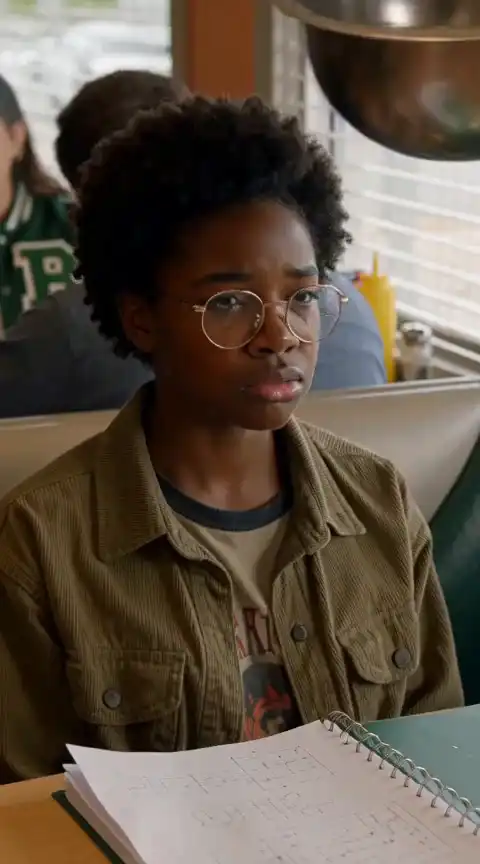
THE CHEERLEADERS THOUGHT THE POOR SCHOLARSHIP GIRL WAS NOBODY WORTH PROTECTING AND DRENCHED HER IN ICE WATER, UNTIL THREE HEAVY BLACK SUVS PULLED UP OUTSIDE AND SHUT THEIR DOORS.
The exhaust from the three engines hung thick in the cold afternoon air.
Inside the Oakwood Diner, nobody had moved yet.
Brianna Vance still had the plastic pitcher balanced in her right hand, drops of murky rinse water pattering onto the linoleum.
Her flyer, Chloe, was still pointing the lens of her iPhone directly at Simone’s dripping face.
Simone did not wipe her cheeks.
She sat rigid in the vinyl booth, her hands resting flat on the soaked laminate table.
The icy water had soaked completely through her thin thrift-store thermal, clinging to her skin like wet lead.
Beneath her palms, the ink on her engineering binder was already bleeding into illegible black swirls.
Five months of late-night calculations were dissolving into dishwater.
“Look at her staring,” Brianna mocked, glancing back at the varsity table for validation.
“She looks like a drowned stray.”
A couple of the football players chuckled, but the laughter died down much faster this time.
Through the greasy front plate-glass window, two more black vehicles turned into the lot.
They were followed by a refrigerated commercial transport truck, its massive white side panels freshly washed and gleaming, completely unmarked.
The three lead Suburbans parked across five diagonal spaces, boxing in Brianna’s powder-blue convertible without hesitation.
The doors did not fly open with sirens or shouting.
They opened smoothly, with the heavy, hydraulic click of reinforced steel.
Four men in tailored charcoal suits stepped out into the gravel lot.
They did not look around like confused customers looking for a booth.
Two of them took positions at the diner’s double front doors, hands clasped loosely in front of them.
The third man walked around to the passenger side of the middle SUV and held the door open with one gloved hand.
The diner fell into an eerie, unnatural hush.
Behind the counter, Rick, the manager, paused with a rag in his hand, his eyes tracking the perimeter outside.
“Hey, Rick,” one of the cooks muttered from the grill window.
“Who is that?”
“I don’t know,” Rick muttered back, his face losing some of its color.
“Just stay on the line.”
A woman stepped down from the running board of the center vehicle.
She possessed the same deep brown skin as Simone, high cheekbones, and dark hair pulled back into an immaculate, low chignon.
She wore a tailored wool overcoat in deep charcoal over a silk blouse, with not a single hair out of place.
She wore no loud jewelry—only a discreet platinum timepiece on her left wrist.
She did not rush.
She adjusted the lapels of her coat against the autumn chill, looked once at the diner’s neon sign, and walked toward the entrance.
Her heels produced a crisp, rhythmic sound against the cracked concrete outside.
The two men at the door pulled the heavy glass handles back before she even reached the threshold.
The diner bell jingled with a sharp, clean chime.
Every eye in the restaurant shifted from Simone’s dripping booth to the woman standing in the entryway.
She did not scan the room like a stranger.
Her eyes swept the room with the practiced efficiency of an auditor who already knew every inventory number.
When her gaze landed on the far booth by the jukebox, her expression did not shatter.
It tightened.
The temperature in the diner seemed to plunge another ten degrees.
Simone didn’t say “Mom.”
She didn’t cry out or point an accusing finger.
She simply closed her eyes for a split second, taking in one long, controlled breath.
Brianna Vance, still holding the empty tea pitcher, let out a nervous snort.
“Can I help you?” Brianna called out across the dining room, her squad snickering behind her.
Brianna was used to owning every room she walked into within a thirty-mile radius.
Her father, Preston Vance, owned Vance Valley Logistics and Vance Quality Meats.
His trucks supplied every butcher shop, convenience mart, and regional grocer in three counties.
At Oakwood High, Brianna’s name was on the donor plaques in the gymnasium foyer.
She was not accustomed to anyone looking past her, especially someone who didn’t attend the country club.
The woman in the dark coat ignored Brianna entirely.
She walked down the narrow center aisle between the vinyl booths, her steps unhurried.
Her eyes stayed fixed on the puddle of ice and ink spread across the table.
Behind her, an executive assistant with a slim leather folder stepped through the doorway, accompanied by an attorney carrying a briefcase.
The diner was so quiet now that the low hum of the milkshake machine sounded like a turbine.
Coach Miller slowly set his fork down on his plate, staring at the woman’s profile.
Something in the coach’s face shifted from indifference to sheer panic.
Miller knew the faces that appeared on regional business boards and national trade journals.
He had seen that exact profile on the front page of the Wall Street Journal three weeks earlier.
Miller’s throat moved in a dry swallow.
The woman reached Simone’s booth and stopped.
She looked down at the soaked sleeves of the corduroy jacket.
She reached out one manicured hand and gently brushed a melting cube of ice from Simone’s collarbone.
“Did any of it get into your eyes, baby?” she asked softly.
The voice was low, warm, and utterly composed.
“No,” Simone whispered.
“Just my notebook.”
The woman looked down at the ruined engineering portfolio.
Her jaw set into iron, but her voice remained at the exact same calm volume.
“The state scholarship binder?”
“Yeah,” Simone said quietly.
“I spent all of September on the load-bearing calculations.”
“We will reprint the blueprints from the cloud server in twenty minutes,” the woman said.
Then she turned.
Her gaze settled on Brianna Vance.
Brianna took a half-step back, suddenly conscious of the pitcher in her fingers.




