Chapter 1:
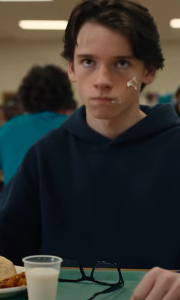
The moment Dax struck me across the head, my glasses flew into my lunch tray, and I realized that every student in the cafeteria was waiting to see whether I would finally break.
Some were waiting for me to cry.
Others wanted me to fight back.
But the six-foot-three senior standing over me wanted something much simpler.
He wanted me to be afraid.
And when I refused to give him that satisfaction, he made the biggest mistake of his life.
My name is Ian Carter. I was sixteen years old, wore glasses with black plastic frames, and had spent most of my time at Westbrook High trying to remain invisible.
I wasn’t especially popular. I wasn’t a member of the football team. I didn’t have wealthy parents or a crowd of friends who followed me through the hallways.
I liked books, science, and quiet places where nobody expected me to prove anything.
Unfortunately, Westbrook High wasn’t the kind of school where being quiet guaranteed you would be left alone.
Especially when someone like Dax Miller decided you were an easy target.
Dax was seventeen, enormous, and convinced that intimidation was a perfectly acceptable way to earn respect.
He walked through the hallways as though he owned the building.
Students moved aside when they saw him coming.
Younger boys lowered their eyes.
Even some of the teachers seemed reluctant to confront him.
He had a talent for turning cruelty into entertainment.
If he shoved someone against a locker, his friends laughed.
If he stole someone’s lunch, they called it a joke.
And if the victim complained, Dax always had the same response.
“Can’t you take a little fun?”
I had watched him humiliate other students for months.
Until that Friday, however, I had managed to stay mostly outside his attention.
That changed at exactly 12:18 p.m.
The cafeteria was packed.
Hundreds of conversations overlapped beneath the fluorescent lights. Plastic trays rattled against metal counters. Someone was laughing near the vending machines, while the cafeteria workers shouted instructions over the noise.
I was carrying a tray with a turkey sandwich, an apple, and a small carton of chocolate milk.
My best friend, Caleb, had stayed behind to finish a conversation with our science teacher.
I was supposed to save him a seat.
There was an empty table near the windows, and I headed toward it without thinking.
That was my first mistake.
Apparently, Dax had decided that particular table belonged to him.
I didn’t know that.
And even if I had, I wasn’t convinced that a school cafeteria was supposed to operate like someone’s private kingdom.
I had almost reached the chair when something scraped violently across the floor.
CRASH!
Dax kicked an empty chair backward.
The chair toppled onto its side, and several nearby students turned.
I stopped.
He was standing directly in front of me, wearing a dark varsity jacket over a gray T-shirt.
Three of his friends occupied the table behind him.
One of them was already smiling.
Dax looked down at me.
“This is my territory.”
His voice was deep enough to carry over the surrounding conversations.
I glanced at the table.
Then I looked at him.
There were no backpacks on the chairs. No trays occupying the empty seats. Nothing suggesting the table was reserved.
“Excuse me,” I said quietly.
Dax didn’t move.
“You deaf, Four-Eyes?”
I felt the first familiar tightening in my stomach.
It wasn’t fear of getting hurt.
Not exactly.
It was the knowledge that whatever I did next would probably become someone else’s entertainment.
For three years, I had trained twice a week at a small community self-defense gym.
My instructor, Mr. Ellis, had taught me how to break a grip, protect my balance, and recognize when someone was preparing to attack.
But the most important lesson had nothing to do with throwing punches.
“The best fight,” he always said, “is the one you don’t have to finish.”
I remembered those words as Dax waited for an answer.
I could have argued.
I could have told him he didn’t own anything.
Instead, I calmly stepped around him, pulled out a chair, and sat down.
Then I opened my milk carton.
The reaction was immediate.
One of his friends snorted.
Another whispered, “He just ignored you.”
I kept my eyes on my lunch.
I wasn’t trying to embarrass Dax.
I simply wanted to eat.
Unfortunately, Dax seemed incapable of understanding the difference.
His shadow fell across my tray.
“Did you seriously just sit down?”
I peeled the wrapper from my sandwich.
“I did.”
Several students laughed.
Not loudly.
Just enough.
Dax’s jaw tightened.
He placed both hands on the table and leaned toward me.
“Get up.”
I took a bite.
“I haven’t finished eating.”
The smile vanished from his face.
“You think you’re funny?”
“No.”
“Then move.”
I swallowed.
“There’s plenty of room.”
For a second, he stared at me as though I had spoken another language.
Dax wasn’t accustomed to calm resistance.
He understood fear.
He understood anger.
He understood someone shouting back, because shouting gave him an excuse to become even more aggressive.
But he didn’t understand someone who simply refused to participate.
He slammed his palm onto the table.
BANG!
My milk carton jumped.
“Move before I count.”
Students at the next table stopped talking.
A freshman with curly hair turned around so quickly that his spoon fell from his hand.
I heard a chair scrape behind me.
Someone whispered, “Ian, just go.”
I knew they meant well.
Nobody wanted to watch another student get hurt.
But something inside me resisted the idea that I should surrender my lunch simply because a larger boy had decided to threaten me.
“I just want to eat,” I said.
Dax leaned closer.
“Then maybe you should learn where you’re allowed to sit.”
I looked up.
“It’s a cafeteria.”
A few students laughed again.
That was when I saw his expression change.
His lips pressed together.
His shoulders rose.




