Chapter 1:
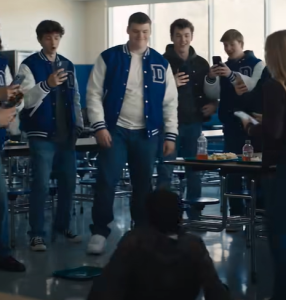
The chair vanished beneath me before I had even finished unpacking my lunch.
One moment, I was sitting at the far end of a cafeteria table, trying to open my sandwich without attracting anyone’s attention.
The next, my body was falling backward, my elbow struck the hard floor, and the sound of thirty students laughing filled the room.
My lunch bag slid from my fingers.
The chair scraped across the tiles with a terrible metallic screech.
For half a second, I couldn’t understand what had happened.
Then I looked up.
Travis stood over me, holding the back of my chair with one enormous hand.
At six feet four inches tall, he was the biggest player on our varsity football team, the captain everyone knew, and the kind of student whose name teachers remembered even when they couldn’t remember the names of the boys sitting quietly in the back of their classrooms.
He wore his football jacket over a gray T-shirt.
His sandy brown hair was neatly cut, and his handsome face carried the easy confidence of someone who had spent years being told he was special.
He looked down at me with a smile.
“Oops.
Didn’t notice you there, little guy.”
His teammates erupted in laughter.
Someone shouted that they wished they had recorded the fall from a better angle.
Another boy held his phone above his head, trying to get a clear picture of me sprawled between the chairs.
I could see myself reflected in the black screen of a phone somebody had aimed directly at my face.
A skinny boy in a dark blue hoodie, one knee bent awkwardly beneath him, staring up at a crowd that found his humiliation entertaining.
That was what they saw.
That was what they had always seen.
I slowly pushed myself upright.
Pain traveled through my left elbow, sharp enough to make me wince.
I pressed my right hand against the floor and waited for the first wave of dizziness to pass.
The laughter continued.
I had spent eight months learning how to keep my expression still when Travis wanted a reaction.
Eight months of pretending not to hear his comments, not to notice his friends, not to care when people laughed.
But sitting on that cafeteria floor, with my lunch scattered around me, I felt something I hadn’t expected.
I was tired.
Not simply tired of Travis.
I was tired of feeling grateful whenever a school day ended without something worse happening.
Travis leaned down slightly.
“What’s wrong?
Forget how chairs work?”
His friends laughed again.
I didn’t answer.
I reached for my lunch bag.
Before my fingers touched the handle, Travis kicked it.
The bag skidded across the floor, struck the base of another table, and tipped onto its side.
The sandwich I had packed that morning slipped out of its wrapping.
Travis pointed toward it.
“Pick that up.”
I looked at the bag, then back at him.
“Just leave me alone.”
It wasn’t loud.
I didn’t shout.
In fact, I barely recognized my own voice because I had become so accustomed to saying nothing.
But Travis heard me.
His smile changed.
“What was that?”
I stayed where I was, one knee against the floor.
“I said, leave me alone.”
The laughter nearest us began to fade.
Travis took one slow step closer.
For the first time that afternoon, he wasn’t smiling.
And I realized that the words I had spent eight months swallowing had finally come out.
There was no way to take them back.
Eight months earlier, Travis had barely known I existed.
That was one of the things I remembered most clearly.
We hadn’t grown up together.
We weren’t childhood rivals.
I hadn’t taken something he wanted, embarrassed him in front of a girl, or challenged him for a place on the football team.
I was simply quiet.
I liked sitting near windows.
I finished my assignments without talking much.
I ate lunch alone more often than I ate with other students, mostly because being alone was easier than trying to join conversations that already seemed complete without me.
I was the kind of boy teachers described as well-behaved.
They liked that I didn’t cause problems.
They didn’t always realize how much effort went into making sure nobody noticed the problems happening around me.
Travis first started paying attention to me because I moved out of his way.
One afternoon, while the hallway was crowded between classes, I stepped against the lockers to let him and three teammates pass.
Travis noticed, laughed, and told his friends that I looked like someone making room for royalty.
I hadn’t thought much about it at the time.
The next day, when I passed him again, he made an exaggerated gesture for me to step aside.
I did.
His friends laughed.
After that, it became a game.
Sometimes he would stand in the middle of a hallway until I walked around him.
Sometimes he would call me “little guy” even though we were close enough in age to share classes.
At first, the comments were so small that I couldn’t imagine explaining them to anyone.
How was I supposed to tell a teacher that a boy had laughed because I stepped aside?
How could I explain why hearing my own nickname in a crowded hallway made my stomach tighten?
There were students who had worse problems.
I knew that.
I reminded myself of it whenever I felt like complaining.
But small things don’t always remain small.
A month later, Travis had begun calling attention to me whenever I entered a room.
“There he is!”
“Everybody be quiet.
The little guy’s here.”
“Careful.
You might scare him.”
His friends laughed because he laughed.
Other students learned to look toward me whenever they heard his voice.
Eventually, I began changing the way I moved through school.
I waited until hallways emptied before leaving classrooms.
I took longer routes to avoid the gym entrance.




