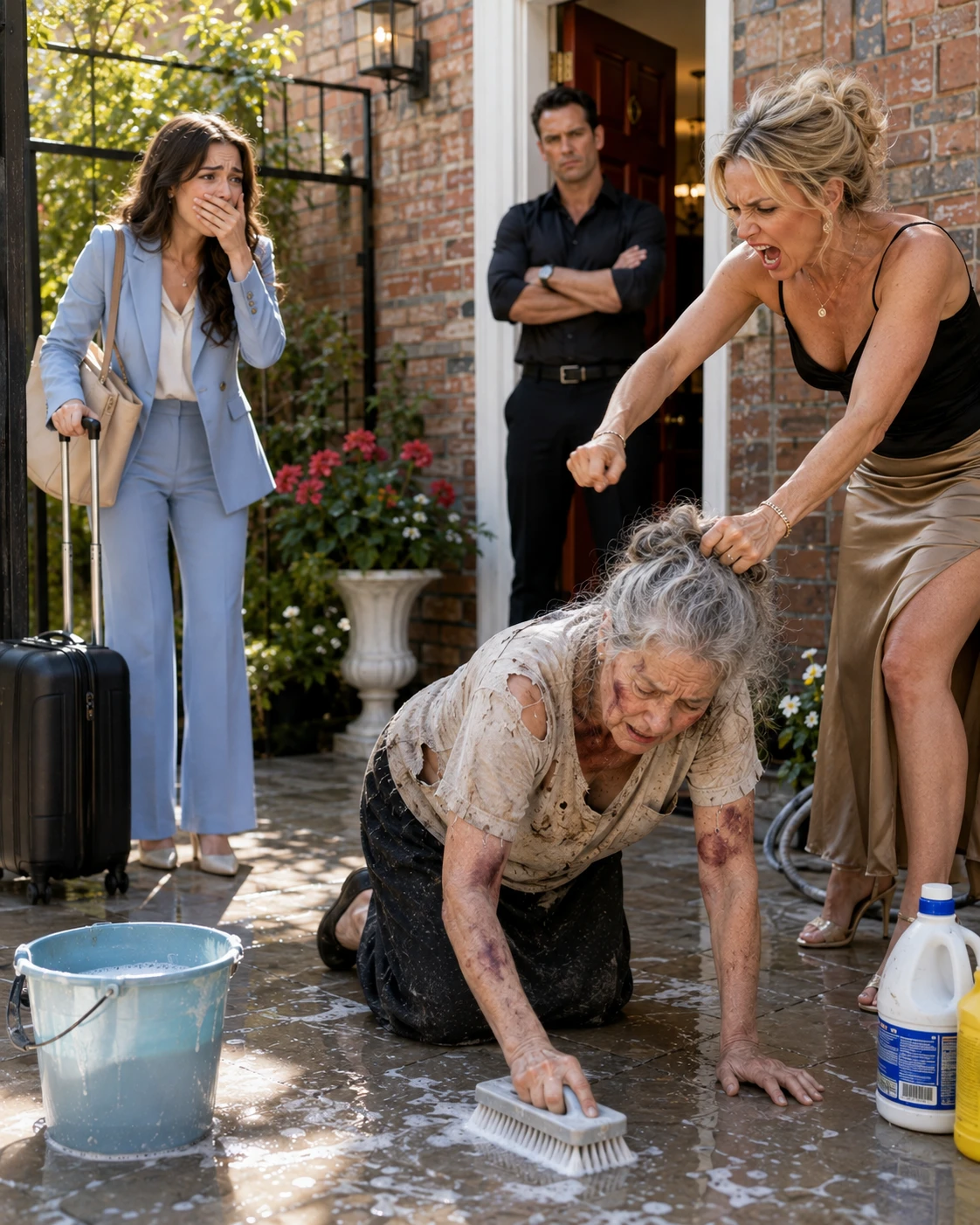
She slapped my 66-year-old mother across the face, called her “”the maid,”” and proudly told everyone the house belonged to her. She had no idea I was the real owner—and by the end of that dinner, her perfect little lie would explode in front of every guest.**
When I came home after six years working overseas, I expected to surprise my mother with flowers and a long overdue hug.
Instead, I found her on her hands and knees, scrubbing the backyard patio with swollen fingers while my sister-in-law shouted orders from inside the house.
“”Move faster! The guests will be here in an hour!””
For a second, I thought I had the wrong address.
Then my mother looked up.
She froze.
Her eyes filled with panic instead of joy.
“”You should’ve called first,”” she whispered. “”Please… don’t make a scene.””
That was the moment I knew something was terribly wrong.
I had worked endless night shifts as an ICU nurse, sacrificed birthdays, holidays, and almost every important moment of my own life to buy this beautiful home for my mother after my father passed away. She deserved peace.
Instead, she was living like a prisoner.
My older brother, Derek, and his wife, Melissa, had moved in “”temporarily”” after they ran into financial trouble.
Temporary had somehow turned into two years.
Melissa greeted me with a cold smile.
“”Oh… you’re finally back.””
She looked me up and down before handing me a grocery bag.
“”If you’re going to stand there, at least help your mother.””
Not once did she thank me for buying the house.
Not once did she ask how I had been.
Inside, I noticed something strange.
Family photos of my mother had disappeared.
Melissa’s decorations covered every wall.
Even worse…
My mother’s bedroom was gone.
Melissa’s mother had taken it.
My own mother now slept on a narrow folding bed beside the laundry room.
When I asked why, Mom forced a smile.
“”It’s only temporary.””
But the trembling in her voice told another story.
Later that afternoon, while Melissa prepared for her dinner party, I witnessed something that made my blood boil.
My mother accidentally dropped a serving tray.
The plate shattered.
Without hesitation, Melissa stormed over and slapped her hard across the face.
The entire room fell silent.
“”You useless old woman!”” she screamed.
“”Do you know how expensive that plate was?””
My mother immediately apologized while holding her burning cheek.
“”I… I’m sorry… I’ll clean it up.””
She looked terrified.
Not embarrassed.
Terrified.
As if this had happened many times before.
Derek stood only a few feet away.
He didn’t defend her.
He didn’t even look surprised.
He simply sighed and walked away.
I helped my mother pick up the broken pieces.
That’s when I noticed bruises hidden beneath the sleeve of her sweater.
Old bruises.
New bruises.
Some yellow.
Some deep purple.
My hands started shaking.
“”Mom…””
She quickly pulled her sleeve down.
“”I slipped.””
I looked into her eyes.
She couldn’t even finish the lie.
That evening, while everyone laughed in the dining room, I quietly searched through the house.
What I found made everything even worse.
A chore schedule listed only one name.
My mother’s.
Cooking.
Cleaning.
Laundry.
Bathrooms.
Yard work.
Every single day.
Then I opened the kitchen drawer.
Inside were bank statements showing hundreds of dollars disappearing from her Social Security account every month.
Hidden inside her Bible was something that completely broke my heart.
An application for a tiny government senior apartment.
She had written a note beside it.
“”Maybe they won’t be angry if I leave.””
I closed my eyes.
The house I bought so she could live with dignity had become the place where she was humiliated, abused, and made to believe she no longer belonged.
They thought my mother was powerless.
They thought no one was coming to save her.
They had absolutely no idea who really owned that house.
And they certainly had no idea what was waiting for them after tonight.
PART 2: SHE CALLED MY MOTHER “THE MAID”—BUT THE HOUSE WAS NEVER HERS 3.104 029
My mother’s name was Margaret.
Melissa did not say it with warmth. She said it the way someone might summon an employee.
I folded the application along its existing crease and slipped it back inside the Bible. Then I returned the book to the drawer beneath my mother’s folding bed.
For a moment, I remained beside that narrow bed, staring at the thin blanket tucked with military precision around the edges. Beside the pillow sat a plastic cup of water, a bottle of arthritis medicine, and a framed photograph of my father.
That was all my mother had been allowed to keep in the room.
The rest of her life had been packed into three cardboard boxes stacked beside the washing machine.
I heard Melissa call again.
“Margaret!”
This time, irritation sharpened her voice.
I walked into the kitchen before my mother could answer.
“I’ll take the coffee,” I said.
Mom was standing at the sink with her back to me. Her shoulders were hunched, and one hand rested against the counter as though she needed it for balance.
She turned quickly.
“No, sweetheart. I can do it.”
“I know you can.”
I kept my voice gentle.
“But you’re going to sit down.”
Her eyes moved toward the dining room.
“No, I shouldn’t.”
“Why not?”
“The guests—”
“Are not your responsibility.”
Her lips parted, but no words came.
I poured the coffee into the silver pot Melissa had placed beside the stove. My hands were steady now. The shaking had stopped.
That frightened me more than the anger.
In the hospital, I had learned that panic could make a person impulsive, but clarity could make them dangerous in a different way. Clarity made people act.
I placed the coffee pot on a tray.
“Sit in the living room,” I told my mother. “Please.”
She reached for my wrist.
“You don’t understand.”
“Then help me understand.”
“Not tonight.”
“Why?”




