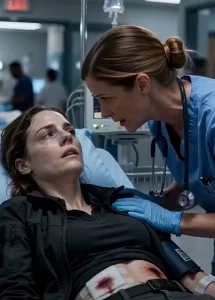
My sister told the ER nurse I was faking it. My mother refused emergency testing because her daughter’s wedding weekend mattered more. And while my monitor slowed toward a flatline, I reached inside my tactical jacket and activated the one device my family never knew I carried.
By midnight, the people arranging white roses on our lawn would be answering questions they could not charm their way around.
But that afternoon, all I wanted was a bed.
I wasn’t supposed to be home. Officially, I was on medical leave. Unofficially, I had come back from a classified assignment with shrapnel damage beneath my ribs and a surgeon’s stern order to rest. I could tell my family I was hurt. I could not tell them where it had happened, who had been with me, or why the man in the next hospital bed had needed a new name before discharge.
Those were separate facts. Later, people would confuse them.
My name was Nora Whitmore. I was thirty-two, an Army captain assigned to a joint recovery task force, and very good at giving clear instructions in rooms where everyone was afraid. I had never learned how to ask my mother for a glass of water without first proving I deserved the inconvenience.
My authorized discharge instructions sat inside my bag. No lifting. No exertion. Seek immediate care for worsening pain, weakness, or bleeding. My follow-up appointment was Monday. A colleague had offered me her guest room until then, but she had two small children and a husband working nights. I had told myself my parents’ house would be quieter.
I checked the address on the dashboard out of habit, though I had known it since childhood. There was something comforting about a place that required no directions. I mistook that familiarity for welcome.
It was remarkable what hope could make a trained observer overlook.
My phone had broken during transport. The replacement was still being configured. I had a basic loaner, a number for the duty desk, and the old habit of turning toward home when I was too tired to think.
I arrived without warning. Catering vans blocked half the curb. Men were raising a white tent across the lawn, and a florist carried branches of white flowers past the fountain my father had installed instead of fixing the upstairs plumbing.
Then I remembered Jessica’s wedding.
I sat in the car and closed my eyes. She had sent the date months earlier. I had said my leave depended on work. Then work had become a night I could not discuss, a flight I barely remembered, and eleven stitches I could feel every time I breathed too deeply.
I should have turned around. For years afterward, I would refuse to turn that simple truth into a charge against myself. I made an unwise choice. Other people still had choices after mine.
Inside, my mother was directing decorators. My father stood near the study, speaking into his phone with the low, pleasant voice he reserved for people who might cost him money. Jessica stood in the living room in a white silk robe, surrounded by bridesmaids who held coffee cups like delicate equipment.
She looked up.
“Oh. You’re here.”
That was my welcome home.
“For a couple of nights,” I said. “If the guest room’s free.”
My mother turned, took in my boots, canvas bag, and faded tactical jacket, and gave a tiny sigh.
“You could have called.”
“I know. My phone broke.”
“There’s always something with your phones.”
Her name was Caroline. Strangers described her as gracious. They usually met her in rooms she had chosen, under lighting she had approved, before anyone asked her to surrender an advantage.
Jessica held out a box.
“Since you’re here. Upstairs. Second room on the left. Be careful. Those are crystal.”
“Jess, I can’t lift much. I had a procedure.”
“It’s one box, Nora.”
One box had been the beginning of most jobs in that house. One box became a closet. One favor became a weekend. A refusal became a discussion about how little I understood family.
I took the box.
It was not heavy. That made me foolishly confident. My side pulled on the first flight, but I set the crystal on a table and stopped beside a window until the room settled. Below me, workers spread a runner across the grass. Someone laughed. A sound system tested three bright notes.
For an instant I imagined coming downstairs and saying plainly that I needed help. I imagined my mother looking up, really looking, and putting her hand on my face the way she had when I was small and feverish.
Then a bridesmaid called my name.
There were shoes next. Then gifts. Then another carton of accessories Jessica did not trust the staff to carry. Between trips I tried to find my father alone. Each time, he raised one finger without looking at me.
Wait.
That finger was the whole architecture of my childhood.
Between the second and third trips, Elena offered me a chair near the pantry. I said I was fine because my mother was within hearing distance. Elena looked at my hand braced against the wall and did not believe me, but a server called her away before she could insist.
Years of military briefings had taught me to give accurate information when lives depended on it. At home, accuracy still felt rude. I understood the contradiction even then. Understanding did not undo it. I kept waiting for permission to stop, as though pain required a witness before I could treat it as real.
By the third trip, the stitches beneath my jacket felt as though they were pulling apart. I stopped beside the stairs and pressed a hand against my side. When I pulled it away, there was blood on my fingers.
Not a great deal. Enough.
Jessica saw it before I could hide it.
“Can you not be dramatic today?”




