The chandelier above Table Nine did not swing, yet its crystal teardrops shivered whenever the busboys rolled their heavy silver trolleys across the tiled floor of *La Estancia Real*. It was an old-money restaurant in the heart of Guadalajara’s Providencia district, a place where the air tasted of roasted picanha, expensive oak-aged tequila, and the quiet, suffocating perfume of women who had never worked a twelve-hour shift in their lives.
My mother-in-law, Beatriz, had chosen it. Naturally.
“A girl only turns two once, Valeria,” she had declared four weeks ago over Sunday breakfast, cutting her papaya into translucent, millimeter-thin slices. “A child of the Morales name does not celebrate in a park with cheap clown balloons and store-bought sponge cake. It reflects upon us. It reflects upon Mateo.”
Mateo had nodded into his coffee cup back then, his dark eyes never leaving the rim. *Of course, Mom. Whatever you think is best.*
Now, at 7:14 p.m., the banquet room smelled of spent tallow from forty blown-out decorative votives and the cloying vanilla frosting of a four-tiered cake that cost more than my first monthly paycheck as a pediatric trauma nurse at the Civil Hospital. Forty guests. Mateo’s cousins, his second uncles who owned auto-part franchises across Jalisco, his mother’s bridge circle, and a handful of colleagues from Mateo’s commercial real estate firm who looked like they were attending an audit rather than a toddler’s birthday.
Sofía sat in the high-backed upholstered chair between Mateo and me.
She was exhausted. Her little eyelids were rimmed with pink. She had missed her afternoon nap because Beatriz had insisted on a midday dress-fitting—an absurd silk creation with stiff tulle underskirts that scratched my daughter’s porcelain thighs until red wheals rose on her skin. I had swapped the dress for a soft cotton smock before dinner, an act Beatriz had received with the tight, pale smile she usually reserved for stray dogs that wandered too close to her driveway.
*Tap.*
It was a gentle sound.
*Tap. Tap.*
Sofía had picked up a heavy silver dessert spoon. Her little fingers were sticky with dried apple juice. She was rhythmically tapping the handle against the white porcelain rim of her untouched fruit bowl.
*Tap. Tap. Tap.*
She wasn’t screaming. She wasn’t throwing a tantrum. She was two years old, running on four hours of broken sleep, seeking a simple rhythm to anchor herself against the wall of adult chatter, the clinking wine glasses, and the mariachi quartet Beatriz had hired to perform in the adjoining courtyard.
“Valeria,” Beatriz spoke across the table. Her voice was like shears cutting through dry linen. “Control her.”
“She’s just tired, Beatriz,” I said softly, reaching out to gently curl my hand over Sofía’s wrist. “The music is loud. We’ve been here since two.”
“A child who is permitted to make noise at the table becomes an adult who cannot keep a husband,” Beatriz said, not even looking at me. She addressed the remark toward Mateo’s godmother, who gave an obliging, brittle chuckle.
Mateo nudged my foot beneath the table. The sole of his Italian leather loafer pressed against the toe of my sensible flats.
“Vale,” he murmured, his breath warm against my ear, carrying the sharp tang of his third scotch. “Please. Not today. Just take the spoon.”
*Not today.*
I had lived inside the borders of that sentence for four years. *Not today, Vale, Mom’s blood pressure is high.* *Not today, Vale, she’s sensitive about the family anniversary.* *Not today, Vale, let her choose the nursery color.*
I reached for the spoon. “Sofi, mi amor, give Mami the spoon, okay? Let’s draw on the napkin.”
Before Sofía’s fingers could loosen, Beatriz reached across the linen. Her hand was fast—strikingly fast for a woman of sixty-two with arthritis in her knuckles. She snatched the silver spoon from Sofía’s grip with such force that the spoon’s edge scraped across my daughter’s thumb.
Sofía gasped. Her small lower lip trembled. She reached her empty hands into the air, her fingers opening and closing, seeking the object that had been ripped away.
“Mine,” Sofía whimpered. “Mami, mine.”
“Quiet,” Beatriz hissed. She didn’t raise her voice; she compressed it, sharpening it into a barb. She leaned forward, her heavy gold bangles clinking against the mahogany table. “You are an ill-mannered, insolent little thing. Just like your mother’s people.”
“Beatriz,” I said, my voice dropping an octave, the cold, clinical calm of the emergency room settling instantly into my veins. “She is two years old. Give me that spoon and do not speak to my daughter like that.”
What happened next did not happen in the shadows.
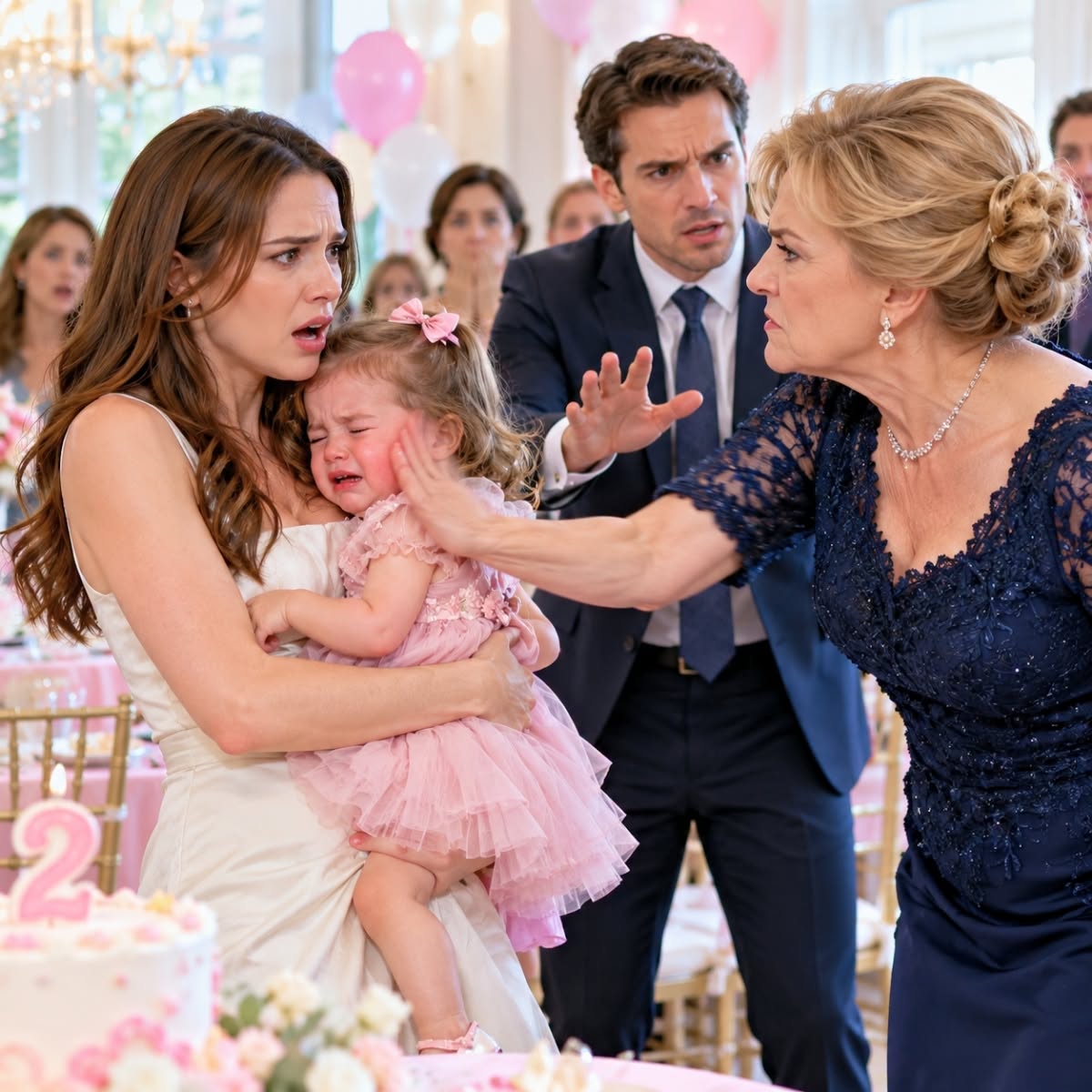
Beatriz reached down. Beneath the overhang of the damask tablecloth, her manicured fingers locked onto Sofía’s tiny left wrist, twisting it inward until the child let out a sharp, choked yelp. Sofía tried to yank her arm back, her tiny shoulders twisting in panic.
Then, with an open palm and the full leverage of her shoulder, Beatriz brought her right hand across the table and struck Sofía across the face.
*Smack.*
The sound was not dull. It was the wet, sharp crack of skin meeting flesh, ringing out over the hum of forty conversations like a dropped plate shattering on marble.
The table went dead.
Uncle Hector stopped his fork halfway to his mouth. Daniela, Mateo’s cousin sitting near the gift table, froze with her smartphone poised in midair. Even the waiter refilling water glasses three feet away went rigid, his silver pitcher hovering over an empty tumbler.
Sofía didn’t cry. Not immediately.
Trauma at two years old does not register as anger or protest; it registers as sensory betrayal. Her wide, hazel eyes—so much like my father’s—dilated until the black swallowed the irises. Her left cheek turned a ghostly white where the fingers had landed, before the broken capillaries flooded the skin with a violent, blotchy crimson. She stared at her grandmother, her tiny mouth open in an unformed oval of sheer incomprehension.




