THE DAY THEY MADE A TERRIBLE MISTAKE
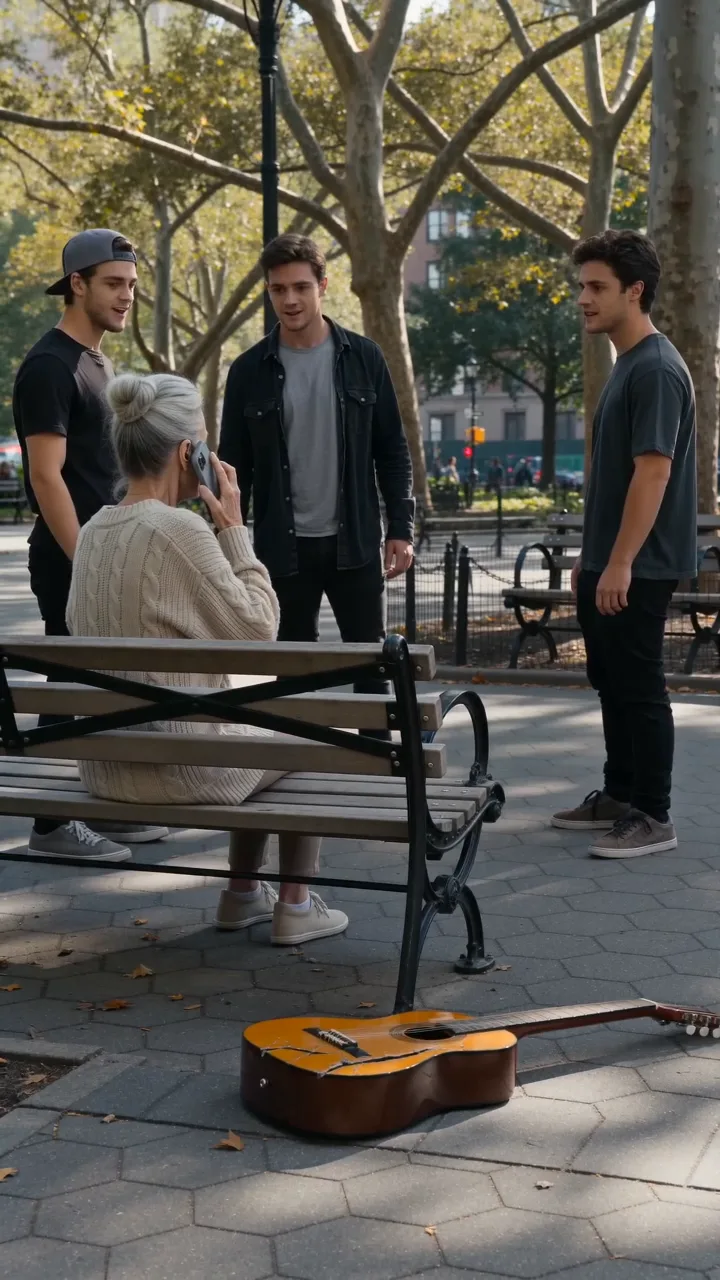
The afternoon sun shone over a peaceful public park in an American neighborhood. Tall trees stretched their branches over the walking paths, families passed by with their children, and a few older residents sat on benches enjoying the fresh air.
It was the kind of ordinary afternoon when nobody expected anything terrible to happen.
On a wooden bench near a brick walkway sat an elderly woman with silver hair. Her face showed the lines of a long life, and her hands rested gently around an old acoustic guitar.
The guitar was more than an instrument.
It was something she had cared for over the years, something that had accompanied her through quiet evenings, family gatherings, and memories she could never replace. The wood had grown worn with use, and the strings had lost some of their shine, but the instrument remained precious to her.
She held it carefully, adjusting it across her lap as she looked down at the strings.
For a moment, the park was peaceful.
Then a young man wearing a black T-shirt and a backward baseball cap approached her.
He did not greet her.
He did not ask permission to sit down.
He walked straight toward the bench, looked at the guitar, and reached for it.
The elderly woman barely had time to react before he snatched the instrument from her hands.
Her eyes widened.
She instinctively reached toward him, confused by what was happening. The young man ignored her reaction and stepped away from the bench, holding the guitar as though it were nothing more than a cheap object he could do whatever he wanted with.
Two of his friends soon approached.
They watched with amused expressions, apparently expecting something entertaining to happen.
The elderly woman struggled to understand why they were targeting her.
She had done nothing to provoke them. She had not insulted them, threatened them, or interfered with their afternoon.
She was simply sitting in a park with her guitar.
But the young man had already decided to turn her peaceful afternoon into a cruel spectacle.
He lifted the instrument.
Then, before she could stop him, he slammed it against the brick pavement.
The sound of breaking wood cut through the park.
The guitar struck the ground with brutal force. Its body splintered, pieces of wood scattered across the bricks, and the strings snapped loose.
The elderly woman froze.
For a second, she could only stare at the broken instrument lying on the ground.
Her mouth opened slightly, but no words came out.
The guitar that had rested safely in her hands moments earlier was now destroyed.
The young man laughed.
His two friends joined him, clapping and celebrating as though they had just performed some hilarious prank. Their laughter carried across the walkway, drawing the attention of people nearby.
But the elderly woman did not see anything funny.
She looked at the broken wood, then at the young man who had destroyed it. Her hands trembled as she tried to process what had happened.
The guitar was gone.
And the three young men were laughing at her pain.
She slowly leaned forward, as though she might be able to gather the broken pieces and somehow make sense of what remained.
But the damage was obvious.
The instrument could not simply be picked up and played again.
The young man stood over her with a mocking grin. His friends moved closer, surrounding the bench and making it difficult for her to feel that she had any space left to herself.
The old woman looked from one face to another.
Her expression changed from disbelief to fear.
She was alone, elderly, and visibly shaken. The young men were younger, louder, and confident in their numbers.
They seemed to believe that her vulnerability gave them permission to do whatever they wanted.
One of them laughed again.
Another moved closer.
The woman instinctively pulled back against the bench.
She had spent years living her life, building relationships, and carrying memories that mattered to her. Yet now she found herself facing three strangers who seemed determined to make her feel powerless.
The park no longer felt peaceful.
Every laugh sounded threatening.
Every step toward her made her more anxious.
She needed help.
Her trembling hand reached into her pocket and pulled out her phone.
The young man in the black shirt noticed immediately.
His grin widened as he watched her bring the phone up.
He seemed more interested in mocking her than in understanding how frightened she had become.
The woman tried to steady her fingers. Her eyes were filled with worry, and her breathing became uneven as she searched for the person she trusted most.
Then she made the call.
Her voice came out trembling, urgent, and full of fear.
“Son, come to me.”
The words were short, but they carried the desperation of a mother who had reached the point where she could no longer protect herself from the people standing around her.
She did not ask for money.
She did not demand revenge.
She asked her son to come.
Somewhere else, in a bright, modern living room, a middle-aged man sat on a sofa with two younger men nearby. The room was comfortable and orderly, a world away from the frightening scene unfolding in the park.
When the phone rang, the man’s attention immediately shifted.
He listened.
His expression tightened.
The two young men sitting beside him noticed the sudden change in his face. Whatever he had heard was serious enough to erase the relaxed atmosphere in the room.
He rose from the sofa, already focused on the call.
There was no lengthy discussion.
No hesitation.
He answered his mother with a firm, reassuring voice.
“Okay Mom, I’m coming.”
The response was immediate.
He did not need his mother to explain every detail before deciding that he had to get to her. Her frightened voice was enough to tell him that something was wrong.




