Chapter 1: Before the Problem
A white orchid that had barely opened was the only thing Alma didn’t want to forget that day. No one would have given that scene a second glance. Alma had no reason to, either; she was there for a specific reason and wanted to resolve it quietly. She had come to a flower exhibition inside a botanical garden in Cuernavaca to photograph an orchid she had first cultivated forty years earlier.
The place was in the midst of its routine. Visitors lowered their voices without being asked and lingered in front of each piece a few seconds longer than usual. Alma chose the easiest path: asking when she didn’t know and waiting when she had to. Diego, who was nearby, saw it from the start.
Those who dealt with Alma regularly knew that she never used her family as a calling card. She found it simpler to handle paperwork based on who she was, without forcing anyone to look at surnames or connections. For Alma, this way of life wasn’t a lesson; it was simply less tiring.
There was, however, one detail that might catch the eye of an observant person: the gardeners approached to greet her, and a discreet label on the collection included her surname. Alma preferred not to explain the connection behind that phrase. She continued with the same composure.
Lorena entered the scene knowing nothing of what had come before. She only saw Alma occupying a space she wanted to use and decided that was enough to make her impatient. First, there was a sigh. Then an insistent look. After that, a step too close.
There wasn’t a fight yet, just a minor annoyance that could have been resolved with an explanation. But a visitor wanted to clear the background for a photo shoot and treated the woman in the wheelchair like she was part of the furniture. The change was clear: from a minor inconvenience to outright contempt.
Chapter 2: The tone changed first
“There is an order,” Alma explained. “I’m not deciding anything against you.”
Lorena let out a short laugh.
“I didn’t ask you to give me orders,” Lorena replied.
The question was less about finding out the answer than about making it clear that, in her mind, Alma had no right to set limits.
Lorena stopped arguing about the original issue and started arguing about who deserved to be there. The word “trash” crossed a line that those present immediately recognized. Alma took a deep breath and held her gaze.
“She doesn’t know anything about me,” Alma said.
“I don’t need to know,” Lorena replied.
Alma had an easy way out: to say that the woman had founded the garden along with other botanists and continued to visit it unannounced. She chose not to. She repeated the original request and left the surname out of the conversation.
The discussion was a rollercoaster of emotions: silence, discomfort, phones put away, and people who finally decided to intervene. One person walked away. Another stood frozen. Diego decided to approach and said he had heard the insult. That small intervention changed something: Alma was no longer alone in the face of Lorena’s version of events.
There were normal ways to resolve the matter, but Lorena seemed interested in something else: making it clear who she thought should step aside.
Someone mentioned in a low voice that the gardeners were approaching to greet her, and a discreet label on the collection included her last name. Diego connected the dots with what was happening and decided to alert the responsible staff.
Chapter 3: The witnesses stopped watching
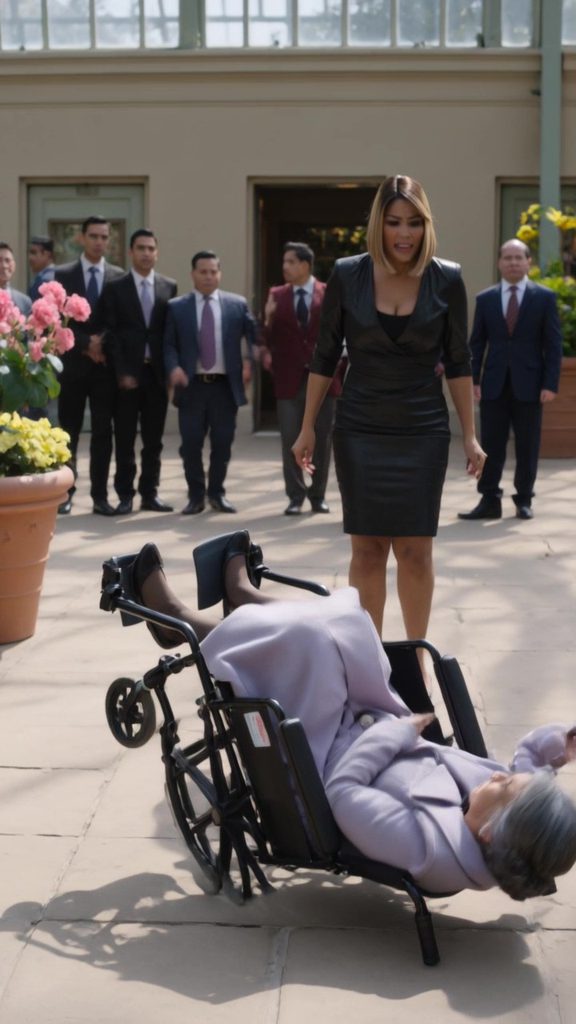
The most serious moment lasted only seconds: Lorena reacted abruptly and Alma lost her balance. From then on, the place responded as it should have before.
For the first few minutes, those around were overly confident that no intervention would be necessary. Alma’s fall shattered that illusion. Diego asked someone to alert security, and another person offered to pinpoint the exact time so they could review the security camera footage.
Lorena’s confidence turned to caution. She began to talk about stress and an involuntary reaction. Alma asked them to wait for the cameras and mentioned that someone close to her was already on their way for a different matter.
“There are cameras,” Diego said.
Lorena looked up at the ceiling for the first time. It didn’t sound like a warning, but rather a request to review what had happened with facts, not impressions. There was something more useful than discussing memories: schedules, employees present, and records that established the sequence of events.
A white orchid that had barely opened was still nearby. Alma looked at it for a few seconds and remembered the original plan: to take a photograph of an orchid she had first cultivated forty years ago. Everything else seemed out of proportion.
Then a message came in to the staff. Hector was either arriving or would be just minutes away. No one had called Hector to come and sort everything out. His schedule already took him there, which is why he was nearby. The fact that the gardeners came to greet him and a discreet label on the collection, bearing his last name, explained why some employees were waiting for him.
Chapter 4: A surname doesn’t change the facts
Hector recognized Alma from afar and quickened his pace, but he didn’t turn his concern into an order. He took care of Alma first. When he confirmed she could continue, he asked that the note-taking not be interrupted. Hector’s recognition of Alma changed the atmosphere, but not the facts the staff had just recorded.
Finally, what some had suspected was confirmed: the woman had founded the garden along with other botanists and continued to visit it unannounced. Lorena remained silent and looked at Alma with a caution she hadn’t shown before.
“It was a misunderstanding,” Lorena insisted.
Alma shook her head.




