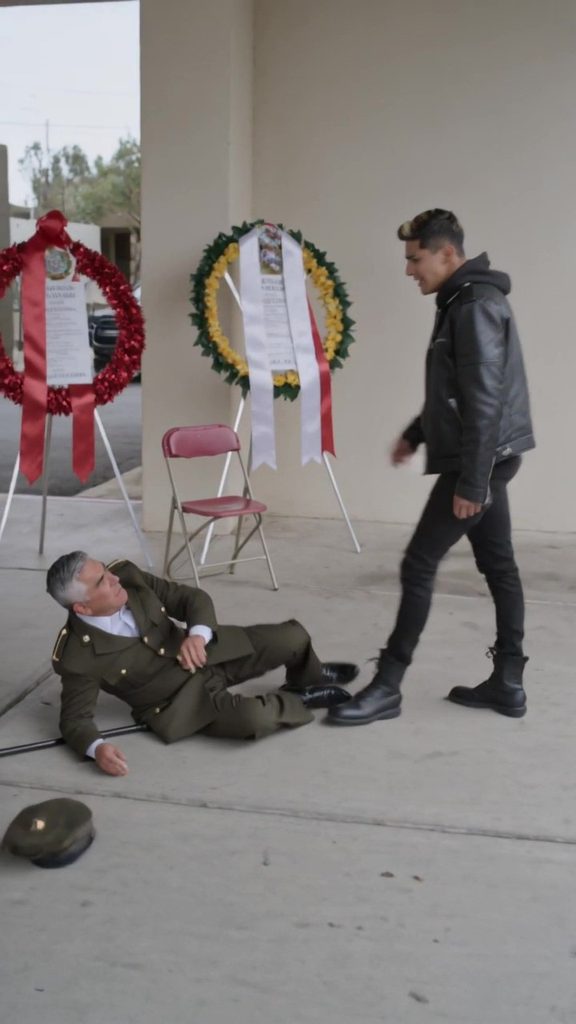
Chapter 1: After the Crowns and the Flags
The afternoon seemed designed to unfold without incident. At the entrance of a community center, after a veterans’ memorial ceremony, everyone appeared to occupy a perfectly defined place. Some arrived in a hurry, others were attentive to detail, and still others were simply trying to do their jobs without drawing attention to themselves. Among them was Don Aurelio Campos, a sixty-eight-year-old veteran. Don Aurelio Campos hadn’t come to be the center of attention. His role was simple: attending the ceremony and a former member of the armed forces. He carried it out with the focus of someone who knows that a small task can affect the work of many others.
Those who dealt with Don Aurelio Campos frequently knew that he rarely argued. He preferred to ask questions before acting, follow instructions, and leave things better than he found them. This way of working wasn’t always apparent to those who only arrived for a few minutes. However, precisely because of this, he knew routines, access points, schedules, and minor risks that others overlooked. That day, that knowledge would prove important, though at first no one could have imagined it.
There was also Damián Cruz, a twenty-four-year-old who despised the ceremony. His focus was on making everything appear perfect and ensuring that nothing disrupted the image he wanted to project. The pressure of the day had made him impatient. Instead of asking what was happening when something changed in front of him, he decided to interpret the scene based on appearances. Damián mocked Aurelio and treated him with contempt when the veteran spoke about his service. What could have been resolved with a simple question thus became an immediate judgment.
Several people sensed the tension, though at first no one intervened. Don Aurelio Campos tried to calmly explain what had happened, without raising his voice or responding to the provocation. His version was simple and straightforward, but Damián Cruz had already decided he didn’t need to hear it. That was the real beginning of the problem: not the physical incident, but the certainty with which someone believed they knew the whole story without bothering to verify it.
Chapter 2: An Out-of-Place Joke
Tensions escalated when Damián Cruz turned a minor annoyance into a personal attack. He stopped talking about what had happened and started questioning who he thought Don Aurelio Campos was, how much his work was worth, and whether or not he deserved to be there. Don Aurelio Campos maintained his dignity. He didn’t try to impress anyone or boast about his connections. He simply repeated the facts and asked them to review the necessary information before drawing conclusions.
For those observing, the difference between the two behaviors began to become clear. One person demanded verification; the other demanded obedience. Damián Cruz seemed convinced that authority was demonstrated by imposing silence. But each unjust statement prompted more witnesses to recall details: who had arrived first, what had happened moments before, and what instructions had been given.
The matter was more important than it seemed because respect at a community event and the safety of an elderly person were at stake. A hasty decision could affect several people and have consequences greater than the initial incident. Don Aurelio Campos knew this, which is why he insisted on not acting impulsively. Even amidst the humiliation, his main concern wasn’t winning an argument, but preventing a lie from becoming the official version.
The most awkward moment came when Damián Cruz tried to end the conversation as if his opinion were sufficient. Some of those present took a step back. Others began looking toward entrances, offices, or those in charge, waiting for someone in authority to appear. No one yet knew that General Roberto Montalvo, a retired high-ranking officer and Aurelio’s former colleague, was about to enter the scene and that he possessed information capable of completely changing the interpretation of what had happened.
Chapter 3: The Convoy That Stopped at the Entrance
The arrival of General Roberto Montalvo, a retired high-ranking officer and former colleague of Aurelio’s, altered the atmosphere without any shouting. Before asking about responsibility, he made sure Don Aurelio Campos was alright and listened to his full account. That detail was crucial. He didn’t start by protecting a reputation or salvaging a negotiation; he started by attending to the person who had been treated unfairly.
Then he asked for something simple: facts. No rumors, assumptions, or hierarchies. It was then revealed that Roberto recognized Aurelio and publicly recalled his career and sacrifices. The explanation fit the timeline, what the witnesses had observed, and the available records. Each piece of information narrowed the scope for the initial accusation.
Damián Cruz tried to justify his actions by saying he only wanted to avoid problems, protect the area, or maintain order. General Roberto Montalvo responded that maintaining order did not mean humiliating people or determining guilt before reviewing the information. Authority, he calmly explained, is only meaningful when it serves to resolve issues and protect, not when it is used to impose a version of events through fear or for appearances’ sake.
With the new information, several people who had previously remained silent felt emboldened to speak. They confirmed schedules, positions, and small details. The scene shifted from revolving around Damián Cruz’s status to revolving around verifiable facts. The surprise wasn’t in discovering that Don Aurelio Campos knew someone important, but in verifying that his version had been consistent from the very beginning.
Chapter 4: The name the general did remember
Once the situation was under control, General Roberto Montalvo requested a review of the entire process. He didn’t want the episode to end with a simple, impromptu apology. If someone had been treated that way in front of witnesses, it was necessary to determine whether it was an exception or standard operating procedure. That question changed everyone’s tone.




