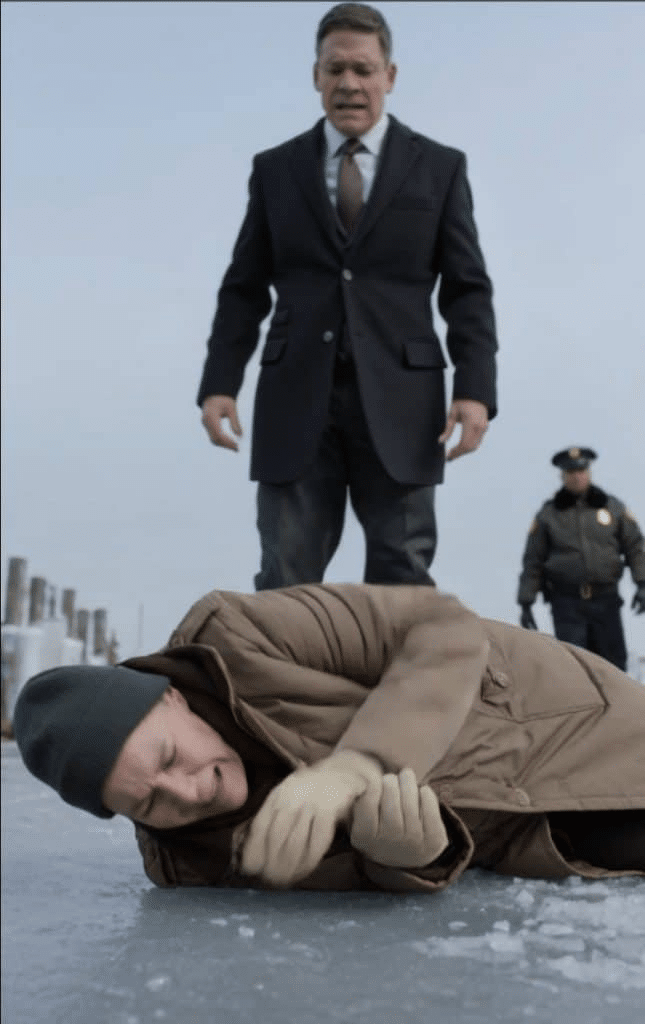
Act I
The ice cart wheel rolled over the front of his leather shoe before the old woman could stop it.
It was light.
Barely more than a bump.
The kind of accident that happens on an icy dock where everyone is fighting the wind, the cold, and the frozen ground beneath their boots.
But the man looked down at his imported leather as if the whole harbor had insulted him.
The winter fishing dock was slick with ice and saltwater. Fishing boats rocked against their lines. Crates were stacked along the pier, ice carts creaked over frozen boards, and workers moved slowly because one wrong step could send a body hard onto the ground.
The old woman pushing the cart was seventy-one.
She wore a thick coat and gloves, her shoulders bent from years of hauling ice for fishermen who needed to get boats unloaded before the weather turned worse.
Her breath fogged in the cold.
Her hands tightened on the cart handle.
“I’m sorry,” she said quietly. “It slipped.”
The man in front of her wore an expensive coat and polished shoes that looked ridiculous on a frozen dock. He was a seafood restaurant owner, the kind of man who sold the harbor’s work at elegant tables but seemed disgusted by the people who made those tables possible.
He stared at his shoe.
Then at her.
“Trash. You stepped on imported leather.”
The workers around them slowed.
A fisherman holding a crate looked over.
Someone near a boat stopped tying a rope.
The old woman did not argue.
She only tried to pull the cart back, careful not to make the ice shift beneath her feet.
But the man had already decided the accident was not an accident.
To him, it was proof.
Proof that workers like her should stay invisible.
Proof that labor should appear as finished plates and profit, not as tired hands pushing ice through freezing wind.
His face twisted with contempt.
And the dock, already dangerous from the cold, became dangerous for another reason.
Act II
He charged forward and struck her with violent force.
The impact knocked the old woman off her feet and down onto the slick, frozen dock.
The ice cart jolted.
A few chunks slid out and scattered across the boards.
Her knee hit the icy surface, leaving a small light trace of blood. It was brief, non-gory, and quickly softened by slush, but everyone nearby saw the fall.
The old woman stayed down for a second, breathing through the pain.
Not crying.
Not begging.
Just trying to steady herself on ground that had betrayed her once and a man who had chosen to betray basic decency.
The restaurant owner stood over her, fury still burning in his face.
“Trash. You stepped on imported leather.”
The words sounded colder the second time.
Because now she was on the dock.
Because now the ice had spilled around her.
Because now the shoe he worshiped seemed smaller than the woman he had hurt.
A young dock worker took one step forward, then stopped when another worker grabbed his sleeve.
Not fear.
Shock.
The old woman tried to turn onto her side.
Her gloved hand scraped against the frozen dock as she reached toward the cart handle.
Even hurt, her instinct was to finish the job.
To move the ice.
To keep the walkway clear.
To not become a burden to people already working against the cold.
The man stepped closer.
Two heavy follow-up kicks landed while she was still down, one toward her back and one toward her rib area. The scene remained wide and non-gory, but the cruelty was unmistakable.
The dock went silent except for the wind and the slap of water against the boats.
Then the man leaned over her.
“People like you should stay below the dock.”
At the far end of the harbor, a group of men in dark coats appeared beside port management.
And the silence changed.
Act III
They came down the dock with purpose.
Port management first.
Dock security beside them.
And in the center, a powerful man in a long black coat, walking straight through the cold as if the wind had no authority over him.
He was fifty-seven, composed, and watched by everyone before he spoke a single word.
The restaurant owner turned when he noticed the workers’ faces.
That was the first thing that unsettled him.
Not the man himself.
The reaction.
Fishermen stopped moving.
Dock hands straightened.
Security opened a path without being ordered twice.
Even the port manager, a man everyone knew for barking instructions over engines and wind, went quiet near the man in the black coat.
The inspector walked toward the fallen woman.
He did not look at the restaurant owner first.
He looked at the cart.
At the ice scattered across the dock.
At the woman’s knee.
At the way her hand still gripped the boards as if she could pull herself back into duty before anyone worried about her.
The old woman’s face was tight with pain, but not shame.
That mattered.
The man in the black coat reached her and stepped between her and the restaurant owner.
One controlled movement.
A boundary drawn on ice.
Behind him, port managers and security formed a silent line.
The restaurant owner’s posture changed.
His chest lowered.
His eyes flicked from one official face to another.
A few moments earlier, he had been the loudest person on the dock.
Now he looked like a man hearing the harbor judge him without speaking.
The inspector held his gaze.
No explanation.
No title.
No speech.
Only presence.
And the restaurant owner began to understand that the woman he had called trash was not alone on this dock.
Act IV
“Step away from her.”
The words cut through the wind.
The restaurant owner froze.
The command was not shouted.
It did not need to be.




