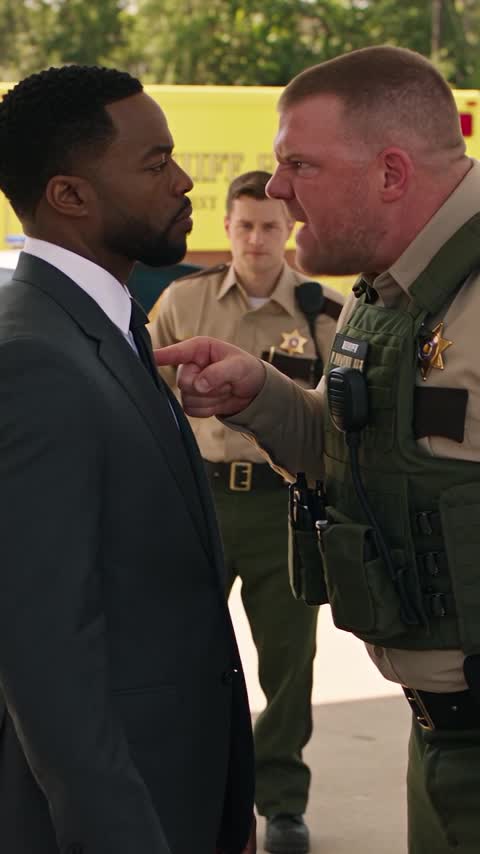
“”Chapter 1: The Weight of the Badge
They tell you at the FBI Academy in Quantico that the gold shield in your pocket carries the full constitutional authority of the United States government. They teach you that when you flip open that credential case and announce your title, the temperature in the room drops, order asserts itself, and the rule of law takes the front seat. But at high noon on an isolated stretch of Highway 82 in Blackwood County, Alabama, the badge did not bring order. It brought bloodlust.
My name is Regginal Jerome Okaffor. I am forty-one years old, a senior Special Agent with the Federal Bureau of Investigation’s Counterintelligence and Public Corruption Division out of the Atlanta Field Office. Over sixteen years on the job, I have stared down seasoned Russian intelligence officers in secure hotel rooms, dismantled transnational weapons syndicates across four states, and negotiated hostage standoffs where one wrong breath meant a casket. Yet nothing in my training prepared me for the feral, unhinged venom radiating from the man standing less than six inches from my face.
Deputy Carson Puit was built like a retired middle-linebacker who had swapped athletic pride for cheap bourbon and unchecked local authority. His thick forearms were covered in sunburned freckles and faded tattoos, his heavy tactical vest groaning against a thick barrel chest. His thumb was not resting politely on his belt buckle. It was wedged against my sternum, driving the hard tip of his blunt forefinger right over the knot of my silk tie, pressing hard enough to bruise the bone beneath my tailored charcoal suit.
“I am going to say this exactly once more, boy,” Puit snarled, his breath smelling of bitter black coffee and wintergreen dip. “I do not care about your little federal ID. I do not care about Washington, D.C. You are sitting in the dirt of Blackwood County, and around here, the only badge that keeps a man breathing is pinned to my chest.”
Behind him, parked haphazardly across the apron of the dusty Exxon travel plaza, his county cruiser sat with its engine idling, doors flung wide, tires chewing the edge of the scrub grass. A second cruiser was parked alongside my rented black Dodge Charger, and twenty yards to the rear, a yellow-and-white county paramedic rig sat near the diesel islands, its engine humming while an EMT in a dark blue uniform watched our standoff with wide, terrified eyes.
“Deputy Puit,” I said, keeping my voice dead level, my diaphragm steady, my chin held at a precise angle that gave him nothing to feed on. “You are currently obstructing a federal agent operating under a Department of Justice warrant. My credential card is in my left breast pocket, and my credentials were authenticated the moment I crossed the county line through regional dispatch. If you do not remove your hand from my chest immediately, I will charge you under Title 18, Section 111 of the United States Code with assaulting a federal officer.”
Puit laughed. It was a wet, barking sound that rattled in his throat, carrying pure theatrical malice designed to intimidate whoever happened to be looking.
“Title eighteen?” Puit echoed, leaning in until his stubble practically scraped my jawline. He twisted his finger into my lapel, his face turning an angry shade of beet red. “You hear this, Earl? The city boy wants to lecture me on federal statutes. He thinks because he wears an Italian suit and drives an agency fleet car, he gets to roll into my town and start sniffing around the railyard without kissing Sheriff Hollister’s ring first.
That single sentence told me everything I needed to know.
Until thirty seconds ago, I hadn’t been entirely certain whether Carson Puit was simply a racist, power-tripping county deputy eager to harass a Black man in a three-thousand-dollar suit, or if he was a compromised player in the covert logistics pipeline I had been tracking for nine months. Now, the mask was entirely off.
The operation was codenamed Iron Siphon. For nearly a year, high-grade defense avionics, military drone guidance subassemblies, and specialized telemetry chips manufactured by a defense contractor in Huntsville had been vanishing from sealed freight cars during overnight layovers along the central Alabama rail corridor. The thefts were surgically precise. No manifests were altered on the main servers; no container seals were broken with pry bars. Whoever was skimming the hardware had inside access, master electronic overrides, and total immunity from local patrol units.
Three days ago, an intercepted encrypted dispatch indicated that a primary shipment—four crate-loads of restricted radar transceiver boards bound for an aerospace hub in Florida—had been diverted to an abandoned cotton gin two miles off Highway 82 in Blackwood County. The local sheriff, Vance Hollister, had run this jurisdiction like a private feudal estate for twenty-two years. My orders were simple: establish discreet surveillance, log license plates, and wait for the regional FBI tactical team out of Birmingham to coordinate the simultaneous takedown.
I had pulled into this fuel plaza solely to top off my tank and grab a bottle of water before tucking my vehicle into a deer blind off the secondary access road. I had not engaged my emergency lights. I had not sped. I had simply existed in a county where Sheriff Hollister’s handpicked thugs treated every unfamiliar vehicle as a hostile scout.
When Puit’s cruiser had whipped into the parking lot, cutting across three empty parking spaces to pin my front bumper, I had anticipated a roadside inquiry. I had prepared myself for the usual passive-aggressive posturing that rural deputies often direct toward federal agents trespassing on their turf.
I had not anticipated that Carson Puit was directly on the payroll of the syndicate stealing the hardware.
“You’re making a catastrophic mistake, Deputy,” I said, keeping my posture entirely neutral, my hands resting loosely at my sides in the universal defensive posture taught to federal operatives. Every instinct screamed at me to step back, establish distance, and draw my Glock 19 from its concealment holster beneath my jacket. But out here, with two armed deputies and zero backup within forty miles, the first man to clear leather would dictate whether I walked away or was zipped into a canvas bag.
“The only mistake made today was you renting a car with Georgia plates and thinking this badge would scare me,” Puit whispered. He didn’t drop his hand. Instead, his left hand shot out and clamped onto the collar of my shirt, his knuckles digging hard into my throat, cutting off half my air as he shoved me backward two paces until the small of my back slammed hard against the hot metal quarter panel of my Dodge.
“Carson, stop!” Gant shouted, taking two hurried steps forward. “There are people watching, look at the damn ambulance crew!”
“I told you to shut up!” Puit roared, his eyes bulging as he closed the distance again, bringing his face inches from mine. “Nobody saw anything except a suspicious subject reaching inside his jacket during a lawful investigatory stop. Ain’t that right, Agent Okaffor? You reached for your waistband, didn’t you?”
The terrifying reality of the moment washed over me with icy clarity.
May you like
This was not an arrest. This was an engineered execution.
Puit didn’t intend to book me at the county jail. He didn’t intend to let me sit in an interrogation room where telephone calls to the United States Attorney’s Office would dismantle his entire department by nightfall. If I went into the ground out here in the pine woods, my disappearance would be written off as an unsolved missing-persons case along a drug corridor. My car would be stripped, crushed at the local salvage yard, and my credentials buried beneath six feet of Alabama clay.




