COACH MEREDITH CRUSHED THE SCHOLARSHIP GIRL’S MEAL UNDER HER BOOT IN A PACKED HALLWAY AND LAUGHED — THEN DISTANT ROTORS SHOOK THE GLASS AND HER SMUG SMILE VANISHED.
The vibration didn’t stop with the glass.
It traveled straight through the reinforced foundation of Westbridge High, rattling the brass plaques in the display cases and buzzing in our teeth.
Coach Meredith kept her foot planted on the split plastic lid of my lunch container, but her sweet smile hitched at the corner.
“Someone tell grounds maintenance to turn off whatever mower they’re testing before the track team steps outside,” she called out, keeping her voice light and melodic.
Nobody moved toward the double exit doors.
The students leaning against the blue lockers weren’t looking at Meredith anymore; they were staring past her shoulder toward the northern windows that looked over the main football field.
The sound outside wasn’t a commercial lawn tractor or an idling district maintenance truck.
It was the heavy, twin-turbine chop of an incoming aircraft descending fast through the cloud cover.
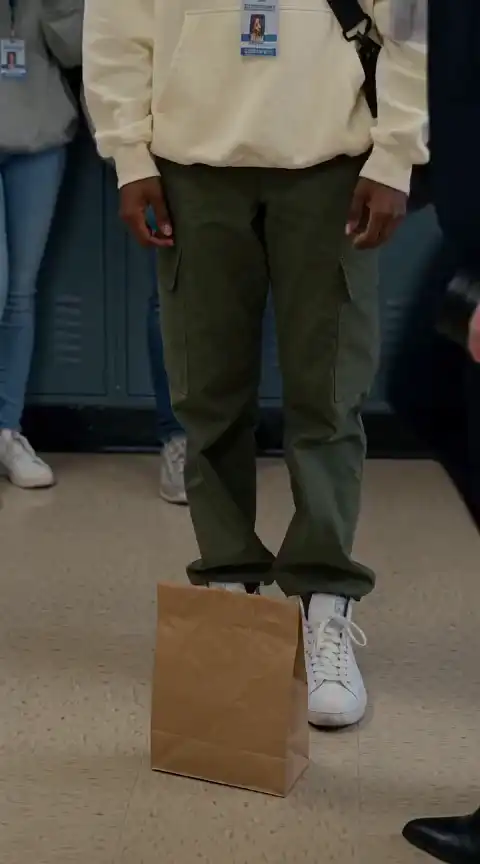
I didn’t move an inch from where I stood in my cream hoodie and olive cargo trousers.
The cold tea Meredith had poured was still soaking through the canvas edge of my right sneaker, pooling around the snapped halves of my district meal card.
“Kendall, pick up this mess before the bell rings,” Meredith commanded, though her tone carried a sudden, brittle edge.
“I didn’t make this mess, Coach,”
I answered softly, my hands resting in the deep front pocket of my hoodie.
“Insolence will get you removed from the regional relay team before four o’clock,” she snapped, though her eyes flickered nervously toward the ceiling.
The acoustic tiles were visibly trembling now.
Dust sifted down in thin, sunlit ribbons near the trophy cabinet that housed thirty years of state track trophies.
Two junior girls who had been giggling behind their lockers suddenly pushed their phones down into their pockets.
“Look outside,” someone muttered from the third row of lockers.
“Look at the fifty-yard line.”
A dozen kids pressed their foreheads against the wired safety glass of the stairwell doors.
Descending directly over the center of the stadium turf was a sleek, midnight-blue twin-engine helicopter marked with bold white numbers and a gleaming medical emblem.
Downwash from the massive main rotor tore across the manicured grass, flattening the yard markers and sending empty paper cups cartwheeling into the bleachers.
The landing skids touched the turf with perfect, practiced ease right over the painted school crest.
Meredith’s jaw tightened as she turned away from me to look through the corridor windows.
“Who authorized an air ambulance drill during fourth period?”
she demanded, scanning the hallway for any administrator.
Mr. Henderson reopened his office door, his face pale and bewildered as he held a phone receiver against his ear.
“Henderson, call the front desk and tell them to clear that bird off our track turf immediately,” Meredith ordered, waving her hand with practiced authority.
“Meredith… the superintendent just called the direct office line,” Henderson stammered, stepping into the corridor without looking at either of us.
“He said nobody approaches that field until the passengers are inside the main building.”
“The superintendent?” Meredith scoffed, recovering her sugary sneer.
“Carl knows we have regionals qualifying heats scheduled in two hours; he wouldn’t allow a municipal stunt on my track.”
“It’s not municipal, Coach,” a boy by the doors whispered.
Outside, the turbine whine began to spool down, dropping from an ear-piercing scream to a steady, deep-throated idle.
The rear cabin door slid back on smooth rails.
Two men in dark charcoal suits stepped down onto the turf first, carrying thin leather cases and scanning the perimeter with cold efficiency.
Then a third man stepped out from the main cabin.
He was tall, with the same deep brown skin as mine, his hair cut clean and sharp, wearing an impeccably tailored dark wool coat over charcoal trousers.
Around his neck hung a laminated silver-and-blue lanyard bearing the distinct seal of the state’s largest medical research consortium.
He didn’t rush.
He didn’t look at the bleachers, the press box, or the school banners.
He walked with a quiet, deliberate stride straight across the crushed turf toward the athletic wing entrance.
The two men in suits flanked him half a step behind, moving like seasoned security personnel who had walked corridors far more dangerous than this one.
Coach Meredith smoothed her blazer again, her fingers catching slightly on the gold lapel pin that marked her ten-year coaching tenure.
“Well, whoever’s father thinks he can land private charters on school property is about to receive a massive bill from the county athletic board,”
she declared loudly to the corridor, projecting that same effortless superiority that had kept the booster club in her pocket for a decade.
None of the students answered her.
The hallway had gone unnaturally quiet, the kind of heavy, suffocating silence that settles over a room before a storm breaks.
The heavy glass doors at the end of the corridor swung open.
The rush of cold autumn air and the smell of aviation fuel rolled down the linoleum hallway, mixing with the sharp scent of spilled iced tea at my feet.
My father walked through the doorway without breaking his cadence.
His dark eyes swept the lockers, the students lined against the walls, and then dropped straight to the floor between Meredith and me.
He saw the shattered container.
He saw the seasoned rice ground into the gray floor wax.
He saw the two halves of the blue district card resting in the puddle next to my white sneaker.
Then he looked up and met my eyes.
I didn’t say a word, and neither did he, but the air in that hallway dropped ten degrees.
Coach Meredith took half a step forward, bringing her professional smile back into position like a shield.
“Excuse me, sir, but unauthorized visitors are required to sign in at the front administration office through gate four,”




