I. Introduction: Fifteen Seconds in Examination Room Four
The fluorescent lights of the hospital examination room cast a sterile, unforgiving glow over a scene that plays out in silent, agonizing tension thousands of times a day across global healthcare systems—though rarely with the cinematic explosive violence that follows in this particular fifteen-second artifact.
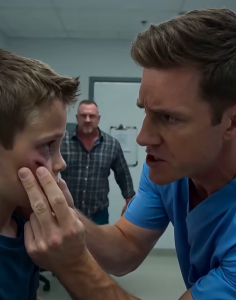
Sitting on the edge of a blue vinyl examination table, draped in white crinkle paper, is a young boy, approximately eight to ten years old. He wears a dark navy T-shirt and gray shorts. His posture is rigid, his shoulders slightly hunched, and his gaze fixed downward in the unmistakable thousand-yard stare of a child conditioned to absorb pain in silence. Beneath his right eye, spreading across the zygomatic arch and maxillofacial tissue, is a deep, violaceous contusion—a bruise dark with coagulated blood beneath the dermis, punctuated by a fresh, crusted laceration along the cheekbone.
Leaning in closely is a male healthcare practitioner clad in bright blue clinical scrubs. His fingers—un-gloved in the immediate urgency of initial visual assessment—gently palpate the periorbital rim and infraorbital margin, checking for crepitus, step-off fractures, or subcutaneous emphysema that might indicate a blowout fracture of the orbital floor. The child barely flinches; his stillness is more alarming to a trained clinician than tears would ever be.
Then, the heavy wooden door swings open, and the atmosphere in the room fractures.
A large, heavyset man with a buzz cut and a goatee, wearing a dark plaid button-down shirt, steps into the threshold. His body language is immediately territorial, his jaw set, his eyes narrowing not with paternal concern for the injured child, but with irritation at the delay. Before the door has even clicked shut behind him, he barks a dismissive command that chills the blood of any mandatory reporter: “Just give him antibiotics. He’s not worth missing a shift over.”
Without looking up from the boy’s bruised face, his fingers still resting protectively against the child’s uninjured temple, the clinician replies in a measured, resolute voice: “This needs further examination. He’s not leaving yet.”
What transpires over the next seven seconds converts a clinical assessment into an acute crime scene. The older man’s face contorts in explosive rage. “We’re going. NOW!” he roars, lunging forward and reaching past the clinician to seize the boy by the arm. In a split-second transition from healer to physical defender, the clinician intercepts the man, shoving him back from the examination table. The aggressor swings wildly; the clinician blocks the incoming blows with practiced martial precision, delivers a series of defensive counter-strikes, and drives a front kick squarely into the man’s chest, sending him crashing backward onto the linoleum floor as a stunned female nurse in patterned scrubs freezes in the open doorway, clipboard clutched to her chest. Breathing heavily, standing like a human shield between the fallen adult and the traumatized child, the clinician delivers the final line of the clip: “You’re not taking him until we finish.”
In the upper left corner of the frame sits a small, translucent square watermark bearing the letters “AI.”
This fifteen-second video is a product of generative artificial intelligence—a hyper-realistic synthetic melodrama engineered for viral consumption on short-form video platforms. Yet to dismiss it merely as algorithmic fiction is to miss why millions of viewers stop scrolling when it appears on their screens. Every element compressed into those fifteen seconds—the telltale presentation of non-accidental pediatric trauma, the behavioral red flags of an abusive guardian, the agonizing ethical and legal crucible of a healthcare worker refusing an unlawful discharge against medical advice, and the terrifying reality of physical violence erupting inside clinical spaces—mirrors urgent, deeply complex crises unfolding in real hospitals every single day.
This comprehensive report deconstructs the anatomy of this fifteen-second artifact across five distinct dimensions: the forensic and clinical pathology of pediatric maxillofacial trauma; the behavioral psychology of abusive guardians in clinical settings; the legal, ethical, and procedural frameworks governing mandatory reporting and emergency medical holds; the epidemic of workplace violence against healthcare professionals; and the socio-technological phenomenon of AI-generated “moral justice” micro-dramas reshaping public perceptions of medicine, law, and heroism.
II. Frame-by-Frame Forensic and Narrative Deconstruction
To understand how a fifteen-second synthetic video achieves such visceral emotional resonance, one must first examine its visual, auditory, and structural architecture. Modern generative video models synthesize human micro-expressions, lighting physics, and kinetic choreography by drawing upon vast datasets of cinema, television medical dramas, and real-world surveillance footage. The resulting sequence operates with the economy of a classic three-act play compressed into 360 frames.
1. Act I: Clinical Intimacy and Diagnostic Focus (00:00 – 00:03)
The opening three seconds establish vulnerability and professional care. The camera begins in a medium two-shot before cutting to an tight close-up of the boy’s face.
-
Visual Pathology: The injury on the child’s right malar prominence (cheekbone) and infraorbital region is rendered with striking anatomical specificity. There is periorbital ecchymosis (bruising around the eye socket) accompanied by localized edema (swelling) and a linear, slightly irregular epidermal/dermal laceration approximately two centimeters below the lower eyelid.
-
The Child’s Affect: Psychologically, the child displays what pediatric trauma specialists term frozen watchfulness or blunted affect. In accidental pediatric injuries—such as falling off a bicycle or being struck by a baseball—children typically exhibit either acute distress (crying, seeking parental comfort) or animated storytelling about how the accident occurred. When a child sits in stony silence, averting eye contact from both the examiner and the accompanying adult, clinicians immediately elevate their index of suspicion for Non-Accidental Trauma (NAT).
-
The Clinician’s Technique: The practitioner uses the pads of his index and middle fingers to palpate the zygomatic arch while stabilizing the posterior aspect of the child’s head and neck with his left hand. This bimanual stabilization is both clinically sound—preventing sudden head movement during palpation of a tender area—and deeply reassuring at a tactile level.




