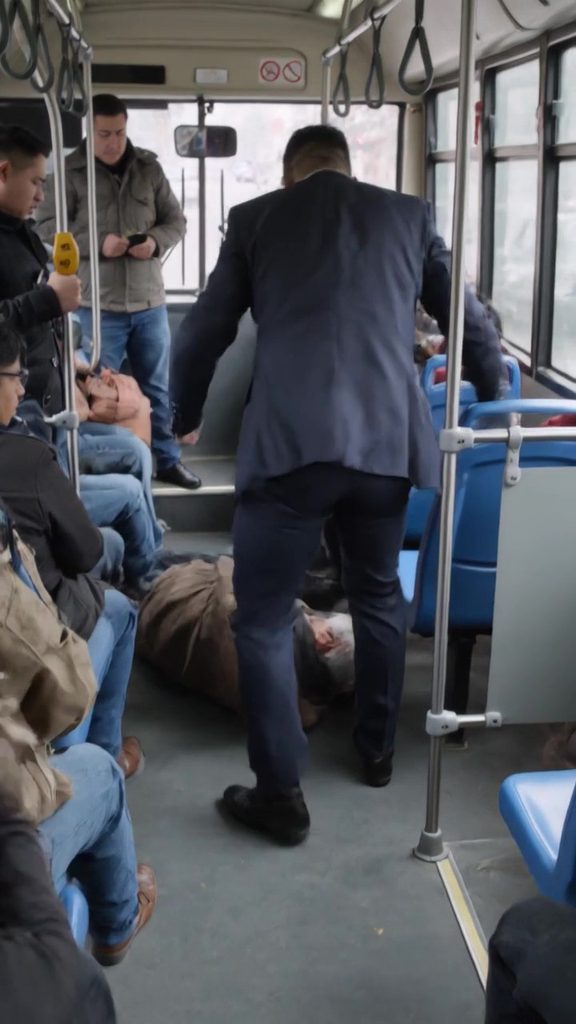
Chapter 1: Before Everything Changed — The door opened
At that hour, a packed city bus during rush hour was filled with routine sounds and people focused on finishing their day. Óscar Campos, 75, had been working for hours on a task that almost no one noticed until it was no longer being done. His clothes showed the wear and tear of a long day, but his work was meticulous. He wasn’t looking for special treatment. He simply wanted the agreement to be honored and to be able to return home with the peace of mind that comes from having fulfilled his duties.
The situation began with a small detail: a bill, a payment, a shift, or a rule that should have been resolved simply. Óscar Campos approached Rubén Torres, who was working as a suite passenger, and asked calmly. The response was cold. Instead of checking the facts, Rubén Torres looked at Óscar Campos’s appearance and decided he could speak to him as if his time were worth less. Some people listened. No one said anything.
Óscar Campos persisted without raising his voice. He explained that he had done his part and wasn’t asking for a favor. That calm tone seemed to irritate Rubén Torres even more. For him, authority meant not being questioned. For Óscar Campos, on the other hand, dignity meant not accepting injustice simply because the perpetrator held a higher position.
The atmosphere changed. Conversations died down, and several glances were averted. Rubén Torres hurled an insult and tried to turn an administrative issue into a public humiliation. Óscar Campos felt ashamed, but also certain: if he left without saying anything, it would probably happen again to someone else.
Before the discussion ended, someone noticed something that would later prove important: a receipt, a camera, a shift log, or a witness who could confirm what had happened. At the time, it seemed like a minor detail. Later, it would be the difference between a convenient version of events and the truth.
Chapter 2: The Humiliation That Crossed the Line — The Door Opened
Rubén Torres wasn’t content with simply denying the request. He wanted to demonstrate in front of everyone that he could decide who deserved to be heard. His words grew harsher, and the conflict escalated. There was a brief, though not graphic, physical altercation that left Óscar Campos stunned and forced those present to acknowledge that this was no longer a simple argument. No one could continue pretending it was just a misunderstanding.
The most painful thing for Óscar Campos wasn’t just the blow or the threat. It was looking around and discovering how many people had witnessed the abuse from the beginning. Some were afraid of losing their jobs. Others didn’t want to get involved. One person even looked away when Óscar Campos asked for help. That silence gave Rubén Torres a few seconds of false security.
But the silence wasn’t agreement. One employee had noted the time. Another witness remembered exactly where everyone had been. In some cases, there was a camera; in others, a record, a receipt, or a log sheet. The scene was leaving traces.
Óscar Campos managed to get up and refused to respond with violence. He said he wanted a solution, not a fight. That statement changed the attitude of some of those present. A woman took a few steps closer. An employee stopped pretending to organize materials. Someone asked if they should call a supervisor.
Rubén Torres reacted with a disdainful smile. He was convinced that no one important would show up for someone like Óscar Campos. He thought he knew the hierarchy of the place and believed his position was enough to control the story.
Then there was movement at the entrance. A vehicle stopped, a door opened, or several people came forward from the entrance. Rubén Torres looked in that direction and, for the first time, felt uneasy. He didn’t yet know who was arriving, but he recognized the way the others moved aside to let Fernando Vega pass.
Chapter 3: Someone Arrived Asking Questions — The door opened
Fernando Vega didn’t start by asking about losses, damages, or procedures. He first looked for Óscar Campos. He approached him, checked that he was safe, and asked for space. This priority surprised Rubén Torres, who was used to conversations of authority beginning by protecting the business, not the person.
“First I want to know if he’s okay,” said Fernando Vega.
He then asked that no one alter records, move important objects, or pressure the witnesses. His tone was calm, but he made it clear that the situation would be reviewed. Rubén Torres tried to preempt the issue with an explanation. He said that Óscar Campos had caused the problem, that everything had been blown out of proportion, and that he was simply enforcing the rules.
Fernando Vega didn’t argue. He asked specific questions: who had witnessed the beginning, what was required, which rule had been applied, and where it was documented. Each question reduced the room for improvisation. Rubén Torres began to change small details in his account.
Then the first witness spoke. He didn’t give a speech. He simply said that Óscar Campos had asked for what was rightfully his and that the response had been unnecessarily humiliating. Another person corroborated the sequence of events. Then the record that everyone had forgotten about surfaced.
Óscar Campos watched without satisfaction. He didn’t want to see anyone destroyed; he wanted the truth to no longer depend on who had the most power to speak. Fernando Vega understood this and avoided turning the moment into a spectacle.
When Rubén Torres asked who Fernando Vega was to give him orders, several people exchanged glances. The answer didn’t require any drama. Fernando Vega had sufficient authority to stop the situation, review the facts, and demand that the correct procedure be followed.




