The first crack was almost too quiet to hear over the wind moving through the dry Alabama grass.
Sheriff Arthur Cleary held the military retirement identification card between both hands, pressed his thumbs into the center, and bent it until the plastic split. He looked directly at the Black man standing beside the silver Ford F-150, waiting for the anger he believed would come.
Then he tore the damaged card into two pieces and threw them through the open driver’s door.
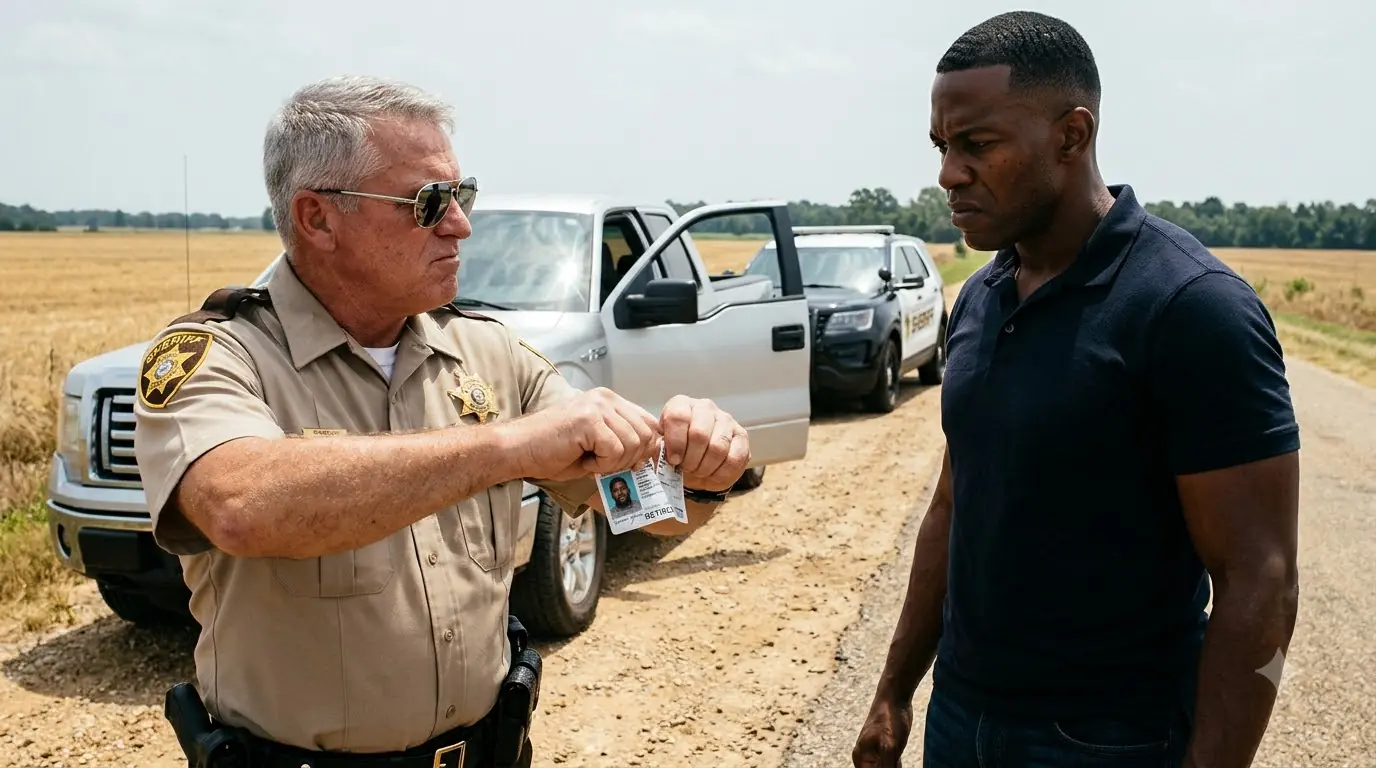
They landed on the gray fabric seat, one fragment showing a photograph of a younger Isaiah Brooks in uniform, the other carrying the remaining identification details. The two pieces lay a few inches apart, perfectly still beneath the blazing afternoon sunlight.
Forty-four-year-old Isaiah stared at them.
Twenty-two years of military service had ended just forty-eight hours earlier. He had survived dangerous assignments overseas, endured months away from his family, and carried the responsibility of leading younger soldiers through circumstances that demanded extraordinary discipline.
Now he was standing beside an empty stretch of County Road 44 outside Coopersville, Alabama, watching an American sheriff destroy the identification he’d received during his retirement processing.
“You shouldn’t have done that,” Isaiah said quietly.
Cleary smiled.
He was fifty-seven, with short silver-gray hair, a broad weathered face, and reflective aviator sunglasses that concealed his eyes. His tan sheriff’s uniform fit tightly across his stocky shoulders, with dark-brown panels, a gold badge, and a black duty belt.
He took one step closer.
“What are you going to do about it?”
Isaiah remained still.
He wore a fitted dark-navy polo shirt, dark jeans, and rugged tan leather work boots. He was tall and muscular, with deep-brown skin, short neatly faded black hair, and the controlled posture of a man who had spent most of his adult life standing at attention when the situation demanded it.
His hands remained open at his sides.
“I’m asking you to explain why you destroyed my identification.”
Cleary laughed.
“Because I don’t tolerate stolen valor in my county.”
Isaiah glanced toward the broken card.
“That identification is legitimate.”
“Sure it is.”
“You can verify it.”
Cleary stepped closer until their faces were only inches apart.
“You think I need some smart-mouthed stranger from Illinois telling me how to do my job?”
Isaiah didn’t answer immediately.
He could see his own reflection in the sheriff’s mirrored sunglasses, distorted by the curved lenses. Behind him, the silver pickup stood on the gravel shoulder, while Cleary’s black-and-white patrol SUV waited at an angle with its emergency lights flashing.
There were no nearby buildings.
No houses close enough for someone to hear the conversation.
Only the long road, flat fields, and afternoon heat.
Isaiah took a slow breath.
“Sheriff, you have my driver’s license and registration. You can verify my retirement status through the appropriate channels.”
Cleary’s expression hardened.
“You’re getting real comfortable giving orders.”
“I’m not giving orders.”
“Then shut your mouth.”
Isaiah became silent.
For several seconds, they stared at each other.
Then Cleary moved.
His open hand struck Isaiah sharply across the face.
The slap snapped Isaiah’s head to one side.
He stumbled half a step but recovered his balance without raising his hands.
The sound faded across the gravel shoulder.
For one terrible moment, everything was still.
Isaiah slowly turned his face back toward the sheriff.
His jaw tightened.
A burning sensation spread across his cheek.
But he didn’t retaliate.
Cleary seemed almost disappointed.
“That’s right,” he said. “You’d better remember who’s in charge out here.”
Isaiah looked directly at him.
“You’ve just made this much worse.”
The sheriff scoffed.
“For you, maybe.”
He shoved Isaiah backward toward the open pickup door.
Then reached for his handcuffs.
“Turn around.”
Isaiah glanced toward the road.
There was no point physically fighting an armed officer over a traffic stop, even one behaving this recklessly.
He turned slowly.
Cleary pulled his wrists behind him.
The handcuffs closed with two metallic clicks.
Then the sheriff began guiding him toward the patrol SUV, still wearing the satisfied smile of a man who believed he’d won.
He didn’t notice the small indicator light glowing inside the pickup.
He didn’t know that the vehicle’s dash camera had been recording since before the stop.
And he had no idea that Isaiah had been expected to contact a federal investigator twenty minutes earlier.
Inside the patrol SUV, the radio suddenly crackled.
“Unit One, dispatch.”
Cleary glanced toward it.
“Go ahead.”
The dispatcher sounded uneasy.
“Sheriff, we have an urgent call requesting direct contact with you.”
He frowned.
“From who?”
There was a pause.
Then the answer came.
“Department of Defense Inspector General’s office. Washington.”
For the first time that afternoon, Cleary stopped smiling.
Isaiah slowly lifted his head.
And somewhere behind those mirrored sunglasses, the sheriff began to understand that the man he’d just assaulted wasn’t the stranger he thought he was.
Forty-eight hours earlier, Isaiah Brooks had stood in a military administrative building outside Fayetteville, North Carolina, holding a folder that represented the formal end of his career.
The folder contained retirement documents, benefit information, transition instructions, and the paperwork he’d spent weeks preparing.




