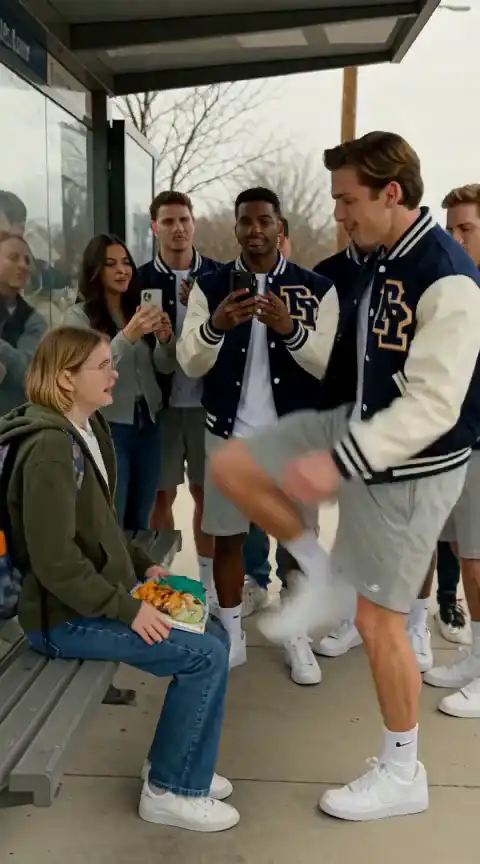
A SCIENCE STUDENT HAD HER ONLY MEAL STOMPED AT A BUS STOP — BUT THE STAR QUARTERBACK HAD NO IDEA WHOSE FAMILY SHE’D JUST HURT.
The black car stopped so close to Grant Holloway that the heat from its engine touched the wet sleeve of his jacket.
He stepped back, still holding the torn meal card between two fingers.
For one second, nobody moved.
The car had no plate.
It had no dealership tag, no state inspection sticker, and no chrome badge anyone at the bus stop recognized.
Its body was low and smooth, almost too clean for the dirty curb, with a thin silver line running over the hood.
The line ended in a small raised mark that looked like a hand holding a flame.
Grant stared at it.
Then he looked at the teammates filming him.
“Is this some kind of commercial?” he asked.
No one answered.
Lillian stood beside the bench with milk dripping from her hair and the remains of her notebook stuck to her shirt.
She had stopped crying before the car arrived.
That was the part Grant did not understand.
He thought silence meant surrender, and he had spent the last ten minutes treating her silence like permission.
The driver’s door opened.
A man stepped out.
He was tall, fair-skinned like Lillian, and wore a dark coat with no logo on it.
He did not look at Grant first.
He looked at the crushed lunch bag beneath Grant’s shoe.
Then he looked at Lillian.
Her mouth tightened.
“Dad,” she said.
The word moved through the crowd faster than the traffic noise.
Grant’s smile slipped, but only for a moment.
“Wait,” he said. “You know this guy?”
The man shut the car door.
His eyes stayed on Lillian’s face.
“Are you hurt?”
Lillian shook her head.
“Just my notebook.”
He glanced at the ruined pages.
“Your hand?”
She looked down.
A thin cut ran across one knuckle where the carton had split.
“It’s fine.”
Her father took one step toward her, but stopped before touching her.
He had warned her never to let anyone connect her to the company before graduation.
He had wanted her to ride the bus, enter the science fair, and be judged on her work instead of his name.
For almost a year, she had carried that warning like another schoolbook.
Grant raised the torn meal card.
“Your daughter started something,” he said.
The man finally turned toward him.
He did not raise his voice.
“Put that card down.”
Grant laughed, and the sound came out too high.
“Man, this is school drama.”
“Put it down.”
Grant looked toward the football parents near the curb.
His mother stood beside a white luxury SUV, one hand wrapped around a paper cup.
His father was on the phone near the bus shelter.
Both of them had been watching.
Neither came closer.
Grant dropped the card.
The damp paper landed in the milk on the sidewalk.
His father ended the call.
“Grant,” he said. “Walk away.”
That was the first time the crowd heard fear in an adult voice.
Grant’s teammates lowered their phones.
Lillian bent to pick up the crushed lunch bag.
Her father reached it first.
He lifted it carefully, as if the torn canvas still mattered.
The black car gave a soft chime.
Grant turned toward it.
A narrow panel on the dashboard lit through the windshield.
A white symbol appeared, followed by a line of text nobody outside the car could read.
Grant took another step backward.
His own vehicle sat behind him, a silver Aurelian R8 with black wheels and a custom plate bearing his jersey number.
He had spent all morning bragging about it.
He had told three teammates that the car could recognize him before he touched the door.
He had said the company built machines for people who mattered.
Now its headlights flashed twice.
The locks clicked.
Then the engine started by itself.
Grant’s father turned sharply.
“What did you do?”
“I didn’t do anything,” Grant said.
His mother hurried from the SUV.
“Grant, get in my car.”
He reached for the driver’s door of the Aurelian.
The handle stayed flat.
He tried again.
The panel on the door lit red.
ACCESS RESTRICTED appeared beneath his name.
One of the football players whispered, “Dude, it says your name.”
Grant slapped the handle.
“It’s glitching.”
His father moved toward the car.
“Call the dealer.”
Grant’s mother pulled out her phone.
The screen showed no signal.
Then her phone buzzed.
She read the message and went still.
Grant saw her face.
“What?”
She turned the screen away.
His father took the phone from her hand.
The message was short.
REMOTE PRIVILEGES REVOKED.
VEHICLE STATUS UNDER REVIEW.
He looked at the black concept car.
The small silver emblem on its hood caught the afternoon light.
His lips parted.
“Everett,” he said.
Lillian’s father did not answer.
Grant’s father took one step closer.
“You’re Everett Mercer.”
The bus driver came down again.
This time he stayed on the pavement.
A woman near the grocery cart raised her phone openly.
No one told her to stop.
Everett Mercer looked at Grant’s father.
“Yes.”
A murmur passed through the stop.
Somebody said the name again.
The football players looked at one another.
One of them opened a search page and stared at the picture that loaded.
Everett Mercer stood beside a black car with the same silver emblem.
The caption beneath the photograph called him the founder of Mercer Automotive Systems.
The company had built the Aurelian line.
Not just the body.
The engine controls, the identity system, the security network, and the software that decided whether a vehicle belonged to the person holding the key.
Grant had spent months bragging about owning one.
He had never asked who built it.
His father had.
He had also spent years asking Everett Mercer for better dealership terms.
Everett looked down at the milk on Lillian’s shirt.




