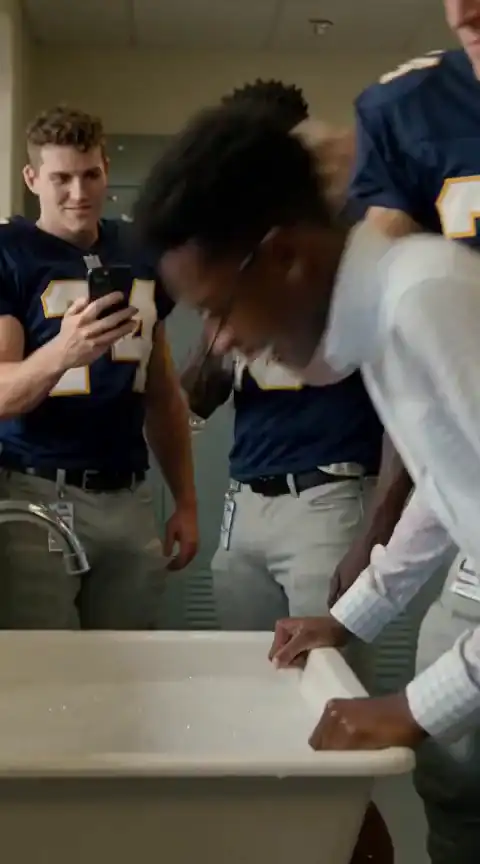
A SCHOLARSHIP KID’S WORN NOTEBOOK WAS DRENCHED BEFORE HIS HEAD HIT THE SINK, BUT THE STAR QUARTERBACK HAD NO IDEA WHO REALLY STOOD BEHIND HIM.
The low, rhythmic thunder vibrating through the concrete floor didn’t come from the school boiler.
It rattled the metal locker doors in their frames.
It sent tiny ripples through the scummy grey water filling the basin where Julian Vance still clung to the porcelain rim.
Tanner Hayes let go of Julian’s hair, but he didn’t step back.
He wiped his wet palm on his grey fleece sweatpants and turned toward the high, frosted security windows at the top of the wall.
“What is that?” Brett asked, lowering his phone by two inches.
Nobody answered him.
The vibration grew heavier, pressing against the eardrums of every boy standing in the tiled corridor.
A blast of downward air hit the glass outside, rattling the steel mesh screens bolted over the transom.
Julian did not wipe his face again.
Water dripped from his chin onto his ruined white shirt, soaking into the cotton until the fabric clung translucent against his brown collarbone.
He remained on his knees, breathing in shallow, raspy hitches, his hand resting on the wet tile six inches from his crushed wire-rim glasses.
“Hey, Albright!” Tanner shouted toward the coaches’ office.
“The hell is that noise outside?”
The office door cracked open by three inches.
Coach Albright stepped out onto the rubber runner, holding a clipboard in his left hand, his whistle dangling loose against his navy polo.
He didn’t look at Julian.
He didn’t look at the puddle of soapy water spreading toward the floor drain.
His eyes went straight to the exterior exit doors at the end of the breezeway.
“Boys, clear the floor,” Albright said, his tone hesitant, not authoritative.
“Put the phones away right now.”
Not one phone disappeared.
Tanner gave a short, cocky snort and crossed his arms over his chest.
“Probably some booster showing off for homecoming weekend,” Tanner said, kicking Julian’s broken notebook two feet farther into the puddle.
“My dad said the board was reviewing flight permits for the new pavilion.”
Julian closed his eyes and leaned his forehead against the cool base of the porcelain sink.
Outside, the high-pitched turbine whine began to spool down from a scream to a steady, whistling thrum.
The heavy blades thumped twice more against the cold autumn air, then settled into an idle spin.
Heavy running footsteps echoed down the exterior concrete ramp outside the double metal doors.
It wasn’t students running.
The footsteps were hard, synchronized, and heavy.
The panic bar on the heavy steel exterior doors slammed downward with a sharp metallic clack.
Principal Garrison walked in first, his necktie visibly crooked and his forehead beaded with sweat despite the fifty-degree draft.
Behind him walked two men in identical charcoal tactical uniforms carrying black communications kits.
And behind them walked a tall, broad-shouldered Black man wearing a tailored navy coat over hospital surgical scrubs.
A heavy laminate credential dangled against his chest from a lanyard bearing the gold crest of St. Jude-Mercy Health Systems.
Across the laminate, stamped in dark red block letters, was the title: CHIEF EXECUTIVE OFFICER & SURGICAL DIRECTOR.
Principal Garrison looked at Tanner, then at Coach Albright, and his mouth fell open without making a sound.
His skin had gone the color of wet cardboard.
“Dr. Vance,” Garrison whispered, his hand shaking as he tried to adjust his tie.
“Sir, we were told the landing was an emergency transport for the county clinic.”
The man in the navy coat didn’t look at Principal Garrison.
He didn’t acknowledge Coach Albright, who had frozen on the rubber runner with his clipboard pressed against his ribs.
His dark eyes swept the row of lockers, the circle of boys holding phones, and stopped directly on the basin.
He saw the dirty water.
He saw the scattered torn pages floating in the scum.
He saw his son kneeling on the concrete, drenched, shivering, without his glasses.
The man took three long, deliberate strides across the damp tiles.
Tanner didn’t move at first.
He stood his ground with his chin tilted up, trying to look broad, relying on his six-foot-two frame and his father’s seat on the district foundation board.
“Excuse me, sir,” Tanner said, putting on the polite prep-school tone he used during alumni banquets.
“This is the private athletic quarters.”
Dr. Robert Vance stopped exactly twelve inches from Tanner’s chest.
He did not raise his hands.
He did not raise his voice.
“Step away from my son.”
Five words.
The hallway went dead silent.
It was not a request, and it was not an argument.
It was the tone of a trauma surgeon ordering a junior resident out of an operating theater before an amputation.
Tanner’s jaw tightened, but his boots instinctively slid back two inches across the slick floor.
Dr. Vance went down on both knees onto the wet, filthy tiles without hesitating, ruining the wool trousers of his thousand-dollar suit.
He caught Julian by the shoulders, his large, warm hands steady and firm.
“Julian,” he said, his voice dropping into a quiet, gravelly warmth that cut right through the locker room chill.
“Look at me, son.”
Julian blinked, squinting through the burning soap residue, his shoulders trembling violently under his father’s grip.
“Dad,” Julian choked out.
“I tried to pick up the paper.”
“Don’t worry about the paper,” Dr. Vance said.
He pulled a clean linen handkerchief from his overcoat pocket and gently pressed it against Julian’s eyes, blotting the stinging suds from his skin.
“Did he hold your head under?”
Julian didn’t answer with words; he simply nodded once, his breath catching in his throat.
Dr. Vance picked up the broken plastic frame of Julian’s glasses from the drainage grate.
The left hinge was snapped completely off.
He folded the broken arm, slipped the pieces into his breast pocket, and stood up.
When he turned back around, his face was entirely devoid of anger.




