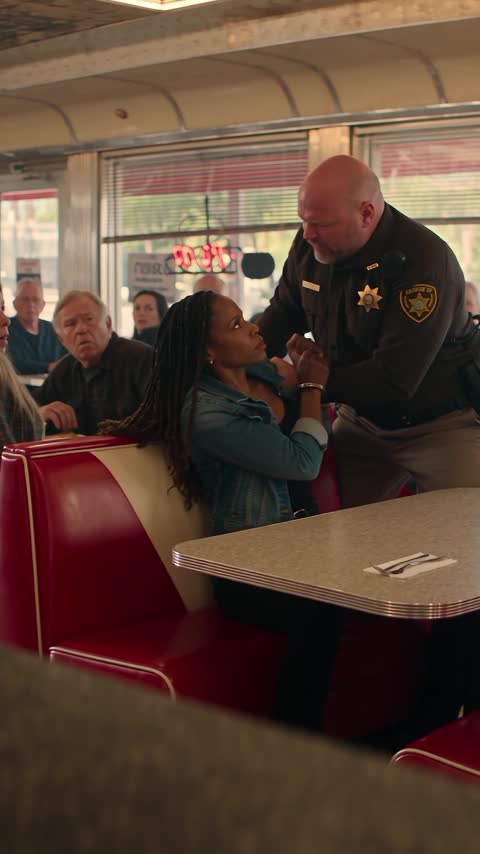
“”Chapter 1: The Weight of Steel and Gold
The heavy metal cuffs slammed onto my left wrist before I even had time to lower my fork.
“Hands behind your back, right now!” Sheriff Dalton Voss growled, his deep voice booming across the roadside diner like sudden thunder.
The entire dining room of the Kettle & Comb fell dead silent. A ceramic coffee mug clattered against a laminate saucer three booths down. Forks paused halfway to parted lips. Local men in dirt-streaked ball caps and faded work jackets averted their gazes toward their plates, their shoulders hunching as though an artillery shell had just whistled through the ceiling. Nobody looked Dalton Voss in the eye. In Randolph County, looking the high sheriff in the eye was the kind of mistake you paid for in bruised ribs and missing bail money.
I did not flinch. I did not scream. I sat perfectly upright against the cracked crimson vinyl, feeling the bite of cold, ratcheted steel against my radial bone as I finished chewing the last bite of skillet potatoes.
“You have five seconds before I take you out of this booth face-first,” Voss said, his heavy hand clamping down across my collarbone, driving all two hundred and sixty pounds of his frame into the leverage.
“Sheriff,” I said. My voice was level, quiet, and dropped into that distinct cadence I had used for six years to silence rowdy courtrooms from Savannah to Macon. “You have not stated a lawful basis for this detention, nor have you asked for my identification.”
Voss barked a laugh that smelled of stale pipe tobacco and chicory coffee. “I don’t need your permission to police my own county, girl. Stand up.”
He didn’t wait for me to comply. He hooked his thick fingers through the center link of the cuffs and hauled me upward. The steel dug into my flesh, scraping the skin raw, and the edge of the formica table shoved hard against my hip, overturning a glass of ice water. The liquid spread in a cold sheet over the paper placemat, soaking into the county map printed across its center. Around us, two dozen citizens looked anywhere else—at the floor, out the greasy front windows toward Highway 82, at their own shaking hands. Only the young waitress behind the counter, a girl named Martha whose nametag tilted crookedly on her apron, kept her eyes locked on us, her knuckle pressed hard against her teeth to keep from crying out.
My name is Amara Whitlock. I am forty-four years old, the granddaughter of an Albany brickmason and the daughter of two public school teachers. For six years, following a unanimous Senate confirmation, I have served as a United States District Judge for the Middle District of Georgia. But on this humid Tuesday afternoon in late October, clad in an off-the-rack denim jacket, dark jeans, and braided hair pulled back with a simple tortoiseshell clip, Sheriff Dalton Voss saw only what his arrogance allowed him to see: a lone Black woman passing through his fiefdom, easily intimidated, utterly disposable, and completely devoid of recourse.
He had no idea that sixty miles north, inside the federal courthouse in Macon, my senior law clerk was tracking my vehicle’s transponder. He did not know that for three months, the Department of Justice’s Civil Rights Division and the Federal Bureau of Investigation had been compiling a sealed dossier on Randolph County—a thick, damning ledger of highway interdictions, unlawful seizures under the guise of civil asset forfeiture, missing impound cash, and county jail inmates who somehow ended up with fractured orbital bones before their first appearance before a rubber-stamp magistrate. I had chosen to see the town for myself before signing the sweeping federal warrants sitting on my desk. I wanted to look at the streets, the courthouse square, the people who lived under this boot.
Now, the boot was on my neck.
He shoved me down the aisle toward the door. As we passed the counter, his younger deputy—a lean, pale kid whose uniform shirt looked two sizes too large—hurried behind us carrying my black pebbled-leather shoulder bag. The nametag on the boy’s chest read M. REED. His eyes were wide, darting nervously between Voss and the patrons who sat like statues in their booths.
“Sheriff,” Reed whispered, his voice cracking slightly. “We didn’t get her name. We didn’t check the registration on the sedan out front.”
“Shut your mouth and carry the bag, Marcus,” Voss snapped without breaking stride. “You want to learn how to keep this county orderly, you watch me and you stop bleating like an old woman.”
The glass door of the diner slammed against the rubber stopper as Voss propelled me out into the blinding glare of the Georgia afternoon. The air was thick with the scent of pine sap and exhaust fumes from idling logging trucks. Voss steered me violently toward the rear door of his patrol unit, a black-and-tan Tahoe parked crookedly across two spaces. He didn’t bother using his hand to protect my head; he simply shoved me downward. My forehead clipped the metal doorframe before I landed hard against the molded plastic rear seat.
Through the tinted glass, I saw Deputy Reed pause at the cruiser’s trunk. He glanced back toward the diner’s front window. Inside, Martha the waitress was standing on her tiptoes, holding an iPhone against the glass, her fingers trembling as she aimed the lens at the Tahoe’s bumper.
Voss saw it too. His face darkened into a furious shade of plum.
“Get in the car, Marcus,” Voss barked, rounding the hood. “And call dispatch. Tell them to have Tyler run by the Kettle & Comb. That girl inside has her phone out. Tell him to seize it as evidence in an ongoing felony stop. If she squawks, charge her with tampering and obstruction.”
Reed swallowed hard, his Adam’s apple bobbing in his throat. “Sheriff, she was just serving food—”
“I said make the call!” Voss roared, slamming his door so hard the heavy frame rattled on its suspension.
The young deputy climbed into the passenger seat, his shoulders rigid, while Voss threw the cruiser into reverse with a violent jerk that snapped my head back against the cage divider. As we lurched onto the county highway, Voss adjusted the rearview mirror so he could look directly into my eyes.
“You’re very quiet back there, girl,” he sneered, tapping his fingers against the steering wheel to the rhythm of a country station playing low on the dashboard. “Usually they’re crying by now. Usually they’re telling me about their uncle who knows a lawyer, or how they pay my salary. You’re not going to beg?”
I met his gaze in the narrow strip of glass. My pulse was elevated, but my mind was icy, precise, cataloging every detail. The time on the dashboard clock: 1:38 PM. The odometer: 42,109 miles. The tactical shotgun locked in the center console rack, its safety switch showing red. The badge number pinned to his chest: Badge 01.
“I have no reason to beg, Sheriff Voss,” I replied, keeping my tone completely even. “Every word you speak in this vehicle, and every action you have taken since you laid hands on me in that diner, is being recorded in my memory. When the time comes, you will answer for every syllable.”




