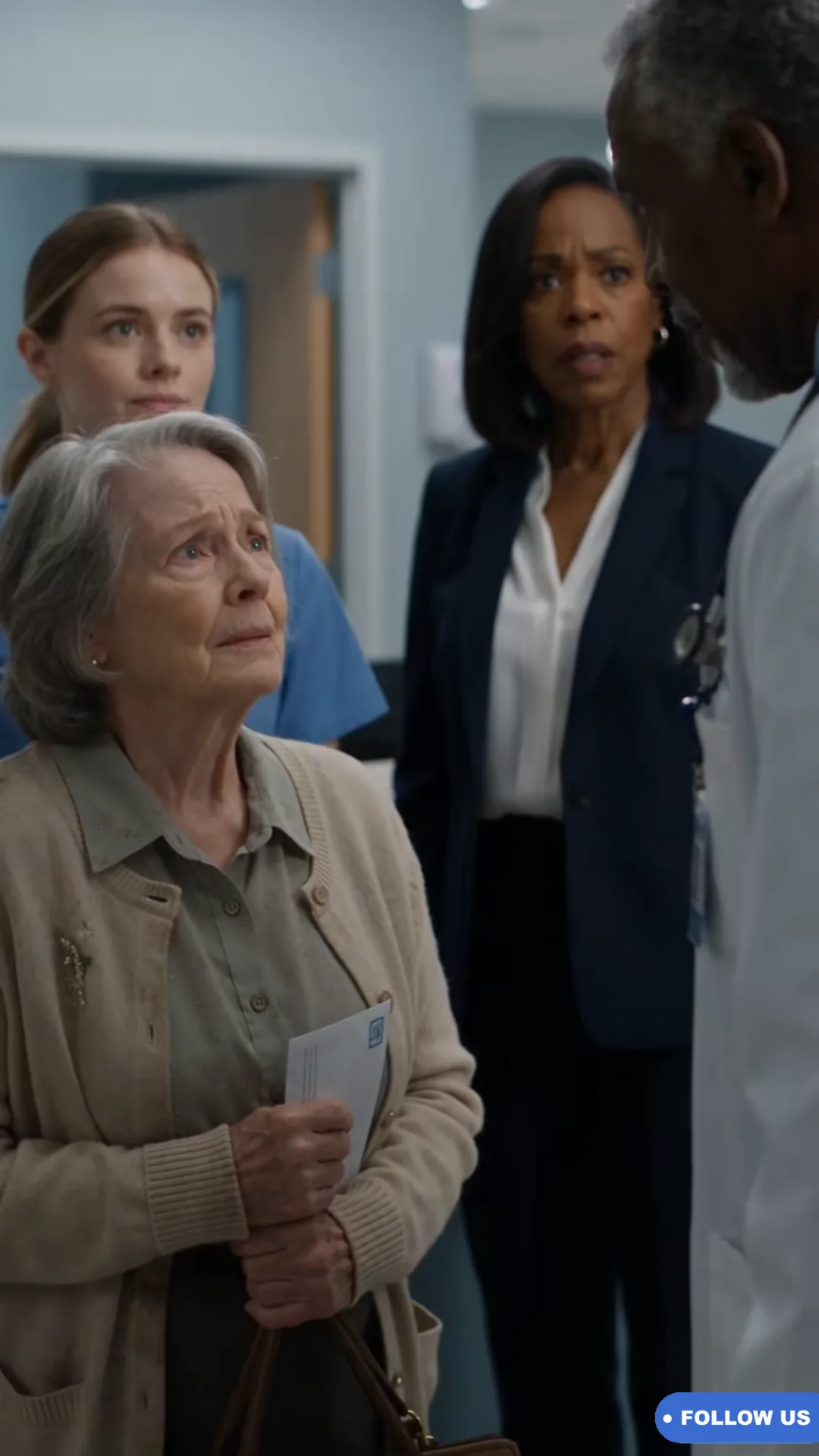
The clock above the registration desk read 7:42 p.m. when Emily Carter noticed the elderly woman sitting alone in the corner of the hospital waiting room.
Outside, a bitter November wind swept through the streets of Chicago. Rain tapped against the tall windows, and the last traces of daylight had disappeared behind the city’s buildings. Inside Lakeshore Medical Center, the fluorescent lights cast a pale glow over the rows of gray plastic chairs.
Emily had already worked a twelve-hour shift.
Her feet ached. Her shoulders were stiff, and she had been dreaming about taking a hot shower and falling into bed since late afternoon.
At twenty-seven, she was still one of the younger nurses in the hospital’s outpatient department, but she had already learned how exhausting the American healthcare system could be for both patients and medical professionals.
Every day, she watched people arrive carrying more than physical pain.
Some carried fear.
Others carried bills they couldn’t afford.
And some, like the elderly woman sitting near the registration counter, seemed to carry the quiet shame of needing help they weren’t sure they could receive.
The woman looked to be in her late seventies.
She wore a faded beige cardigan over a light gray blouse, a dark navy skirt, and flat black shoes that had clearly seen better days. Her short gray hair was neatly combed, and a worn brown handbag rested beside her on the chair.
In her hands was a thin envelope filled with folded papers.
She kept opening it, checking its contents, and closing it again.
Every few minutes, she glanced toward the registration counter.
Then she lowered her eyes.
Emily had seen that expression before.
It was the look of someone trying to decide whether asking for help would make things worse.
She glanced at the clock.
Her shift had ended ten minutes earlier.
She could leave.
Nobody would blame her.
She had already completed her responsibilities, and the evening staff had taken over most of the department.
But something about the woman’s face made Emily hesitate.
The elderly woman pressed one hand against her side and took a slow breath.
Emily noticed the movement immediately.
She picked up her bag, then put it down again.
And instead of walking toward the employee exit, she approached the woman.
“Ma’am?”
The woman looked up quickly.
“Yes?”
“Are you doing okay?”
The woman offered a small, embarrassed smile.
“Oh, I’m fine, dear. I don’t mean to bother anyone.”
Emily crouched slightly beside her chair.
“You’re not bothering anyone. My name’s Emily. I’m one of the nurses here.”
The woman looked at the badge clipped to Emily’s light blue scrubs.
“That’s very kind of you.”
“What’s your name?”
“Margaret. Margaret Hayes.”
“Nice to meet you, Mrs. Hayes.”
Emily glanced at the envelope in Margaret’s hands.
“Have you been waiting long?”
Margaret hesitated.
“A little while.”
“Has someone checked you in?”
The elderly woman looked down.
“Not exactly.”
Emily waited.
Finally, Margaret whispered, “I don’t have my insurance papers.”
Her voice was so quiet that Emily almost didn’t hear her.
And with those six words, an ordinary hospital evening began turning into something neither woman could have predicted.
## The Woman Who Was Afraid to Ask
Margaret Hayes had always been an independent woman.
For most of her seventy-six years, she had taken pride in paying her bills, keeping her promises, and avoiding unnecessary attention.
She had worked as a school cafeteria employee, a housekeeper, and later a part-time caregiver for families who needed help looking after children.
She had never earned much money.
But she had always managed.
Her late husband, Robert, had been a maintenance worker for the Chicago public school system. Together, they raised two children in a modest apartment on the city’s West Side.
They weren’t wealthy.
There were no expensive vacations or luxury cars.
But their home had been warm, their kitchen was usually full of food, and the neighborhood children always knew they could find a safe place there.
Margaret had a particular talent for noticing people who needed help.
Sometimes it was a child who arrived at school without breakfast.
Sometimes it was a neighbor who couldn’t afford groceries.
Sometimes it was a young person who had nowhere to go.
She rarely asked questions.
If someone was hungry, she fed them.
If they needed a place to sit, she pulled out a chair.
If they needed someone to listen, she stayed.
Her husband used to tease her about it.
“Margaret, one day you’re going to bring the whole city home.”
She would laugh.
“Then we’d better make another pot of coffee.”
But life had grown harder after Robert died.
Margaret’s retirement income barely covered her rent, utilities, and groceries.
She had carefully managed her savings, but medical expenses had gradually reduced what little remained.
Now she faced another problem.
Her insurance coverage had changed, and she had received several confusing letters.
She wasn’t sure which documents were valid or whether her new coverage had become active.
For two days, she had been experiencing worsening discomfort in her abdomen.
At first, she ignored it.
Then she tried resting.
When the pain continued, a neighbor persuaded her to seek medical attention.
Margaret took the bus to Lakeshore Medical Center, clutching the envelope containing every medical document she could find.
But once inside, surrounded by computers, registration questions, and unfamiliar paperwork, she felt overwhelmed.
She had become convinced that she couldn’t proceed without proving her coverage.
Rather than risk a bill she might never be able to pay, she sat quietly, uncertain what to do next.
And that was where Emily found her.
“Mrs. Hayes,” Emily said gently, “can you tell me what’s bothering you?”
Margaret looked embarrassed.
“It’s probably nothing.”
“Let’s not assume that.”
The woman hesitated.
“I’ve been having some pain. I thought I should get it checked.”
“Where is the pain?”
Margaret indicated her abdomen.
Emily listened carefully.
“How long has it been happening?”
“A couple of days.”
“Has it been getting worse?”




