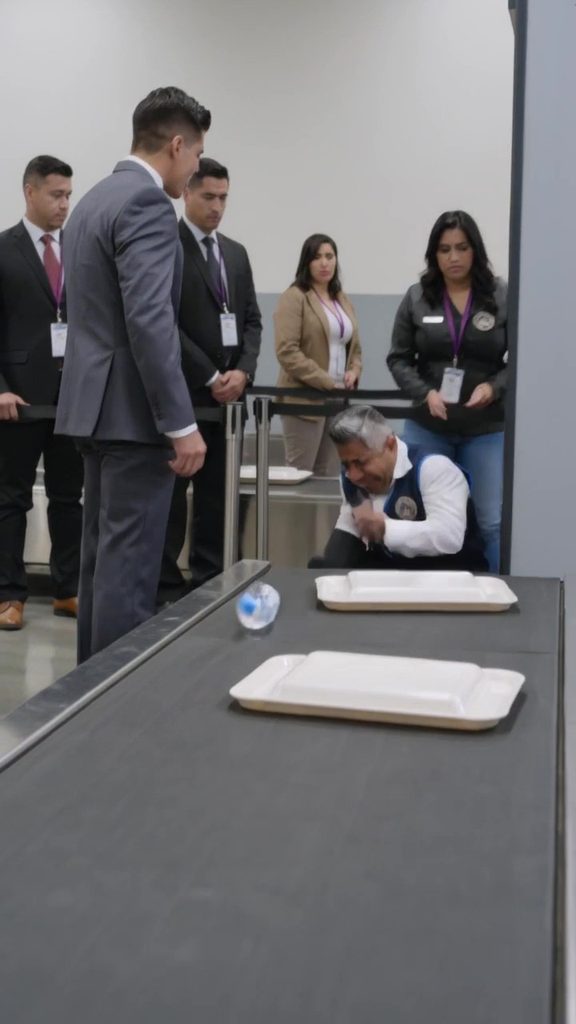
Chapter 1: The day the trays standing next to the band stopped being a detail
At that hour, the security checkpoint at Mexico City International Airport was bustling with the usual noise of any given day. Nicolás Cárdenas was there, doing his job with the patience of someone who understands other people’s rush and doesn’t need to compete with it.
He was a one-handed, veteran volunteer. His routine revolved around an inspection tray and a bottle of water. He did it carefully, without making a fuss, and without seeking recognition. For Nicolás, the best sign that everything was going well was that people could go about their day without giving too much thought to who had kept order.
At home, he didn’t talk about it as a mission. He said it was work, service, or simply a way to stay useful. He had learned to distinguish between helping and putting himself above others. That’s why he explained the rules in a calm voice, even when someone arrived tired, confused, or in a bad mood.
The problem started with Arturo Cortés. He arrived in a hurry, with the self-assurance of someone who believes his own urgency outweighs any instructions. Nicolás, without raising his voice, showed him what to do with an inspection tray and a bottle of water. The explanation was brief and applied to everyone.
Arturo responded with contempt. First, it was a grimace; then, a phrase that made those nearby turn around. He didn’t argue with the rule itself. He attacked the person who was reminding him of it. He spoke to him as if Nicolás’s uniform, age, appearance, or position were an invitation to treat him with less respect.
Nicolás felt that familiar discomfort that arises when you realize the conversation is no longer about resolving anything. Even so, he repeated the instruction once. He didn’t add his resume, didn’t explain his personal history, and didn’t try to demonstrate that he was someone important. The rule still held true even though no one knew anything about him.
Around them, several people watched without intervening. Some lowered their gaze. Others pretended to focus on their phones. The trays stopped next to the conveyor belt remained as a small sign that the day had already deviated from the norm.
In subsequent conversations, Nicolás explained that the hardest part wasn’t the insult itself, but the feeling that everyone expected him to manage everyone else’s discomfort as well. That expectation vanished when the team took responsibility.
A colleague told him she had thought about intervening but didn’t know how. Nicolás didn’t blame her. He suggested something practical: next time, there’s no need to confront the aggressor; simply alert the appropriate person and stay close to the victim.
Chapter 2: An argument in place around an inspection tray and a water bottle
What happened next occurred in seconds, although it seemed much longer to Nicholas.
Arturo ended up crossing a physical line. There was a brief struggle and a kick that knocked Nicolás off his balance. The scene was quick, not graphic, but serious enough to instantly silence the murmur in the room.
Nicolás was in pain and preferred not to get up immediately. A close friend asked for help. No one needed to exaggerate what had happened: it was enough to see that it was no longer just a verbal argument.
Arturo, still agitated, tried to justify it by saying that he had been provoked. The problem was that almost everyone had heard the exchange from the beginning.
That’s where the first difference between a humiliating scene and a real consequence appeared. No all-powerful stranger arrived to resolve it with a single sentence. Procedures were set in motion: someone halted the operation, another radioed for help, and a third person began taking down names.
Mauricio Escobar, the airport security chief, approached Nicolás first. He asked if he needed assistance, checked that he was accompanied, and only then asked to hear Arturo’s side of the story. That sequence mattered. Protecting first didn’t mean condemning without listening; it meant attending to the most vulnerable person before discussing responsibilities.
Arturo tried to sum it all up as a misunderstanding. He said there had been provocations, that the rule was absurd, or that no one had explained it to him properly. Mauricio didn’t respond with a lecture. He asked him to wait while they gathered information.
For those who had witnessed the scene, that administrative silence was more unsettling than a shout. The situation no longer depended on who spoke the loudest.
The scene also showed something rarely seen in short videos: after the tense moment, people were left picking up objects, reorganizing lines, and trying to get back on track. Nicolás remembered that part more than the shouting.
The place took a few minutes to reopen. That time came at a small but worthwhile cost: it confirmed that stopping to protect someone was more important than maintaining a semblance of normalcy.
Chapter 3: What the filter cameras revealed about an inspection tray and a water bottle
The review began with the security camera footage, staff logs, and the passenger queue. It wasn’t a spectacular investigation; it was the kind of routine check that usually determines whether a story holds water.
The records showed that Nicolás had followed the procedure. They also allowed investigators to pinpoint the exact moment the discussion took a turn. Witnesses agreed on one basic point: Nicolás had explained a rule, and Arturo had turned the correction into a personal attack.
Mauricio asked each person to describe only what they had seen or heard. He avoided questions that suggested answers. This approach deflated several exaggerated details and left the important points at the heart of the matter.
Arturo began to realize that the problem wasn’t discovering that Nicolás had a secret identity, powerful connections, or a prestigious past. The relevant information was much simpler: there was a pattern, there was documented behavior, and there were people who could confirm the sequence.




