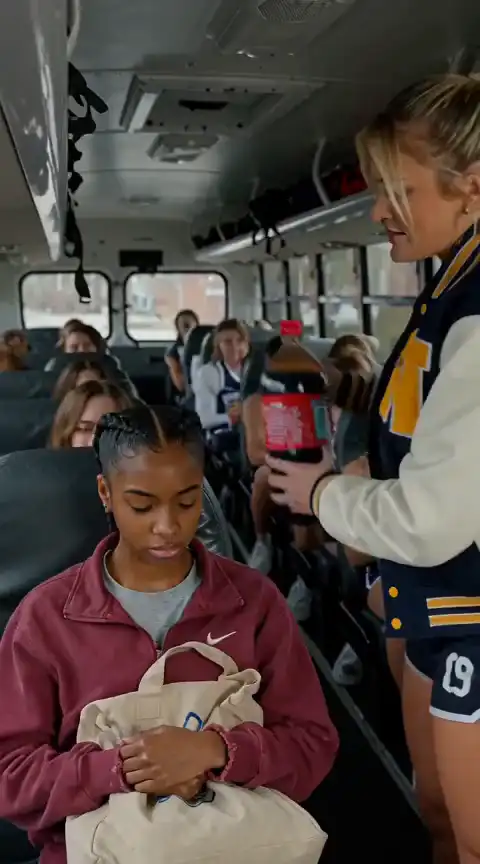
A CHARITY RUNNER WAS DRENCHED IN FIZZING SODA ON A PACKED MORNING BUS — BUT THE PRIVILEGED TEAM CAPTAIN HAD NO IDEA WHOSE FAMILY STOOD BEHIND HER.
The diesel engine of Bus 14 idled with a heavy, shuddering vibration that rattled the rusted window frames.
Nobody moved toward the double front doors.
Aubrey Sterling still had her fingers curled around the damp plastic neck of the empty soda bottle.
Her smirk had stiffened into something curious and irritated as she stared past the driver’s partition.
Through the dusty front windshield, the flashing blue strobes of two state cruiser lightbars cast rapid, rhythmic pulses across the yellow hood.
Two dark, unmarked sedans with heavy tinted glass had parked directly behind the cruisers, cutting off every lane of the district driveway.
“What is Henderson doing?” Aubrey muttered, kicking Kayla’s bag with the toe of her platform shoe.
“Tell him to honk the horn. We have team roll call in ten minutes.”
The bus monitor, Mr. Henderson, did not touch the horn.
His thick knuckles were white where he gripped the steering wheel, his eyes fixed on the state trooper stepping onto the pavement outside.
“Sit down, Aubrey,” Mr. Henderson said, his voice flat and strained in a way the kids had never heard before.
“I’m not sitting down until she cleans her mess off my row,” Aubrey snapped, gesturing at the puddle of brown liquid on the floor.
Kayla Mercer did not move to clean anything.
The syrupy dark soda had soaked through her cotton collar, leaving a cold, sticky band against her collarbone.
Her natural hair, neatly sectioned in cornrows that her grandmother had braided by lamp light on Sunday night, glistened with drying sugar.
A slow drop of brown foam detached from the tip of her left earlobe and fell against her denim knee.
She kept her hands still on the handles of her track bag.
She had spent five months getting up at four-thirty in the morning to run repeats on the cinder track behind the old municipal water tower.
Her father had worked double shifts at the freight terminal until his back gave out three winters ago.
She knew what sweat tasted like, and she knew what cold water felt like when the boiler broke in December.
A few ounces of warm convenience-store soda were not going to make her flinch.
“Look at her,” Chloe, one of the varsity hurdles alternates, whispered from seat twenty.
“She’s acting like she didn’t just get baptized in off-brand cola.”
A nervous giggle rippled through the girls sitting behind her, but it died almost instantly.
The accordion doors of the bus hissed open with a loud release of pneumatic pressure.
A tall state trooper in a crisp khaki uniform stepped up the three rubberized stairs, his campaign hat tilted perfectly level.
Behind him came a man in a tailored charcoal wool coat whose face made Mr. Henderson rise half out of his driver’s seat.
The man in charcoal was tall, broad-shouldered, with deep brown skin and silver threading through his close-cut hair.
He carried a slim leather folio under his arm, and his eyes scanned the interior of the bus with a steady, surgical calm.
He did not look at the varsity letter jackets or the rows of expensive backpacks.
His gaze traveled straight down the center aisle until it landed on row twenty-two.
When he saw the dark glaze of carbonated syrup clinging to Kayla’s forehead, his jaw tightened by a fraction of an inch.
“Governor Mercer,” Mr. Henderson stammered, his hand reaching instinctively for his district identification badge.
“Sir, we didn’t… nobody notified dispatch that you were visiting the campus today.”
The name echoed down the length of the bus like a gunshot.
Aubrey’s hand slipped from the overhead luggage rail.
“Governor?” Chloe whispered, her phone slipping down to her lap.
“Wait, who is that?”
Aubrey stared at the man walking down the aisle, her throat working silently as she tried to process the resemblance.
The high cheekbones, the steady brown eyes, the precise posture—they were the exact adult mirror of the girl sitting drenched in seat twenty-two.
Governor Aaron Mercer walked with a deliberate, unhurried cadence that made the narrow aisle feel suffocatingly small.
The state trooper stayed two paces behind him, his thumbs hooked loosely in his duty belt.
Every phone camera that had been pointing at Kayla was suddenly lowered toward the floor.
Aubrey stood frozen in the aisle, trapped between row twenty-one and row twenty-two, holding the sticky plastic bottle like a weapon she didn’t know how to drop.
Governor Mercer stopped right in front of Aubrey.
He didn’t yell, and he didn’t raise his hand.
He simply looked at the empty two-liter bottle in her manicured grip, then shifted his eyes to the brown puddle soaking Kayla’s canvas sneakers.
“Whose property is that bottle, young lady?” he asked quietly.
Aubrey swallowed hard, her face draining of color until her freckles stood out like dark spots against chalk.
“I… it was just a joke,” Aubrey said, her voice climbing into a thin, defensive squeak.
“We were just messing around before the morning team meeting. Everybody messes around on the bus.”
“A joke,” Governor Mercer repeated, tasting the word with absolute distaste.
He reached into his breast pocket, pulled out a clean, folded white handkerchief, and stepped around Aubrey as if she were a piece of discarded luggage.
He knelt down on the rubber floor runner, ignoring the damp spots of soda near the hem of his trousers.
“Kayla,” he said gently.
“Uncle Aaron,” she whispered, her voice steady but tight with the strain of holding back tears of humiliation.
“You ran fifty-four flat on Tuesday,” he said, his hand resting warm and firm on her shoulder.
“Fifty-four point zero two,” she corrected, a tiny tremor finally breaking through her lower lip.
“That’s the fastest preliminary time in this region since nineteen ninety-eight,” he said, unfolding the linen cloth.




