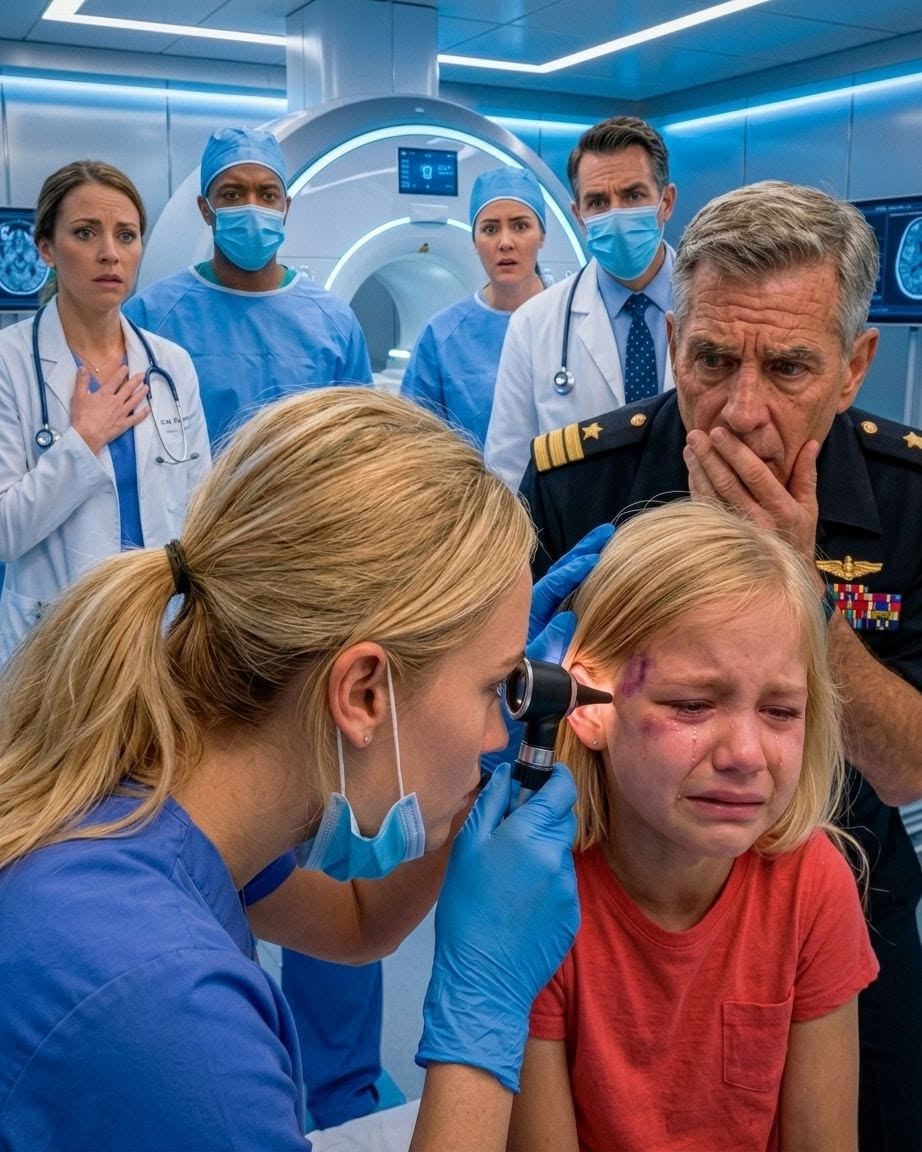
The imaging suite smelled of heated electronics, ozone, and the sterile citrus spray used between patient transfers. Priya’s fingers flew across the control terminal, setting up the pediatric protocol while the high-resolution CT gantry hummed to life.
Chloe lay on the motorized bed, clutching a faded plush bunny against her collar. The fever made her small chest rise and fall in shallow, rapid gasps.
“Grandpa,” she whimpered, her voice muffled as the foam head stabilizers were slid into position. “My head is buzzing like a bee.”
Nathaniel Grayson did not hesitate. The three-star admiral stepped directly to the head of the bed, placing his large, calloused hand over hers. “I’m right here, sweet pea. Eyes on me. Just like when we watch the gulls at the pier.”
Dr. Marcus Whitfield stood five feet back, arms folded across his pristine white coat, his foot tapping an irritated rhythm against the linoleum. “You’re irradiating a five-year-old for clinical theater, Sinclair. When these slices come back clear, you’re explaining this breach of chain-of-command to Chief Nursing Officer Ramos. Directly.”
Maya did not reply. She kept her fingers resting lightly on Chloe’s radial pulse, counting the beats against her own internal clock. Seventy-two. Then a sudden skip to eighty-eight. Arrhythmic spikes under high intracranial pressure—Cushing’s reflex was beginning to murmur in the background.
“Priya, run thin cuts through the temporal bone,” Maya said, her voice dropping into a quiet, flat cadence. “Axial and coronal. Contrast-enhanced if the IV line holds.”
“Injecting contrast now,” Priya called from behind the lead-glass partition.
The scanner began its mechanical sweep, the internal tube whistling as it spun. On the primary diagnostic monitor mounted above the console, gray-scale cross-sections began populating in rapid succession.
First came the soft tissue of the neck. Then the jaw. Then the external auditory canal—inflamed, thickened, consistent with the otitis media Whitfield had diagnosed eight times.
Whitfield snorted softly. “Inflamed canal. Exactly what the otoscope showed. Satisfied?”
Maya leaned closer to the glass. “Scroll three millimeters superiorly. Look at the petrous apex.”
Priya dragged the trackball.
The image shifted.
The normal honeycombed appearance of the mastoid air cells did not look like crisp, black pockets of air. On the right side, the delicate bone trabeculae were completely gone, replaced by a dense, murky cloud of gray erosion.
And right along the sigmoid sinus plate—the thin layer of bone separating the inner ear from the major venous drainage of the brain—was a sharp, jagged defect.
Through that defect, a crescent-shaped fluid collection was expanding into the epidural space, pushing against the right temporal lobe and displacing the midline of the brain by nearly four millimeters.
The suite went dead silent.
Priya stopped breathing. He took his hands off the console as if the trackball were wired to high voltage. “Midline shift… there’s an epidural abscess. It’s compressing the transverse sinus.”
Whitfield’s foot stopped tapping.
His arms dropped from his chest. His jaw went slack, the color draining from his face so fast he looked as though he had stepped into a walk-in freezer. “That’s… that’s impossible. She presented with localized pain forty-eight hours ago. Bone destruction doesn’t happen that fast.”
“It does when the organism is an aggressive beta-hemolytic strep that seeds under cortical bone,” Maya said, not looking at him. She spun toward the intercom. “Priya, call a pediatric neurosurgical stat alert. Page Dr. Aris Thorne. Tell him we have an impending uncal herniation secondary to coalescent mastoiditis.”
“Sinclair, wait—” Whitfield stammered, stepping forward, his hands trembling. “Protocol requires the attending of record to verify the radiology reading before calling surgery—”
“Get out of the way, Doctor,” Admiral Grayson’s voice hit the room like a naval artillery strike.
The admiral didn’t yell. He stepped directly into Whitfield’s path, towering over the younger physician, his eyes burning with lethal, terrifying clarity. “You had eight chances to read this right. She saw it with a penlight. If you touch that console, so help me God, I will have military police escort you out of this building in irons.”
The elevator ride to the third-floor surgical suites was an eternity measured in mechanical dings and descending vital signs.
Chloe’s eyes had rolled half-open, fixed and vacant, unblinking in the fluorescent glare of the elevator ceiling. Her left arm began to twitch with small, rhythmic tremors.
“She’s seizing,” Maya said, slamming the elevator’s emergency service override button. “Focal motor seizure from cortical irritation.”
Grayson leaned over the railing, his knuckles white. “Chloe! Chloe, look at Grandpa! Stay with me, baby!”
Maya pulled a pre-filled syringe of lorazepam from the emergency crash kit clipped beneath the gurney. Without waiting for a verbal physician order, she snapped the safety cap, swabbed the port on Chloe’s IV line, and pushed two milligrams smoothly into the lumen.
“Hold her head steady, Admiral. Do not let her tongue occlude.”
Within fifteen seconds, the twitching slowed, then stopped. But Chloe did not wake up. Her breathing became deep, stertorous, the snore-like respiration of a brain struggling against rising fluid pressure.
The elevator doors chimed open on the third floor.
Waiting in the hallway was Dr. Aris Thorne, chief of pediatric neurosurgery. He was fifty-two, wearing dark green surgical scrubs, his hair silver at the temples, reading the preliminary CT scan slices on a portable tablet with razor-sharp intensity.
Beside him stood Chief Nursing Officer Elena Ramos, her clipboard tucked under her arm, looking between the incoming bed and Maya with a mixture of shock and stern assessment.
“Where is Whitfield?” Dr. Thorne asked, falling into step beside the moving bed.
“Left behind in imaging, sir,” Maya reported, her voice clipping out the vitals with military precision. “Five-year-old female, acute mastoiditis with cortical erosion into the posterior fossa. Four-millimeter midline shift. Sigmoid sinus thrombosis suspected. Just administered two milligrams of Ativan for a focal seizure forty seconds ago.”
Thorne glanced at Maya, his sharp gaze lingering on the steady, unblinking focus in her eyes. “You pushed Ativan without an attending’s counter-signature?”
“I pushed it because her temporal lobe was herniating through the tentorium,” Maya answered without breaking stride. “Would you prefer a signed order or a living patient, Doctor?”
Thorne’s eyebrows twitched. A faint, grim smirk crossed his lips. “Fair point. Prep OR 4. Full craniotomy tray, pediatric burr holes, and get the ENT team on the horn for a combined mastoidectomy.”
As they reached the double doors of the sterile surgical corridor, Ramos stepped in front of the bed, putting a flat hand against the rail. “Hold on. Hospital policy dictates that first-year floor nurses do not scrub into emergency neurosurgical procedures. Nurse Sinclair, return to the pediatric floor. Your shift ended twenty minutes ago.”
Maya stopped.
Before she could speak, Admiral Grayson stepped forward.
He didn’t raise his voice, but the weight of his three stars and thirty-one years of commanding aircraft carriers slammed into the hallway like a tidal wave.
“Who are you?” Grayson asked Ramos.
“Elena Ramos, Chief Nursing Officer for this facility—”
“Mrs. Ramos,” Grayson interrupted, his voice dropping into that chilling, quiet register that made international defense ministers sweat through their suits. “That woman in the blue scrubs is the only person in this facility who didn’t let my granddaughter die of a misdiagnosed earache. She stays at that bedside. If you try to remove her, I will have the Department of Defense review every federal grant and Medicare contract this hospital holds before midnight.”
Ramos swallowed hard, her mouth opening and closing without producing a sound. She looked at Thorne.




