Chapter 1: The table by the window
Tomás Medina always chose the table next to the cafe window.
It wasn’t the most comfortable spot for his wheelchair. In fact, he had to enter sideways because one of the legs was too close to the aisle. But from there he could see the field and discuss the soccer matches with his friends, even though he preferred chess.
At fifteen, Tomás had learned to hate one thing more than stairs without a ramp: when people spoke to him as if every sentence had to come wrapped in pity.
That’s why, when he changed schools in Querétaro, he made a very specific request to his father.
—Don’t come talking to the teachers about everything.
—For everything?
-Throughout.
—Excellent level of detail.
-You already know.
His father, Colonel Arturo Medina, knew.
Tomás wanted to solve his own problems.
And Arturo tried to respect that.
That Tuesday seemed like a normal day. The cafeteria was full, students were carrying trays with cakes, fruit, and cartons of milk, and someone was arguing because the water machine had stopped working.
Tomás was wearing a worn-out blue sweatshirt that he refused to throw away.
On her lap was a tray of food.
He approached her table.
Someone had left a backpack on the chair next to me.
—Whose is it?
A tall boy wearing a sports team jacket turned around.
Gael Fuentes.
Seventeen years old. Forward for the school team. Popular, loud, and used to teachers letting certain things slide because he “represented the school.”
—Mine —he said.
—Can you move it?
Gael looked at the wheelchair.
—Find another table.
—I always sit here.
-Not today.
Thomas looked around.
There were other places, but the hallway was narrow because of several backpacks.
—Just move the backpack.
Gael smiled.
—And if not?
His friends who were with him remained silent.
Tomás was familiar with that kind of silence.
It wasn’t approval.
It was calculation.
Everyone wanted to know how far Gael would go without them being the ones to pay the price.
Chapter 2: When a joke stops being a joke
“I don’t want to fight,” said Thomas.
Gael put a hand on the table.
—Nobody is fighting.
—Then move the backpack.
—You move.
Tomás took a deep breath.
“You don’t belong at this table,” Gael added.
One of his friends let out a nervous laugh.
Thomas looked at him.
The boy stopped laughing.
“Okay,” said Thomas. “Keep the table.”
He turned the chair around.
It could have ended there.
But for Gael it wasn’t enough.
There were two students filming from a distance. Tomás saw them. So did Gael.
And when someone starts acting for a camera, sometimes they stop thinking about the real consequences.
“Look at him,” Gael said. “He’s getting angry.”
Tomás continued advancing.
Gael stood in front of him.
-What do you want?
—Don’t come this way.
—This is the hallway.
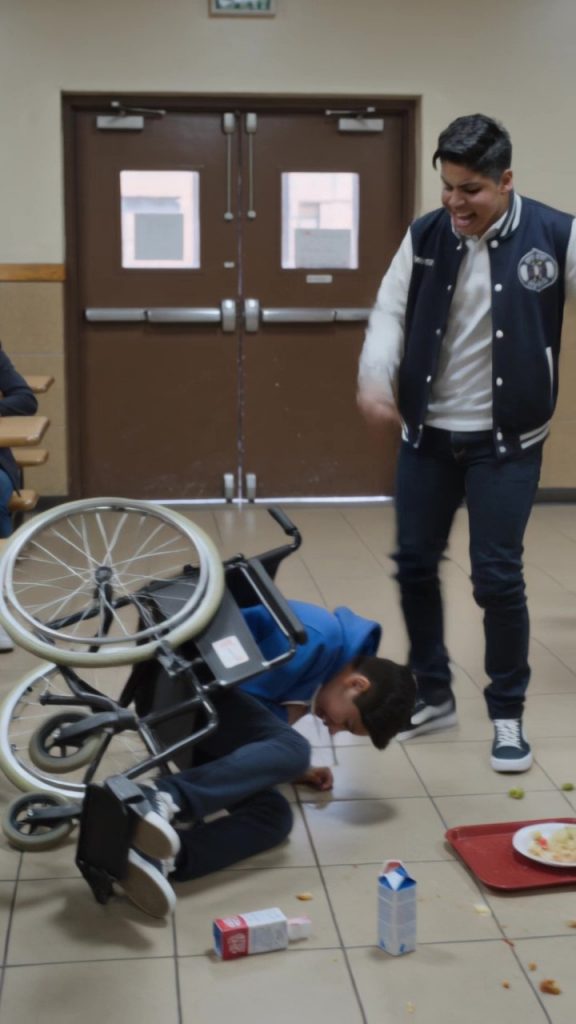
Gael pushed the tray. The milk carton fell and opened on the floor. Tomás tried to stop the rest of the food from sliding.
“That’s enough,” said a girl.
Gael ignored her.
—Trash. You don’t belong at this table.
Thomas looked up.
—Are you finished yet?
That enraged Gael more than an insult.
In the confusion, he hit the front of the chair hard. Tomás lost his balance and ended up on the floor next to the overturned chair. The tray fell beside him.
The cafeteria fell silent.
Tomás put a hand on the floor.
-Do not touch me.
Gael took a step towards him.
—Stay on the ground so everyone can see you.
The girl who had spoken earlier stood up.
– Get it, yes.
He turned.
—Stay out of it.
For a few seconds nobody moved.
Then something small happened.
A student named Ivan placed his tray on a table and approached Tomas.
—Do you want me to lift the chair?
Thomas nodded.
Another student picked up the milk carton.
A third person stopped recording and put the phone away.
The silence was beginning to break.
And just then the double doors of the cafeteria opened.
The director entered accompanied by a man in military uniform.
They hadn’t come because of the fight.
At least, not at first.
Chapter 3: The father who wasn’t supposed to solve everything
Arturo Medina had been invited to the school for a civic activity that had been scheduled for weeks.
Tomás was aware of it.
What she didn’t know was what time her father would arrive.
Arturo came in talking to the director about a career guidance event. He took three steps and saw the chair overturned.
Then he saw his son on the ground.
The conversation ended immediately.
—Thomas.
Gael stepped back.
Arturo reached his son and bent down.
—Did you hit your head?
—No.
—Does anything hurt?
—My shoulder, but I’m fine.
Ivan had put the chair back in position.
Arturo only helped Tomás after he showed him how to do it.
That detail did not go unnoticed by the counselor who had just arrived: the father didn’t pick him up like a small child. He waited for instructions.
Once Tomás was seated, Arturo looked around.
-What happened?
Gael tried to speak first.
—It was an accident.
“No,” said the girl at the other table.
Gael turned around.
She held his gaze.
—It wasn’t an accident.
Another student raised his hand.
—I saw it.
Tomás looked at his companions.
I wasn’t expecting that.
The director approached.
—Let’s go to the office.
Arturo miró a Gael.
—Who touched my son?
The question was not a shout.
But Gael paled.
—Your son…?
Several students looked at Arturo’s uniform and then at Tomás.
Tomás closed his eyes for a second.
That was exactly what I didn’t want.
That people would change their attitude because of their father.
Arturo seemed to read his face.




