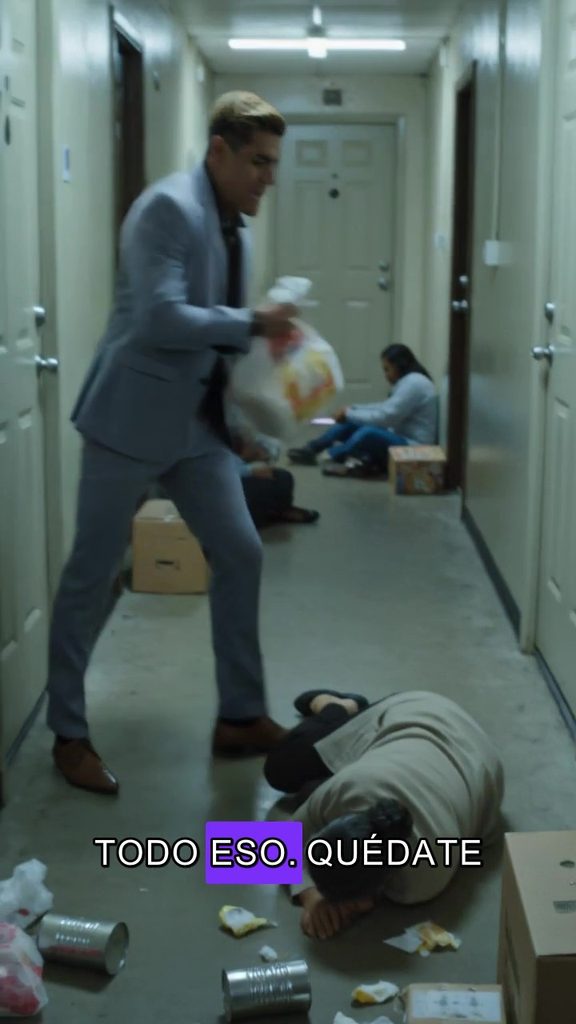
Chapter 1: A Pantry Bag in a Narrow Hallway
At a temporary shelter for low-income families in Chicago, hardly anyone gave Doña Ofelia Ramos a second glance. That didn’t bother her. She preferred to go unnoticed, finish her shift or her errand, and return to her routine.
She was seventy years old and a temporary resident. Her day was organized around practical matters: schedules, payments, errands, a pending call, or caring for a family member. There was no room for grand speeches. When something went wrong, Doña Ofelia Ramos preferred to resolve it quietly and carry on.
That day, what everyone would later describe as “the beginning” happened, though it was really just an accident or a minor disagreement: Charles took the emergency food bag assigned to Ofelia. He believed she was receiving more help than the others and decided to take some of it for himself. In a temporary housing facility for low-income families in Chicago, what happened could have been resolved with an apology, a check, or a few minutes of conversation.
But Charles Vega, another resident with a history of conflict, arrived ready to interpret the moment in the worst possible way.
—Wait a minute, it wasn’t on purpose—said Doña Ofelia Ramos, trying to keep her voice from trembling.
Charles Vega refused to listen. There was a mixture of anger and a need to control the situation that was more evident in his demeanor than in his words. Charles Vega didn’t even ask what had happened; he spoke as if the blame already had a name.
“There’s always an excuse,” he replied.
Doña Ofelia Ramos tried to explain the situation. She didn’t ask for special treatment, nor did she seek pity. Doña Ofelia Ramos simply wanted to resolve the matter without being subjected to public humiliation. What she encountered was contempt.
The people around began to notice. Around Doña Ofelia Ramos, some lowered their voices and others pretended to be busy. This reaction, so common when no one wants to get involved in someone else’s problem, gave Charles Vega more space to impose his version of events.
Doña Ofelia Ramos still thought the discussion could be stopped.
He didn’t know that, during the last few minutes, more information had already been recorded than Charles Vega imagined.
Chapter 2: Seventy Years Didn’t Make Her Invisible
The argument then crossed a physical line. What happened next at a temporary shelter for low-income families in Chicago was brief and serious, not a prolonged fight. Charles Vega reacted aggressively, and Doña Ofelia Ramos ended up on the floor or against a nearby piece of furniture, dazed and humiliated. For Doña Ofelia Ramos, there was pain, fear, and bewilderment, without needing to make the scene graphic. The important thing was that several people could clearly see who was trying to back away and who was continuing to advance.
—That’s enough— Doña Ofelia Ramos managed to say. —Leave me alone.
The phrase changed something in those watching. Until then, some had tried to convince themselves that it was “a personal matter,” “a family squabble,” or “a work-related argument.” When Doña Ofelia Ramos asked them to stop, that comfort vanished.
A woman nearby pulled out her phone. Another person found a safe spot from which to call for help without approaching Charles Vega. No one made a heroic entrance. They were small decisions, but important ones.
Charles Vega, however, continued to believe that he controlled history.
“Don’t make a big deal out of it,” he said.
Coming from Charles Vega, that phrase provoked more outrage than the previous shout. Because Doña Ofelia Ramos wasn’t making a scene. She was trying to recover something, protect herself, or simply get back on her feet.
It was then that several details about a temporary shelter for low-income families in Chicago began to take on significance. There were recorded schedules, security cameras, people who had heard from the beginning, and objects that allowed for a reconstruction of what had happened. For Doña Ofelia Ramos, none of those details seemed important at that moment. Precisely for that reason, they were useful: they didn’t depend on a biased version of events.
Doña Ofelia Ramos took a deep breath and avoided responding to the provocations. If it was a family conflict, she knew that arguing further would only worsen the situation. If it was a public or work setting, she understood that there were too many eyes around for Charles Vega to erase what had happened with a quick explanation.
What weighed most heavily on him wasn’t the shame of having been exposed. It was the feeling that someone had counted on his silence.
That assumption was about to fail.
Because she arrived with the administrator and security during the weekly distribution.
Chapter 3: Every open door became a witness
The presence of Mauricio Peña, the program coordinator, altered the atmosphere, but not because everyone suddenly discovered an all-powerful figure. His arrival had a specific and verifiable reason: he arrived with the administrator and security during the weekly distribution.
In the case of Doña Ofelia Ramos, that difference mattered.
She didn’t appear because fate had decided to reward Doña Ofelia Ramos. She was there for a prior matter, unrelated to the conflict, and she encountered a scene that demanded action.
The first thing Mauricio Peña, coordinator of the aid program, did was approach Mrs. Ofelia Ramos.
“Are you okay?” he asked.
He then asked for space and ordered that no one touch the objects involved until he understood what had happened. If security personnel were present, their role was to separate the parties, not to threaten them. If a manager or supervisor was present, they were instructed to preserve video footage and contact the appropriate authorities.
Charles Vega tried to speak first.
—It’s not what it seems.
Mauricio Peña, coordinator of the aid program, looked at him calmly.
—Then you won’t have a problem with us reviewing what happened from the beginning.




