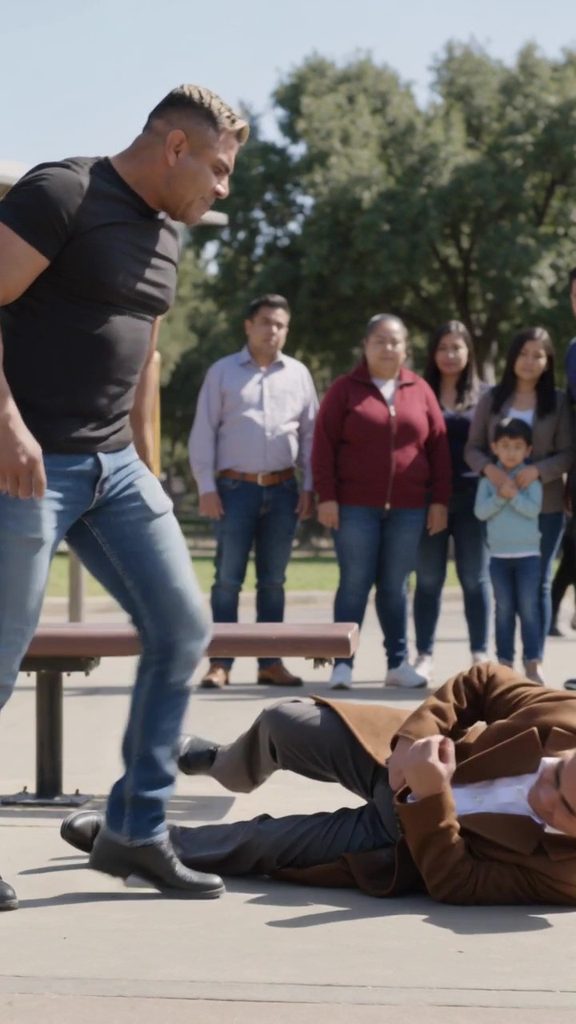
Chapter 1: A girl crying among the trees
At that hour, the public park playground, information booth, park bench, trees, parents nearby, a crying child, and tissues formed an everyday scene. There was movement, brief conversations, and people focused on their own affairs. The 76-year-old Park Helper was there performing a simple task. He wasn’t looking to draw attention to himself or argue with anyone; his movements were discreet and careful, those of someone accustomed to finishing what he starts and leaving without causing trouble.
What seemed like a normal day changed when Muscular Bystander, 40, interpreted a detail of the scene as sufficient proof. Instead of asking what had happened, he decided he already knew the answer. His gaze lingered on Park Helper, his clothing, and his position there. The conclusion came before the events unfolded.
Park Helper tried to explain himself with the words closest at hand: “She was lost. I was helping…” The sentence was clumsy, born of the pressure of the moment, but it contained the essential point: there was an explanation. Muscular Bystander refused to listen. He responded with contempt: “Trash. Stay away from children.” The tone drew stares and turned a minor incident into an awkward spectacle.
Several people stood motionless. Some had only seen the end; others had observed more but hesitated to intervene. This hesitation gave Muscular Bystander the feeling that he could continue speaking as if his version were an established fact. Park Helper, on the other hand, understood that he was no longer trying to clear up a misunderstanding: he was trying to preserve his dignity in the face of a public accusation.
There were, however, details that no one was considering yet. An object out of place, a camera, a record, a person who had witnessed the event, or a document related to what happened. The truth hadn’t disappeared. It was simply waiting for someone to take the time to look for it.
Chapter 2: The accusation that halted the park
Muscular Bystander raised his voice and turned suspicion into a verdict. Each new sentence stemmed from the same idea: that Park Helper must be guilty because he was the easiest person to point the finger at. When Park Helper tried to back away, the confrontation turned physical and ended with him on the ground. The assault was brief, not graphic, but serious enough to completely change the atmosphere. It was no longer about a lost item, damage, or a misunderstanding; it was about a person being humiliated and hurt without any proof.
No one needed to exaggerate what had happened to understand that a line had been crossed. Those around them began to realize that silence also had consequences. One person looked around for an exit, another looked at their surroundings trying to remember what they had seen, and someone else seemed to notice for the first time the elements that could clarify the situation.
Park Helper didn’t plead. He took a breath, tried to sit up, and repeated that things hadn’t happened the way Muscular Bystander said. This calmness further irritated the man who had been expecting an immediate confession. Muscular Bystander issued another demand, convinced that the pressure would be enough to make his version of events seem true.
But the place still held objective traces. There were schedules, positions, cameras, receipts, records, and witnesses connected to the scene. What had happened could be reconstructed. And the more Muscular Bystander insisted on his certainty, the more evident it became that he hadn’t checked anything before acting.
The silence of those present began to break with small gestures. A disapproving glance. Someone holding a phone openly. A person taking a few steps closer. No one yet knew who was going to intervene, but Muscular Bystander’s authority no longer seemed as solid as it had a few minutes before. The question had changed: it was no longer whether Park Helper could defend himself, but how long it would take for the evidence to surface.
Chapter 3: What no one wanted to ask
The response came from a location Muscular Bystander wasn’t monitoring. Laura, 35, arrived accompanied by people with the authority or knowledge to investigate what had happened. She didn’t enter asking who appeared to be at fault. First, she approached Park Helper, checked that he could stand, and positioned herself between them. That order mattered: protect before argue.
Then he listened to their versions. Muscular Bystander spoke quickly, trying to regain control and presenting his interpretation as a certainty. Park Helper responded with fewer words. He didn’t need to embellish the story; he needed someone to look at the facts. Then Laura uttered the phrase that shifted the center of the scene: “He was bringing her to me.”
The instruction pointed precisely to the detail everyone had ignored. Suddenly, the surroundings ceased to be mere decoration and became evidence. What was on a camera, in a record, a bag, an invoice, a box, a history, or in someone else’s testimony could establish a specific sequence of events. Those present drew close enough to understand, without needing to turn the moment into another spectacle.
Muscular Bystander stopped talking for a few seconds. His expression changed because for the first time he had to consider a possibility he had dismissed from the beginning: that Park Helper was telling the truth. “Did he help her?” he managed to ask.
The review began calmly. No one needed to shout. Each piece of information reduced the room for assumptions. A time, a position, a movement, a note, or an image showed that the story was different. The accusation had been born from a first impression and had grown thanks to arrogance. Now it collided with something much harder to manipulate: a verifiable sequence of events.




