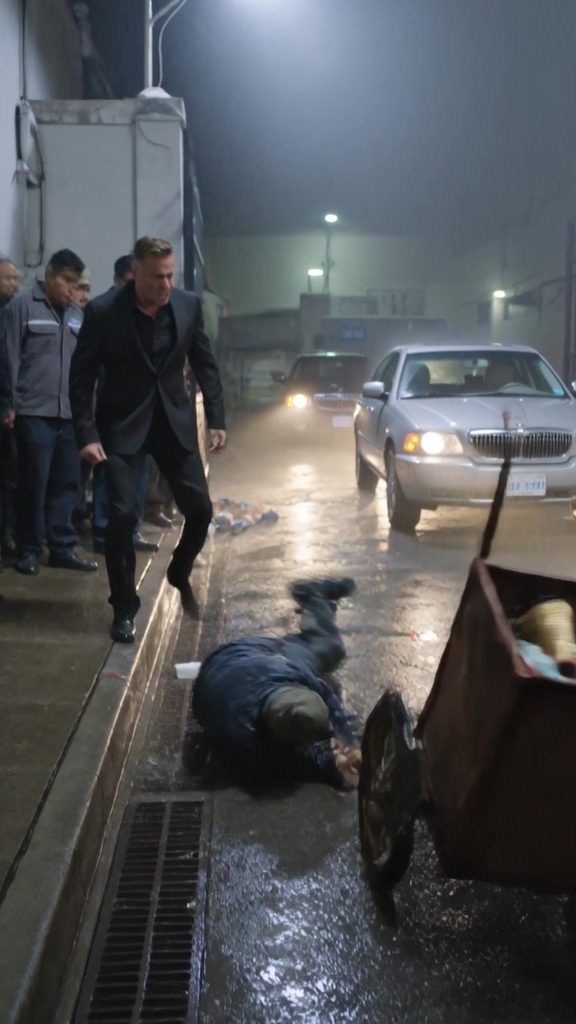
Chapter 1: A moment marked by the bag of rice by the canal
On a narrow industrial road in the pouring rain, with a scrap metal cart, rolling cans, and the headlights of a luxury car, the scene seemed ordinary. However, behind that calm exterior lay weariness, pressure, and people who didn’t know each other—conditions ripe for a misunderstanding to escalate rapidly.
The person who least wanted a conflict was Don Julián Pardo, the head harvester who was bringing food for that night. His manner was careful and reserved, as if he knew that any gesture could be misinterpreted by someone who had already decided to judge.
Don Julián Pardo was well aware of his own limitations and responsibilities. He didn’t intend to impose his will on anyone. Precisely for that reason, when the situation began to change, he decided to stick to his guns and not respond to provocations.
The problem stemmed from something very specific: Ramón became enraged because Julián’s shopping cart was slowing him down and treated his belongings like garbage. What could have been resolved with a simple question ended up being treated as a personal affront.
Ramón Iglesias, the driver in a suit, showed no interest in hearing a full explanation. His first reaction was to assume the other person was wrong and that all it took was raising his voice to impose that version of events.
Around the scrap metal cart, eyes began to gather. Some people looked away; others remained still. The scene became uncomfortable because the problem was no longer just what had happened, but the way Ramón Iglesias was talking about Don Julián Pardo.
Don Julián Pardo tried to keep the conversation simple. He explained what he was doing, why he was there, and what could be reviewed. He wasn’t asking for their trust out of sympathy, but rather for them to verify the information before making a decision.
What no one imagined was that the security cameras at the entrance would end up playing a decisive role. For the moment, however, Ramón Iglesias’s version of events seemed to prevail.
Chapter 2: What happened around the junkyard cart with Don Julián Pardo
The tension grew because Ramón Iglesias spoke with certainty, and certainty is often mistaken for truth when no one dares to question it. Don Julián Pardo, on the other hand, was simply trying to explain the facts.
“I just want us to review what happened,” said Don Julián Pardo, without raising his voice. The phrase wasn’t a provocation. It was a simple request for facts to take the place of assumptions.
Ramón Iglesias interpreted the calmness as weakness. He made comments that sought to reduce Don Julián Pardo to his appearance, his job, or his personal circumstances. This was the part that most unsettled those who were beginning to understand that the discussion had crossed a line.
The surroundings remained the same—a narrow industrial road in heavy rain, with a scrap metal cart, rolling cans, and the headlights of a luxury car—but now every detail seemed more visible. The bag of rice by the canal ceased to be part of the scenery and became the center of a scene no one had planned to witness.
A close acquaintance wanted to intervene, but hesitated. Another noticed the scrap metal cart and recalled a detail that didn’t match the accusation. The silence began to break, not with grand speeches, but with small questions.
Just a few meters from the conflict lay the key: the security cameras at the entrance. Those who knew her began to look at each other, aware that the discussion could change completely as soon as someone reviewed the footage.
Don Julián Pardo didn’t need anyone to invent a defense. The sequence of events itself spoke for itself. That’s why he kept insisting that what had happened be reviewed, even when Ramón Iglesias tried to end the conversation with a definitive conclusion.
It was at that moment that movement was heard from the entrance. Some people turned their heads. Don Vicente Mora’s presence was not yet visible to everyone, but the atmosphere changed before he uttered a single word.
Chapter 3: The Voice That Changed the Balance for Don Julián Pardo
When Don Vicente Mora, the owner of the industrial park, entered the scene, the surrounding noise seemed to subside. His first decision was to separate the conflict from the person who was being pressured.
Vicente temporarily blocked the car’s exit, protected Julián, and ordered a review of the driver’s behavior. Then he requested a simple timeline: what had happened first, who was present, and what records could be consulted.
“First, let’s review the facts,” said Don Vicente Mora. The sentence was short, but it changed the logic of the scene. It no longer mattered who seemed more confident, but what could be proven.
Ramón Iglesias changed his tone and tried to present the conflict as a misunderstanding. However, a misunderstanding did not explain why he had ignored any possibility of verifying the facts before making accusations.
Don Vicente Mora requested that any available records be preserved. He also asked that those who had witnessed the beginning remain for a few minutes. No one was compelled to take sides; only to describe what they had actually observed.
When the security camera footage from the access point was reviewed, the conflict ceased to be a mere dispute of words. Data, timelines, and concrete actions emerged that could be compared.
The contradiction was exposed without the need for a lengthy speech. Ramón Iglesias had taken a conclusion as his starting point, while Don Julián Pardo had requested from the outset that the situation be verified.
The change was evident in their expressions. Those who had previously remained silent began to understand that Don Vicente Mora’s authority wasn’t the most important thing. What mattered was that, finally, someone was following a process.




