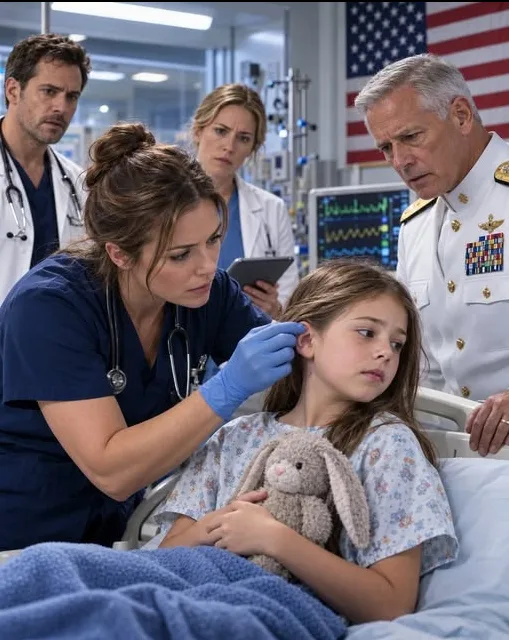
Kayla Doss was just another night-shift nurse in a hospital full of specialists. At least, that was what everyone in the trauma bay believed.
Then a Navy admiral pointed a calloused finger directly at her chest and shouted:
“Don’t touch my granddaughter!”
Eight doctors had already examined the six-year-old girl. One of the region’s most decorated pediatric neurosurgeons had personally declared that she did not need emergency imaging. Yet Kayla was staring at one tiny, catastrophic detail behind the child’s left ear.
And she knew they were running out of time.
“Sir, I need you to step back,” Kayla said. Her voice was flat, level, and entirely devoid of panic.
Rear Admiral Frank Callaway stared at her as if he couldn’t believe a scrub-wearing nobody had just issued him a direct command. He was still wearing his service dress whites, the fabric creased and stained with road grime. His combat ribbons caught the harsh fluorescent glare while his white-knuckled fist remained clamped around the stainless steel bed rail.
“You heard me, young lady,” Callaway growled. “Step away from her.”
“I heard you, Admiral,” Kayla said quietly. “I’m not going to hurt her. But if you keep blocking this bed, you might.”
Behind her, the trauma bay held its collective breath. Two residents, an anesthesiologist, a respiratory therapist, and three floor nurses froze.
The child lying on the gurney was Callaway’s six-year-old granddaughter, Lily. A battered stuffed rabbit with one missing ear was tucked beneath her left arm—pulled from the crushed wreckage of an SUV that had rolled twice down an embankment on Interstate 5.
When Lily had rolled through the automatic doors twenty minutes earlier, the initial triage findings had seemed miraculous. She was breathing spontaneously. Her blood pressure was holding at 100 over 65. Her oxygen saturation sat at ninety-eight percent on room air. To the untrained eye, she looked peacefully asleep.
That stillness made Kayla’s skin crawl. Children who were merely concussed did not breathe with that terrifying, rhythmic shallowness.
Dr. Whitmore Voss, the chief of pediatric neurosurgery, stood at the head of the bed, reviewing the digital chart on an iPad. His scrub top was monogrammed; his silver hair was impeccably coiffed even at two in the morning.
“Scalp contusion,” Voss announced without looking up. “Mild concussion. Stable Glasgow Coma Scale of thirteen. We observe her in the step-down unit for six hours.”
Kayla ignored the chart. She stepped into Voss’s peripheral vision. “Dr. Voss. I need to examine her ears.”
Voss sighed, his jaw tightening with irritation. “You’re a floor nurse, Doss.”
“Night shift. Pediatric trauma overflow.”
“Then let the trauma surgeons and neuro consultants do their jobs. Chart the vitals. Prepare the transfer paperwork.”
Kayla had heard that tone for three years, ever since she hung up her military uniform and took a job at St. Jude Memorial. *Stay in your lane. Don’t question the white coats.*
Tonight, she refused.
“There’s something wrong here,” Kayla insisted, stepping closer to the bed.
“We have eight board-certified physicians in this bay!” Voss snapped, his patience evaporating. “None of us see an indication for radiation exposure through an emergency CT scan. What could you possibly see that we missed?”
“Give me sixty seconds,” Kayla said. “One minute.”
Admiral Callaway moved in, his towering six-foot-three frame casting a shadow over the gurney. “The doctor said no.”
Kayla locked eyes with the battle-hardened officer. She didn’t blink. In her eyes was a dead calm Callaway hadn’t seen since his last deployment to the Persian Gulf—the cold, unshakeable focus of someone who had pulled bodies out of burning wreckage.
“One minute, Admiral,” she whispered. “For Lily.”
Something in her demeanor broke through Callaway’s defenses. He swallowed hard and stepped back half an inch. “Sixty seconds. Not a second more.”
Kayla moved instantly. Supporting Lily’s cervical collar with practiced gentleness, she tilted the overhead surgical lamp. Behind the girl’s left ear, nestled right against the mastoid bone, was a faint, bluish-purple discoloration barely larger than a dime.
Battle’s sign.
Kayla clicked on her pocket otoscope and peered into Lily’s ear canal. A crystal-clear, viscous fluid was welling up from the deep recess of the canal, shimmering under the LED beam.
“Dr. Voss,” Kayla said, her tone dropping into command frequency. “Look at this now.”
Voss approached with obvious reluctance. “It’s just localized road debris—”
“It’s not debris. That’s cerebrospinal fluid,” Kayla stated, her words cutting through the sterile room like a scalpel. “And that’s a basilar skull fracture.”
The room went dead silent.
“Preposterous,” Voss hissed. “You’re diagnosing an occult skull fracture on a superficial bruise?”
Before Kayla could answer, the bedside monitor chimed. A dull, rhythmic warning.
Lily’s heart rate dropped from eighty-four to sixty-one. Then fifty-two.
“Her heart rate is crashing,” Voss stammered, his polished facade cracking. “Could be a vasovagal response—”
“It’s Cushing’s triad!” Kayla shouted, stepping directly between the chief of neurosurgery and the patient. “Look at her chest! Cheyne-Stokes respirations! Her brain is herniating!”
She flicked her penlight into Lily’s left eye. The pupil was completely blown—fixed, dilated, and unreactive.
“Left pupil is wide and non-reactive!” Kayla commanded the paralyzed team. “She’s coning! Call the OR! We need a stat non-contrast head CT and twenty percent mannitol right now!”
Voss went deathly pale. The arrogance vanished from his eyes, replaced by pure terror.
Ten minutes later, inside the CT control room, the first cross-sectional images appeared on the high-resolution monitors.
A massive, biconvex, hyperdense lens of white blood pushed mercilessly against Lily’s left temporal lobe. The brain had shifted seven millimeters across the midline, crushing the brainstem.
Dr. Voss fell back against the console, gripping his own face. “My God… her middle meningeal artery ruptured. It’s an acute epidural hematoma.”
Admiral Callaway turned toward Kayla Doss, his hands trembling violently.




