Chapter 1: PART 1
PART 1: The Boy Who Refused to Fight Back
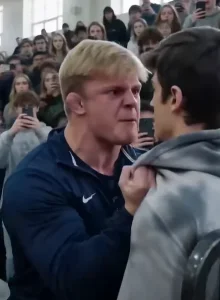
The varsity wrestling captain had his fist twisted into my faded hoodie when he announced to an entire gym full of students that he was going to teach the scholarship kid where he belonged.
Thirty students were watching from the bleachers, and nearly every one of them had a phone pointed at my face.
Coach Miller sat thirty feet away on a wheeled equipment crate, pretending the glowing screen in his hands was more important than what was happening in front of him.
My sneakers squealed against the polished hardwood as Brody Walker shoved me toward the metal bleachers.
Behind him, five junior varsity wrestlers stood shoulder to shoulder across the locker room entrance.
They were laughing.
Some were chanting the nickname I’d hated since seventh grade.
“Charity Case.”
I had heard those two words in hallways, classrooms, the cafeteria, and even during the school’s annual academic awards ceremony.
At sixteen, I had become painfully familiar with the sound of people laughing at things they knew nothing about.
Brody leaned close enough for me to smell his body spray.
“You think getting some fancy scholarship because you can answer test questions makes you better than us?”
I kept my hands open.
“No, Brody.”
“Then why were you staring at Sarah?”
“I wasn’t.”
His grip tightened.
“Now you’re calling me a liar?”
Sarah Mitchell was sitting three rows above us with her friends, looking as uncomfortable as I felt.
She had asked me for help with a chemistry assignment earlier that morning, and apparently that was enough to make Brody decide I had crossed an invisible line.
He was the wrestling team’s undefeated captain.
His photograph hung outside the athletic director’s office.
His name appeared in the morning announcements almost every Friday.
Teachers who barely remembered my name congratulated him in the hallways.
And whenever Brody walked through the cafeteria, students moved aside as though he owned the building.
I knew better than to expect a fair fight.
More importantly, I knew better than to give him one.
“Get on your knees,” he said.
The laughter became louder.
“Apologize for looking at my girlfriend, and maybe I’ll let you walk out.”
I glanced toward Sarah.
She shook her head.
“Brody, I told you he wasn’t bothering me.”
He didn’t even look at her.
“Stay out of this.”
I felt something cold settle inside my chest.
It wasn’t fear of being hit.
I’d been hit before.
It was the familiar humiliation of realizing that everyone around me had already decided the entertainment was worth more than my dignity.
My father once told me that a person could lose a fight without ever throwing a punch.
He also told me that walking away wasn’t the same thing as surrendering.
When I was seven, he began teaching me martial arts in a small community training center that smelled of old mats and floor cleaner.
He never trained me to look impressive.
He trained me to notice balance, control my breathing, protect myself, and recognize the difference between danger and wounded pride.
My father wasn’t interested in trophies.
He believed that the most important thing a strong person could do was decide when not to use strength.
Then, three years earlier, he died after a sudden illness that left my mother and me with medical bills, a nearly empty savings account, and a home that suddenly felt much too quiet.
I stopped attending the training center regularly after that.
But I never forgot what he taught me.
Especially his final lesson.
“Never hurt someone just because they want to hurt you.”
Brody jerked my collar again.
“Are you listening?”
“Yes.”
“Then apologize.”
“I haven’t done anything wrong.”
His smile vanished.
That was when I noticed his front foot shift.
His weight moved forward.
His right shoulder rose slightly.
Anyone else might have seen an angry teenager preparing to shove me again.
I saw the beginning of a punch.
“Brody,” I said quietly, “I’m asking you to let go.”
He laughed directly into my face.
“Or what?”
“Or somebody’s going to get hurt.”
The students immediately began shouting.
Brody looked delighted.
“You hear that?”
He turned toward the bleachers.
“The charity kid thinks he’s tough.”
Someone yelled for him to knock me down.
Someone else shouted my nickname.
I looked toward Coach Miller.
He was still holding his phone.
For one brief moment, our eyes met.
He knew.
I could see it in the way his expression tightened before he deliberately looked away.
That hurt more than anything Brody had said.
I wasn’t naïve enough to believe teachers could prevent every cruel word or ugly confrontation.
But I had hoped at least one adult would care when things went too far.
Brody pulled his fist back.
I brought my feet together.
Then I gently slipped my collar out of his grip, lowered my head, and bowed.
For a moment, nobody understood what they were seeing.
The shouting weakened into scattered laughter.
Brody blinked.
“What was that supposed to be?”
I raised both hands with my palms facing him.
“My last request for you to walk away.”
His face turned red.
Then he lunged.
I stepped sideways, guided his reaching arm past my shoulder, and moved out of his path.
His own momentum carried him several steps across the hardwood.
The crowd gasped.
Brody caught himself before he fell.
He spun around.
“You little—”
He charged again.
This time his arm came toward my face, and I reacted before I had time to think about the watching phones.
I controlled his wrist and elbow, turned away from his forward pressure, and brought him down in one controlled movement.
His back hit the hardwood with a loud thud.
I released him immediately.
No punch.
No kick.
No celebration.
I simply stepped away and held my hands open.
The gym became so quiet that I could hear a basketball bouncing somewhere in the distant hallway.




