By the time I arrived, everyone expected me to run too—but I needed the money badly enough to face a ruthless mafia boss, and before the week was over, I would do the one thing he had forbidden every nurse from doing.
The town car smelled like leather and stale cigarettes as it carried me beyond Chicago into miles of dark evergreens.
My hands rested against my worn scrubs while I thought about the final notice on my kitchen counter and my younger brother Tommy lying ninety pounds thin in a hospital bed.
His leukemia had stopped responding to standard treatment.
The experimental trial that might save him cost more than I could earn in three lifetimes.
Then an anonymous caller offered me $10,000 a week in cash.
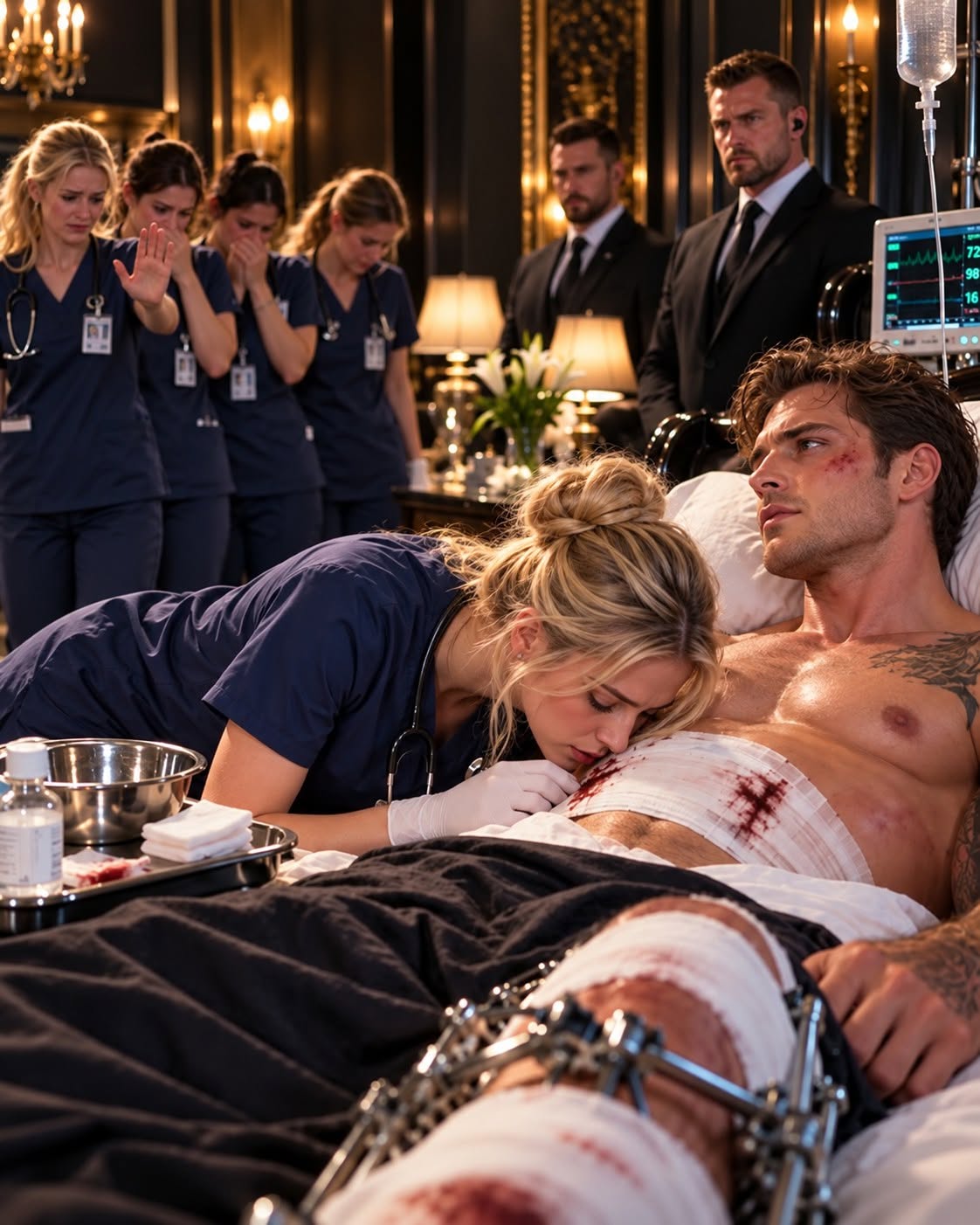
The rules were simple: live on the estate, carry no phone, ask no questions about my patient’s injuries, and ignore the armed men guarding the property.
I said yes.
A man named Leo met me outside the stone mansion.
“Your predecessor lasted two days,” he said as he led me upstairs. “The nurse before her lasted a shift and a half.”
“What’s wrong with him?”
Leo stopped outside a pair of heavy doors.
“Liam Mercer hates being helpless. He’ll insult you, refuse medication, throw things.”
Then his voice lowered.
“Do your job. Don’t try to fix him. Don’t talk back.”
He paused.
“And never touch the blinds.”
“Why?”
“He wants the room dark.”
I shifted my cheap duffel higher on my shoulder.
“As long as Friday still means ten thousand dollars, he can growl all he wants.”
Leo opened the doors.
The room smelled of iodine, sweat, and infected flesh.
From the darkness came a voice rough enough to scrape skin.
“Tell her to leave.”
Leo looked at me once, then shut the door behind him.
I switched on a lamp.
A glass exploded against the wall beside my head.
Liam Mercer lay in the enormous bed, bruised and pale, his right leg trapped inside an external fixator, metal pins drilled into bone. Heavy abdominal bandages were already bleeding through.
“Turn that light off.”
“No.”
His icy blue eyes narrowed.
“I need to inspect your wound.”
“Get out.”
I washed my hands instead.
“From the smell, you’re developing an infection. So unless dying dramatically is part of your schedule, I’m changing that dressing.”
When I peeled the gauze back, the skin beneath it was angry red and beginning to rot.
Liam grabbed my wrist.
“Don’t touch me.”
“You’re cutting off circulation.”
His grip tightened.
“I said don’t.”
I met his stare.
“If I leave that tissue untreated, bacteria enter your bloodstream and you die.”
I leaned closer.
“And I need you alive until Friday.”
Something shifted in his expression.
Slowly, he released me.
I cleaned the wound, started antibiotics, checked every pin in his leg, and sat in the corner with a paperback.
“Turn the light off.”
“When I finish the chapter.”
For the first time in five weeks, nobody ran from Liam Mercer’s room.
By day four, he had stopped throwing things.
Instead, he punished me with silence.
“Pain from one to ten?” I asked, holding his morphine.
Nothing.
I stared at him.
“Fine. You can be stubborn in pain.”
His jaw flexed, but he still refused to answer.
That afternoon, I noticed something I had missed before.
Every time sunlight slipped through the tiny gap between the curtains, Liam turned his face toward it.
Not away.
Toward it.
I looked at the sealed blinds.
Then at him.
“Don’t,” he said quietly.
The heavy cord of the window blinds felt cold against my palm, coated in a fine layer of dust from weeks of neglect. Across the expansive, shadowy bedroom, Liam Mercer’s body went completely rigid. Even with his right leg pinned inside a cruel apparatus of stainless steel and carbon fiber, his shoulders squared with a sudden, predatory tension that made him look less like a wounded animal and more like a cornered wolf ready to strike despite its injuries.
“I said don’t,” he repeated. His voice was lower this time, stripped of the jagged theatrical anger he had used on the previous nurses, replaced by a quiet, lethal warning. “Leave the blinds closed.”
I didn’t let go of the cord. My fingers curled tighter around the plastic toggle. Downstairs in a sterile hospital room sixty miles away, my twelve-year-old brother Tommy was fighting a losing battle against a mutation of leukemia that laughed at standard chemotherapy. Every breath he took was measured in dollars I didn’t have, days I was running out of, and a mountain of medical debt that grew taller with each sunrise. Ten thousand dollars a week in crisp, untraceable cash wasn’t just a paycheck; it was oxygen. It was life.
And right now, the man standing—or rather, trapped—between me and that money was treating sunlight like a personal insult.
“You’ve spent four days staring at the ceiling in a room that smells like a wet tomb,” I said, keeping my tone level, professional, and entirely unbothered by his mafia pedigree. “Your skin has the texture of spoiled milk, your vitamin D levels must be hovering somewhere near absolute zero, and your circadian rhythm is so broken your body doesn’t even know whether to heal or prepare for the morgue.”
Liam’s icy blue eyes narrowed into thin, dangerous slits. “You think you’re a comedian, nurse? You think because you stitched up my abdomen and didn’t run screaming like the last girl that you’ve earned the right to rearrange my room?”
“I’m not a comedian. I’m a surgical nurse who has spent twelve-hour shifts knee-deep in trauma units where patients had far worse attitudes and significantly better manners,” I shot back, turning my head to look him square in the face. “And I am opening this window. A crack, at least. Your body needs air that hasn’t passed through three layers of heavy velvet.”
Before he could bark another threat, I pulled the cord.
A sharp, rattling hiss echoed as the wooden slats spun open, and a pale shaft of late-afternoon autumn sunlight sliced through the gloom, cutting directly across the heavy oak floorboards and landing warm and golden upon Liam’s face.
He didn’t yell.
Instead, he squeezed his eyes shut. His jaw clenched so hard I thought I heard enamel grinding against enamel. His long, pale fingers gripped the edge of the Egyptian cotton sheets until his knuckles turned paper-white.
I froze, suddenly wondering if I had miscalculated. Was it pain? Was it photosensitivity from weeks in the dark?
Then I saw the tear.
A single, brilliant drop of moisture escaped from beneath his tightly sealed eyelashes, cutting a dark track down his bruised, stubbled cheek before disappearing into the collar of his hospital gown.
The silence in the room stretched out, thick and heavy, broken only by the steady beep of the cardiac monitor beside the bed.
“My father kept this room dark after the night on the docks,” Liam whispered, his voice losing its iron armor entirely, sounding impossibly young, broken, and hollow. “If the light gets in… they can see inside.”
I slowly let go of the blind cord. The defiance in my chest evaporated, replaced by a sudden, heavy wave of professional empathy. No amount of money, no amount of mafia intimidation, could erase whatever trauma had locked this man inside a self-imposed prison of eternal night.




