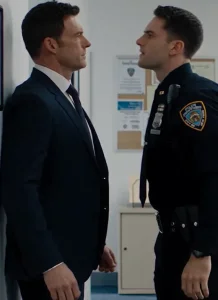
I. The Quiet Arrival: Marcus Reed’s Deliberate Choice
The steady, crisp rhythm of polished leather shoes echoed across the marble floor of the Riverside Police Station’s main lobby. Outside, the city was still waking beneath a thin layer of early-week mist, yet inside this central command hub, the machinery of law enforcement was already grinding into motion.
Marcus Reed stepped through the automatic glass doors with a subtle sense of unfamiliarity. The freshly pressed command uniform draped across his shoulders still carried the faint scent of new fabric—tailored, sharp, and undeniably authoritative, though not yet broken in. Pinned neatly to his collar was the insignia of high command, symbolizing both the authority he was about to assume and the scrutiny he knew would follow.
Reed had deliberately avoided a grand entrance. There were no welcoming applause lines at the front doors, no polished speeches, and no scheduled press briefings prior to the start of the shift. The silence was entirely by design. Over a career spent rising through the ranks across multiple districts, Reed had learned a fundamental truth: if you want to understand how a precinct truly operates, never observe it during a scheduled inspection. Watch it when everyone believes nobody of consequence is watching.
His official department photograph had not yet been distributed to the lower ranks—a routine administrative delay that Reed had quietly requested be maintained for just a few more hours. Carrying nothing more than a slim leather folder containing strategic assessments and personnel files, he moved unobtrusively through the lobby.
The morning routine unfolded before him in raw, unvarnished detail. To his left, the front desk was buried beneath unsorted overnight reports. Down the corridor leading to the booking area, the metallic rattle of holding cell doors mixed with the gruff exchanges between tired officers and morning detainees. Everything ran on the inertia of a long-established ecosystem—one marked by fatigue, routine, and the quiet territorial pride of seasoned veterans.
Marcus paused briefly near the roll-call board, intending to head straight upstairs to the administrative offices before the 7:00 AM briefing began.
He had underestimated, however, the fierce territorial instincts of the man guarding the floor.
II. Confrontation in the Lobby: The Snap of Steel
“Stop right there.”
The command cut through the ambient noise of the lobby like a blade. Reed turned around to find Sergeant Garrett Caldwell blocking his path. Caldwell was a fixture at Riverside—a veteran of nearly twenty years who knew every corner of the building and every face on the morning shift. Broad-shouldered, weathered by decades of street and desk duty, Caldwell let his cold gaze sweep slowly from Reed’s boots to his collar.
“Where exactly do you think you’re going?” Caldwell asked, one hand resting casually near his belt, his posture radiating undisguised skepticism.
Marcus Reed stood tall, maintaining the composed, unhurried demeanor of a leader accustomed to high-stakes environments.
“Upstairs,” he replied evenly.
Caldwell narrowed his eyes. His gaze lingered on the command insignia pinned to Reed’s uniform. In Riverside, every officer from rookie patrol to precinct captain was a known quantity to Caldwell. Seeing an unfamiliar face wearing senior command brass—without prior clearance or introduction—registered immediately as a challenge to his domain.
“Want to give me that answer again?” Caldwell asked, a humorless smirk tugging at the corner of his mouth.
“I have business with the commissioner,” Marcus said, his tone calm and matter-of-fact.
That very composure seemed to strike a nerve. Caldwell let out a short, sharp laugh and stepped closer, closing the distance between them.
“You walk into my station wearing command insignia I’ve never seen on you, and you think you’re just going to stroll upstairs?” Caldwell’s voice rose slightly. “Do I look like I was born yesterday?”
Marcus did not flinch. He held the sergeant’s gaze steadily. “You could confirm my identity in less than a minute.”
What had started as a routine challenge was rapidly drawing an audience. Across the lobby, officers assembling for roll call slowed their pace. Conversations faded mid-sentence. The rustle of paperwork stopped. Dozens of eyes turned toward the center of the floor, watching the standoff between the unfamiliar commander and the precinct’s most vocal shift supervisor.
Caldwell extended an open palm. “Identification. Now.”
Marcus moved deliberately, reaching slowly toward the inside breast pocket of his uniform to retrieve his credentials.
To a sergeant already primed for confrontation, the movement was all the excuse he needed.
“Easy!” Caldwell barked, lunging forward to seize Marcus’s wrist in a vice-like grip.
Marcus froze instantly, keeping his posture relaxed and offering zero resistance. “I was reaching for what you asked me to provide.”
Caldwell’s jaw tightened, his pride clearly bruised by the lack of fear in the man standing before him. He increased the pressure on Marcus’s wrist.
“Keep your hands where I can see them,” Caldwell snapped.
Marcus complied to the letter—no anger, no struggle, no raised voice. Yet his quiet control only seemed to escalate the sergeant’s determination to assert dominance in front of the watching shift.
From behind the front desk, a younger officer—a junior lieutenant with an uneasy expression—stepped forward cautiously. “Sergeant, maybe we should just verify his credentials before—”
Caldwell raised a hand to cut him off without looking back. Stepping closer to Marcus, he inspected the insignia on the uniform once more.
“Where did you get this uniform?” Caldwell demanded.
“It belongs to me,” Marcus answered calmly, betraying no discomfort despite the grip on his arm.
“Of course it does,” Caldwell scoffed.
Around the room, several officers exchanged uncomfortable glances. Something about the stranger’s bearing felt unmistakably authentic. Impersonators rarely possessed that kind of unshakeable stillness under pressure—especially when cornered by a sergeant notorious for his uncompromising temper.
Marcus lowered his voice so only the two of them could hear. “Sergeant Caldwell, verify my name before you make another decision.”
Hearing his own name spoken aloud appeared to push Caldwell past the point of reason.
“You don’t get to intimidate me because you memorized a nameplate,” Caldwell growled. “Turn around.”




