PART 1: The Crutch Across the Gym Floor
The crutch flew out of my hand before I even felt Blake’s shoe strike it, and nine months of surgeries, rehabilitation, and desperate hope collapsed beneath me in one terrifying second.
Metal cracked against polished hardwood as the crutch spun toward the bleachers, while my injured right leg buckled and sent a lightning bolt of pain through my knee.
I caught the gymnasium doorframe with both hands, my fingers digging into the painted wood as I struggled to keep my full weight off the leg that had already cost me almost everything.
Blake stood three feet away, wearing the same arrogant smile I remembered from the afternoon my basketball career had ended, and his expensive white sneakers remained planted exactly where he had kicked me.
“Off my court, cripple,” he said, speaking loudly enough for the basketball players gathering near the benches to hear every humiliating word.
Someone laughed behind him, but the sound disappeared beneath the pounding of my heartbeat and the horrible realization that my knee might have been damaged all over again.
I noticed a phone raised above the bleachers, its camera pointed directly at us, and immediately understood that my worst moment was about to become somebody else’s entertainment.
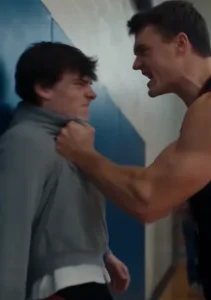
Blake stepped closer and shoved both palms against my chest, making my shoes slide across the floor while the door rattled violently against my shoulder.
“You’re finished,” he said, his smile widening as he watched me struggle to remain upright, “and nobody wants you on this team anymore.”
I grabbed a fistful of his jersey because I had nothing else to hold, not to punch him or pull him down, but to stop him from shoving me again.
“What are you gonna do?”
Blake asked, glancing toward the raised phone as though he wanted the person recording to capture my humiliation from a better angle.
I stared into his face and felt nine months of anger rising through the pain until my voice came out quieter and steadier than I expected.
“You already hurt my knee,” I said, tightening my grip only enough to keep him from stepping forward again.
Something changed in Blake’s expression, and for half a second his confident smile disappeared beneath a flash of recognition that told me he remembered exactly what I was talking about.
Then he jerked backward, tearing his jersey from my fingers while throwing his arms outward so dramatically that anyone watching from a distance might have mistaken me for the aggressor.
I lost my balance completely, landed against the doorframe, and heard several students shouting as Blake stumbled backward onto the basketball court.
Coach Bennett’s whistle pierced the gymnasium, bringing every conversation to an abrupt halt as he hurried toward us from the scorer’s table.
For one foolish moment, I believed the coach would finally do what he should have done nine months earlier and tell everyone what he had witnessed.
Instead, his eyes moved from Blake’s stretched jersey to my shaking hands, and I watched his face harden into an expression I had come to know too well.
“Get your hands off my player,” he shouted, even though I was no longer touching Blake and could barely remain standing without my missing crutch.
Blake straightened immediately, smoothing his jersey and adopting the wounded expression he always used when an adult appeared after one of his confrontations.
“He attacked me, Coach,” Blake announced, pointing toward my hands while several players exchanged uncertain glances behind him.
I stared at the man who had coached me since freshman year, unable to believe he was allowing the accusation to settle over the gym without correcting it.
“He kicked my crutch,” I said, trying to control the trembling in my voice as pain spread from my right knee into my hip.
Coach Bennett glanced toward the bleachers, where the student holding the phone lowered it slightly but did not stop recording.
“I saw you grab his jersey,” the coach replied, keeping his voice firm enough for everyone nearby to hear.
“You saw him kick me,” I answered, and the sudden silence around us told me the entire gym understood how serious that accusation was.
Blake laughed softly, but his eyes remained fixed on Coach Bennett as though he were waiting for a familiar performance to begin.
Coach Bennett looked at my knee brace, then at the crutch lying several yards away, and something almost like shame crossed his face before he turned away.
“You’re done here,” he said, pointing toward the hallway with the same hand that had once rested proudly on my shoulder after every winning game.
I wanted to remind him that I had come only to deliver my rehabilitation clearance, which allowed supervised conditioning but not contact basketball, after months of fighting for the smallest chance to return.
I wanted to tell everyone that I had never stopped thinking about the sound my knee made when Blake hit it during practice nine months earlier.
Instead, I leaned against the doorway and asked the question that had haunted me through surgery, physical therapy, sleepless nights, and every moment when I wondered whether I would ever run normally again.
“Coach, are you really going to pretend you didn’t see what happened?”
His jaw tightened, and he looked past me toward the hallway as though searching for a way to escape the question without answering it.
Blake folded his arms across his chest, clearly enjoying the spectacle of watching the man who controlled our basketball program decide which one of us deserved protection.
Coach Bennett ordered a nearby player to retrieve my crutch, but he refused to look at me while the boy carried it across the gym and placed it within my reach.
I took the crutch with shaking fingers, knowing that accepting help from someone who had just watched me be humiliated should not have felt so much like surrender.




