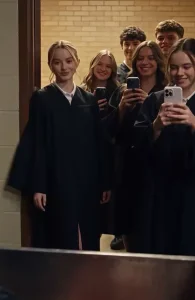
“Your mom’s dog-cop costume is trash, just like you,” Avery Kingsley laughed, ripping the K9 unit patch off my mother’s old police jacket and flinging the jacket into the dumpster outside the stage door.
It landed on a pile of broken folding chairs and spilled punch while two hundred seniors in caps and gowns watched from the hallway before graduation.
Avery’s father was the mayor of the city, and Vice Principal Benton had been angling for a seat on the mayor’s education board all year.
For four years, Avery and her friends had poured soda into my locker, stolen my notes before every exam, and called me the cop’s mutt.
My mother had been a K9 officer for fifteen years, and she taught me one rule in our backyard with her dog watching: you stay calm, you stay in control, and you never strike first.
When Avery’s boyfriend shoved me toward the concrete steps and swung at my face, I stepped inside his arm and set him down gently on the hallway floor.
Six minutes later, the convention center doors opened, and forty police officers in dress uniforms walked in with forty German shepherds heeling at their sides.
Then Vice Principal Benton saw the woman leading them, went white, and slid his phone face down on the podium.
Graduation for Riverside High was held every June in the downtown convention center.
Four hundred and twelve seniors.
Three thousand family members.
A stage with a long blue banner, a podium with the school seal, and one microphone that only a few people would ever speak into.
I was supposed to be one of them.
For four years, I had worked harder than I knew a person could work.
I took eleven AP classes.
I studied at the kitchen table until two in the morning while my mother iced her back in the recliner.
I worked weekends at the animal shelter cleaning kennels.
And in April, when the final grades were tallied, my name came out on top.
Valedictorian.
Molly Hayes.
The first valedictorian in Riverside history whose family had never owned a house.
I had written my speech six times.
The final draft was folded in the pocket of my gown.
And over my gown, on the morning of graduation, I wore my mother’s jacket.
It was a navy-blue police department windbreaker, faded at the elbows, with a gold badge stitched on the chest and a round patch on the left shoulder.
The patch showed the head of a German shepherd over the words K9 UNIT.
Sergeant Karen Hayes had been a police K9 handler for fifteen years.
She worked with three dogs over that time.
Duke.
Ranger.
And Bella, who was eleven now, gray in the muzzle, and asleep on our couch most of the day.
My mother and her dogs had found missing children, lost hikers, and old men with dementia who wandered out into the snow.
Two years ago, she was injured chasing a suspect over a fence.
Her back never healed right.
She retired on a medical pension and spent most days now in a recliner with a heating pad, Bella curled up on her feet.
The school rules said graduates could wear one item over their gown to honor someone who helped them get there.
My mother had taken the jacket off its hanger that morning and helped me into it herself, wincing as she reached up.
You stay calm up there, Molly, she said.
You stay in control.
And you never strike first, even when somebody’s begging you to.
A dog that bites first gets put down.
A handler who swings first loses her badge.
My mother had also signed me up for judo at the police athletic league when I was seven, because she said every cop’s kid needs to know how to stay on her feet.
“Oh my God,” a voice said behind me.
“Is she wearing a costume?”
Avery Kingsley stood in the hallway behind the stage in her gown, surrounded by her friends.
Her boyfriend, Chase Morrow, stood beside her with his arms crossed.
Avery had been salutatorian.
Second.
By two tenths of a point.
And her father, Mayor Thomas Kingsley, was sitting in the reserved front row of the convention center at that very moment, waiting to hear his daughter speak.
“Is that from a Halloween store?” Avery asked.
“It’s my mother’s,” I said quietly.
I kept looking over my speech.
Avery had been doing this since ninth grade.
She had poured soda through the vents of my locker and ruined a semester of chemistry notes.
She had stolen my study guide before the AP Biology exam and passed copies to her friends.
She had started calling me the cop’s mutt, and half the school had picked it up.
Every time I reported something to Vice Principal Benton, he told me that Avery came from a good family and I should focus on myself.
Vice Principal Benton had been nominated for a seat on the mayor’s new education advisory board.
The mayor would make the final pick next month.
Twenty minutes before the ceremony, Vice Principal Benton walked down the backstage hallway with a sheet of paper in his hand.
He stopped in front of me.
“Miss Hayes,” he said.
“I’m afraid I have some unfortunate news.”
He said it loudly enough for the whole hallway of seniors to hear.
“A formal academic dishonesty report has been filed against you.”
“You were seen using a phone during your AP Chemistry final.”
“Your final exam has been voided, and your grade has been changed from an A to a C.”
“That drops you to fourth in the class.”
“You are no longer valedictorian.”
“Miss Kingsley will be giving the address.”
The hallway went silent.
I stared at him.
“That’s not true,” I said.
“Mrs. Lindqvist locks every phone in her desk drawer during exams.”
“Mine was in there the whole time.”
“Ask her.”
“Please.”
“The decision has been made,” Benton said.




