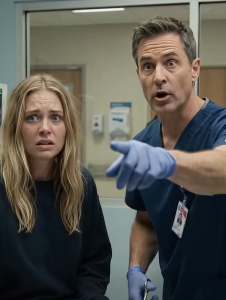
PART 1 — THE NIGHT I REFUSED TO WAIT
The ER doctor did not ask me how much pain I was in. He cut the bandage off my calf, stared at the tiny purple punctures near my ankle, and said, “Lock this room. Call hospital security. Then call the police.”
“I came in with a fever,” I said.
Dr. Colin Shepard looked at me as if the fever were now the least important thing in the room.
“Mrs. Holloway, these marks are not from an infected scrape.”
My mouth went dry.
Five days earlier, I had nicked my ankle on a metal garden edge in our Scottsdale backyard. It barely bled. My mother-in-law, Bonnie Holloway, reminded me she had spent thirty years working in surgical recovery.
“Let me handle it,” she had said.
Every night after that, Bonnie came over with soup, gauze, and antiseptic wipes.
Every night, she insisted on cleaning the wound herself.
And every night, my fever got worse.
By the fifth evening, my skin felt like it was burning from the inside.
I was on the couch wearing sweatpants and an old Navy sweatshirt when I begged my husband, Travis, to drive me to the emergency room.
He did not look away from his laptop.
“Wait until morning.”
I stared at him.
“My temperature is 103.4.”
“You always assume the worst.”
“I can barely stand.”
He sighed.
“Lauren, you’re being dramatic.”
That word did something to me.
Not because it hurt.
Because it was wrong.
Before I became an emergency nurse, I served eight years as a Navy hospital corpsman, then investigated medical billing fraud for a federal contractor. I knew fever, cellulitis, and sepsis.
And I knew my own body.
So I ordered a rideshare.
Travis actually shook his head when I stood.
“If you go in tonight, you’ll sit there for six hours and come home with antibiotics.”
“Then I’ll come home with antibiotics.”
He never offered to come with me.
The driver had to help me out at Copper Ridge Medical Center when my left leg buckled. The triage nurse immediately called for a wheelchair, and ten minutes later Dr. Shepard was staring at my calf.
Now a security officer stood outside the door.
A second nurse drew blood.
Dr. Shepard leaned closer to the wound under a bright examination light.
“There are several puncture sites,” he said.
I stopped breathing.
“No.”
“Yes.”
“I would know if someone injected me.”
“Not necessarily if you were sick, exhausted, medicated, or asleep.”
My mind jumped backward through the week.
Bonnie kneeling beside the couch.
Bonnie lifting the cuff of my sweatpants.
Bonnie saying, “Hold still, sweetheart.”
Bonnie tucking a blanket tightly around my legs.
Then another memory surfaced.
Travis standing in the kitchen doorway two nights earlier, watching her.
Not surprised.
Not concerned.
Watching.
A nurse asked if I wanted her to call my husband.
“No.”
The answer came out so fast that everyone looked at me.
I swallowed.
“Not yet.”
Dr. Shepard ordered emergency imaging and toxicology screening, saying only that the tissue damage and punctures did not match a simple yard injury.
Forty minutes later, my blood pressure crashed.
The room exploded into motion.
Someone cut away my pant leg, started another IV, and rushed me toward surgery as a monitor shrieked beside my head.
Then I heard another voice at the doorway.
Travis.
“What happened?”
He sounded breathless.
For half a second, relief hit me.
Then I saw his face.
He was not looking at me.
He was looking at Dr. Shepard.
More specifically, he was looking at the clear evidence bag in the doctor’s hand containing the bandage from my leg.
Travis went pale.
That was the moment my marriage ended.
When I woke after surgery, it was almost dawn.
My leg was wrapped from ankle to knee.
A woman in a charcoal blazer sat near the window.
She introduced herself as Detective Renee Lawson with the Maricopa County major-crimes unit.
“Your mother-in-law was detained downstairs,” she said.
I stared at her.
“Why?”
“Hospital security saw your mother-in-law enter twenty minutes after your husband and try to reach this floor.”
My heart started pounding.
Lawson continued.
“She had a syringe in her purse.”
The room seemed to shrink.
I looked toward the door.
“Where is Travis?”
“Speaking with another detective.”
“Is he under arrest?”
“Not at this time.”
Not at this time.
The phrase terrified me more than if she had said yes.
A toxicologist arrived with preliminary results. A restricted paralytic compound had been found in my blood at a level designed to create progressive weakness rather than immediate collapse.
Someone had been dosing me gradually.
Someone wanted my death to look medical.
I remembered Bonnie’s hands at my ankle.
I remembered Travis telling me to wait until morning.
Then I remembered something neither of them knew I had found.
Seven months earlier, while looking for a tax document in Travis’s desk, I had discovered an insurance confirmation email.
A life policy.
Three and a half million dollars.
My name.
My supposed signature.
Travis listed as sole beneficiary.
I had copied everything onto an encrypted drive and hidden it in a storage unit across town because I had not yet decided what it meant.
Now there was nothing left to explain.
Detective Lawson leaned forward.
“Lauren, is there any reason your husband would benefit financially from your death?”
I looked at her.
Then I looked at the locked hospital door.
“Yes,” I said.
And before I could tell her how much, my phone lit up on the bedside table.
A security alert.
Someone had just opened my storage unit.




