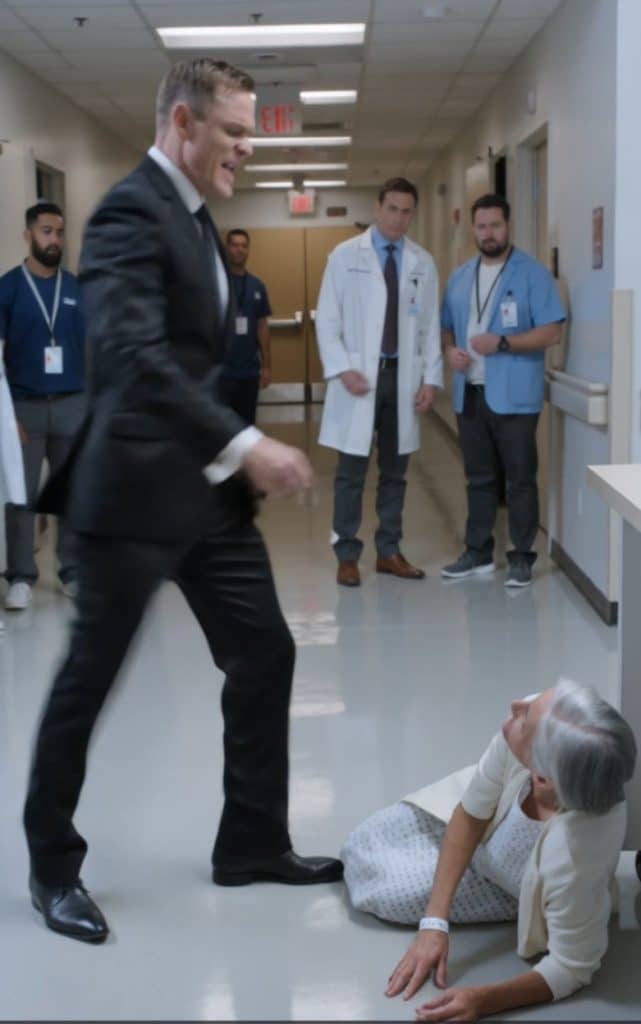
Act I
The volunteer had already placed the final sealed meal box into Margaret Ellis’s trembling hands when the man in the black suit reached across the table and took it.
Margaret was seventy-two.
A hospital wristband circled one thin wrist, and a pale jacket hung loosely over her patient gown. She had spent most of the day moving between appointments and waiting-room chairs beneath the cold white lobby lights.
“Please, I haven’t eaten today.”
The man barely looked at her.
His silver tie was perfect. A gold watch flashed beneath his cuff while exhausted patients watched from nearby chairs.
“Trash. You can eat anything.”
Margaret reached weakly toward the box.
The confrontation turned violent.
She was knocked down beside the meal table and attacked again briefly while volunteers, caregivers, and patients recoiled in horror. The sealed meal box landed nearby, and Margaret remained conscious, shaken, and clearly in pain.
Nobody intervened before the man stopped.
“Stay down and wait for scraps.”
Then the executive corridor door opened.
Dr. Thomas Warren stepped into the lobby wearing a navy suit beneath an open white medical coat. His director badge caught the fluorescent light as two physicians followed several steps behind.
Thomas saw Margaret on the floor.
He saw the man standing over her.
And he saw the final meal box.
He moved quickly, stopped the confrontation with a single physical intervention, and immediately placed himself between the man and the elderly patient.
“That last meal just showed me who should never walk this hallway again.”
For the first time, the man’s confidence changed.
“Who are you?”
Thomas did not answer.
His eyes were fixed on a small blue label attached to the side of the meal box.
It contained a batch number.
A distribution station.
And one line that should have been impossible.
Meal served.
The system showed that box had already been successfully distributed eleven minutes earlier.
Yet Thomas had just watched a volunteer physically hand it to Margaret.
He picked up the box and looked toward her wristband.
Margaret had been approved that morning for the hospital’s patient nutrition assistance program.
Her own meal record still showed pending.
The box said served.
The patient said waiting.
Those two facts could not both be true.
Thomas looked across the nearly empty charity table.
For months, executives had been celebrating extraordinary numbers from the program.
Near-perfect distribution.
Minimal waste.
Thousands of meals reaching patients and caregivers who needed them.
But now he was staring at the last box of the day.
And the computer believed it had already fed someone.
Margaret had lost one meal in front of an entire lobby. Thomas was about to discover how many other missing meals had disappeared inside the word served.
Act II
The program was called Bridge Table.
It had begun after nurses noticed the same problem repeatedly.
Patients arrived early for testing.
Appointments ran late.
Family caregivers spent hours in waiting rooms.
Some people had enough money to buy lunch in the cafeteria.
Others quietly went without.
Hospital social workers began keeping crackers and juice in their offices.
Volunteers brought sandwiches.
Then the hospital foundation created a formal meal program.
Every weekday, the cafeteria prepared sealed boxes containing simple food suitable for general distribution.
Patients and caregivers identified through the hospital’s assistance process could receive one without payment.
The goal was deliberately discreet.
Nobody wanted an elderly patient forced to announce financial hardship in a crowded lobby.
A small eligibility marker appeared in the hospital system.
Volunteers received a daily count.
People collected food with as little ceremony as possible.
For several years, the program stayed modest.
Then donors embraced it.
Local companies funded additional meals.
Foundation supporters sponsored weeks of service.
The hospital began including Bridge Table results in community-impact presentations.
Meals distributed became one of the most popular numbers in the report.
Thomas liked it too.
It was tangible.
A donor could understand what ten thousand meals meant more easily than a page of abstract administrative statistics.
Then the program expanded to three hospital buildings.
That created an inventory problem.
Boxes left the cafeteria in rolling insulated carts.
Some went to outpatient clinics.
Some to the emergency-family waiting area.
Some to the main lobby table.
The hospital hired NourishLink Services to manage distribution logistics.
NourishLink did not prepare the food.
It moved it.
Tracked it.
Reconciled inventory.
Managed volunteer station counts.
Its software was supposed to answer a simple question.
Where did every box go?
At first, volunteers scanned each meal when it changed hands.
That was accurate.
It was also slow.
Lines formed.
Some patients struggled with the process.
Volunteer coordinators complained that the technology was making a kindness feel like a checkout counter.
So NourishLink proposed batch distribution.
When a cart containing forty meals reached an approved station, the station coordinator scanned the tote once.
The system transferred all forty meals from cafeteria inventory into distributed program inventory.
The original technical meaning was that the meals had been released for distribution.
But when the hospital built its executive dashboard, the label was shortened.
Distributed became served.
That one word changed everything.
A box arriving at a table became statistically identical to a box reaching a hungry person.
For a while, the difference seemed harmless.
Most boxes were handed out anyway.
Then demand changed.
Clinic schedules became less predictable.
Some afternoons ended with leftovers.
Other afternoons ran out early.
Volunteers noticed that patients with late appointments were especially likely to miss the table.
The dashboard did not notice.
If forty boxes reached the lobby at noon, the system credited forty meals served even if only thirty-two people received them there.
What happened to the remaining eight depended on the day.
Some were transferred to another station.
Some returned to refrigeration within food-safety limits.
Some were used later.
But because the original batch had already entered the served count, subsequent movement lived in a different inventory record.
The executive report retained forty.
Then there was the opposite problem.




