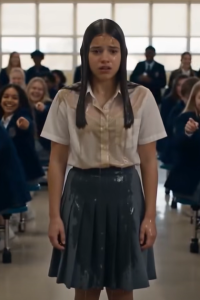
Chapter 1:
The water was so cold that, for one terrible second, I couldn’t breathe.
It crashed over my head in a disgusting brown wave, carrying the smell of old food, dirty floors, and chemical cleaner. My hair plastered itself against my face. My school uniform clung to my skin, and filthy water ran down my neck, soaking into my shoes.
Then came the laughter.
Hundreds of students watched as I stood in the middle of the cafeteria, dripping onto the polished floor.
Across from me, Sloane Prescott lowered the empty bucket and smiled.
“Much better,” she said. “At least now you’ve had a proper bath.”
Her friends nearly doubled over laughing.
Someone shouted, “Do it again!”
Several students raised their phones.
I wanted to disappear.
Instead, I stood completely still, because moving would have meant letting them see how badly I was shaking.
What Sloane didn’t know was that the man who would walk through those cafeteria doors less than a minute later wasn’t simply the principal of Westbridge Academy.
He was my father.
And I had spent six months making certain nobody knew.
My name is Elena Reyes. I was sixteen years old when everything happened.
Westbridge Academy was one of those schools that looked beautiful from the outside. Tall brick buildings surrounded manicured gardens. Expensive cars lined the circular driveway every morning, and students walked through the entrance wearing perfectly pressed uniforms.
The school brochure promised excellence, integrity, and respect.
Unfortunately, those promises didn’t always survive the journey from the front gates to the cafeteria.
My father, Daniel Hart, had been principal for seven years.
He was a serious man with neatly trimmed dark hair, tired brown eyes, and a habit of straightening his tie whenever he faced a difficult conversation.
At home, he was the kind of father who burned pancakes, cried during old movies, and always checked whether I’d eaten dinner.
At school, he was different.
Students lowered their voices when he passed.
Teachers respected him.
Parents listened when he spoke.
And I hated the idea that people might treat me differently because I was his daughter.
My mother and I shared the surname Reyes. My father had kept his own last name when they married, something that had never mattered much until I enrolled at Westbridge.
On my first morning, I asked him for one favor.
“Please don’t tell everyone I’m your daughter.”
He looked surprised.
“Why not?”
“Because I want people to know me, Dad. Not your job.”
He considered that.
“Elena, you understand I can’t promise that nobody will ever find out.”
“I know. I just don’t want an announcement.”
He smiled.
“Fair enough. But remember, being independent doesn’t mean refusing help.”
I laughed at that.
Six months later, those words would come back to haunt me.
At Westbridge, I wore the standard uniform without expensive accessories. My shoes were sturdy, a little worn, and comfortable. My mother packed my lunch most mornings, usually rice, vegetables, and whatever she’d cooked the evening before.
None of those things embarrassed me.
They embarrassed Sloane Prescott on my behalf.
Sloane was seventeen, beautiful in the carefully polished way of someone who had never been told she couldn’t have something.
Her blond hair always fell in perfect waves. Her uniform looked tailored rather than purchased, and she wore a delicate gold bracelet that probably cost more than my entire wardrobe.
Her parents were wealthy donors.
Her mother chaired the school’s annual fundraising committee.
Sloane understood something most students didn’t: at Westbridge, money could make certain doors open.
She had apparently decided it could also make certain people disappear.
Our first encounter happened during my second week.
I was sitting alone near the cafeteria windows when Sloane stopped beside my table with two girls, Brielle Knox and Tessa Mills.
Sloane glanced at my lunch.
“What’s that supposed to be?”
“Food,” I answered.
Brielle snorted.
Sloane tilted her head.
“Did you bring leftovers because you can’t afford cafeteria meals?”
“No. Because I like my mother’s cooking.”
“That’s adorable.”
She said it as though she’d discovered a stray animal.
I returned to my lunch.
That should have ended it.
Instead, Sloane leaned closer.
“You know, Elena, Westbridge has standards. You don’t have to make it so obvious that you don’t belong.”
I looked up.
“Then maybe the school should have better standards.”
For one second, her smile vanished.
Tessa looked away.
Brielle whispered, “Wow.”
Sloane straightened.
“Careful. People who act smart usually aren’t.”
She walked away with her friends.
I thought I’d won something.
I hadn’t.
I’d simply become interesting to her.
The comments started the following morning.
“Same shoes again?”
“Did someone donate that backpack?”
“Does your family know what dry cleaning is?”
Sometimes Sloane spoke loudly enough for an entire classroom to hear.
Other times she whispered as I passed, making sure only I caught the words.
Her friends followed her example.
Brielle was usually the loudest.
Tessa laughed less, but she never told them to stop.
At first, I believed the situation would fade if I refused to react.
I was wrong.
One afternoon, I found my lunch emptied into a trash can.
Another morning, someone had written POOR GIRL across a sticky note attached to my locker.
A week later, Sloane deliberately knocked my books from my arms.
“Oops,” she said, watching me kneel to collect them.
The worst part wasn’t what they did.
It was everyone watching.
Students who normally smiled at me suddenly discovered fascinating things on their phones.
One boy stepped over my fallen notebook rather than help.
A girl who had once invited me to sit with her avoided my table afterward.
Fear was contagious at Westbridge.
So was silence.
I reported the locker incident to the dean of students, Catherine Bell.
Ms. Bell was a tall woman with short brown hair, sharp glasses, and an office so orderly that even the pencils seemed frightened of her.
She listened while I explained.
Then she folded her hands.




