Chapter 1:
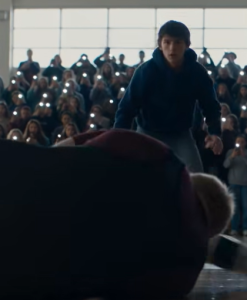
The moment Brody ordered his teammates to block the gym doors, I understood that thirty phones were about to record either my humiliation or the worst mistake of his life.
I wished I knew which.
The gym smelled of floor polish, old sweat, and the rubber soles of shoes dragging across varnished wood. Basketball hoops hung above us like silent witnesses. From the bleachers came the small, excited noises of people preparing to watch something they didn’t intend to stop.
I counted at least thirty screens aimed toward the center court line. Some students stood on the lower benches for a better angle. Others whispered as though we were about to perform a trick for them. My stomach felt hollow, but I kept my breathing slow.
Brody stood between me and the nearest exit. He was our varsity wrestling captain, broad through the shoulders and comfortable with the kind of attention that made other people feel small. Behind him, five teammates moved into a crooked line beside the double doors.
“Got nowhere to go now,” one of them called.
A few students laughed. Someone shouted the nickname Brody had given me when we were six: “Little Mouse!”
Ten years. That was how long he had been turning my silence into a joke.
When we were children, he had taken my lunch and told everyone I had given it to him because I was scared. In middle school he learned he could get a bigger laugh by calling me that name in crowded hallways. By high school, he had stopped bothering to think of new insults. The old one still worked.
At least, it worked on everyone watching.
Coach Miller had called me to the center of the gym earlier to help carry training mats. I had stayed after the last period because he’d asked, and because saying no to a teacher had never come naturally to me. Then he stepped into the equipment room. Brody and several teammates came out from the locker hall, followed by students who clearly expected a show.
By the time Coach Miller returned, the crowd had formed. He sat on an equipment box near the wall, staring down at his phone, his whistle resting against his chest. He was only a few feet from the circle, close enough to hear a sneaker squeak, but he didn’t look up.
I glanced toward him once.
“Coach?”
Brody stepped into my line of sight. “What’s wrong, Little Mouse? Need someone to rescue you?”
His friends laughed again. The coach’s thumb continued moving across his screen.
There had been a time when I’d believed adults noticed cruelty simply because it happened in front of them. I had been wrong often enough to know better now. Still, seeing him there made something heavy settle inside me. All Coach Miller needed to do was lift his head.
When I was younger, I used to rehearse what I would say if Brody ever cornered me again. The sentences always sounded brave in my bedroom. In real life, with people watching and an adult choosing not to look, even ordinary words were difficult to get past my teeth.
I thought about my mother asking how school had gone every evening, and about the little lie I usually gave her: Fine. Nothing happened. I wondered what I would tell her tonight if I came home with a torn hoodie and another story I was too ashamed to explain.
“Move,” I said. “I want to leave.”
Brody looked over his shoulder, playing to the cameras. “Hear that? He wants to leave.”
“Let him,” Sarah said from the front bleacher. Her voice was clear but not loud. “This isn’t funny.”
Sarah and I shared an English class. She wasn’t someone who made speeches or tried to win arguments in hallways, but she had a way of saying a simple thing as though it mattered. Brody barely acknowledged her.
“Then don’t watch,” he said.
No one put their phone away.
I could feel my pulse in my throat. Fear was not new to me, and training had never erased it. Training had taught me what to do while I was afraid. I had started taking self-defense lessons when I was six, after an incident on the elementary-school playground left me too frightened to tell anyone what had happened.
My instructor, Mr. Park, never promised I would become unbeatable. He taught me to recognize when someone wanted a reaction, to find an exit, and to keep my hands visible.
He repeated one lesson until I could hear it even when he wasn’t there:
The goal is to get home, not to win.
I looked again at the doors. Five wrestlers, shoulder to shoulder. Beyond them, a strip of afternoon light shone through the narrow windows.
“You’re all recording,” I said. “Then record me asking him to let me pass.”
A few smiles faltered. Brody’s didn’t.
“You’re acting tough now?” He shoved my shoulder.
My sneaker slid against the floor. I caught my balance without raising my fists. Somewhere above us, a student made an appreciative noise, the way people did when a game finally began.
“Don’t touch me,” I said.
“Make me.”
The words weren’t an invitation. They were a trap.
If I struck first, his friends would have the scene they wanted. If I kept backing up, they could chase me until I tripped, cried, or begged. And if I reacted angrily enough, nobody would remember who had cornered whom.
Brody was watching my face.
I watched his right heel.
He shifted his weight backward before he moved forward, a small habit I’d noticed during gym class. His shoulders tightened before a grab. His footwork was good when he expected an opponent on a wrestling mat, but here he was impatient, angry, and certain I couldn’t answer him.
“Look at me when I’m talking to you,” he said.
I raised my eyes. “I’m looking.”
“You scared?”
“I want you to stop.”




